
Vogenx, Inc.: Early-Stage Biotech Ambition Confronts Severe Liquidity and Execution Hurdles
Recent stock price surges highlight market attention, but fundamental challenges remain unresolved.
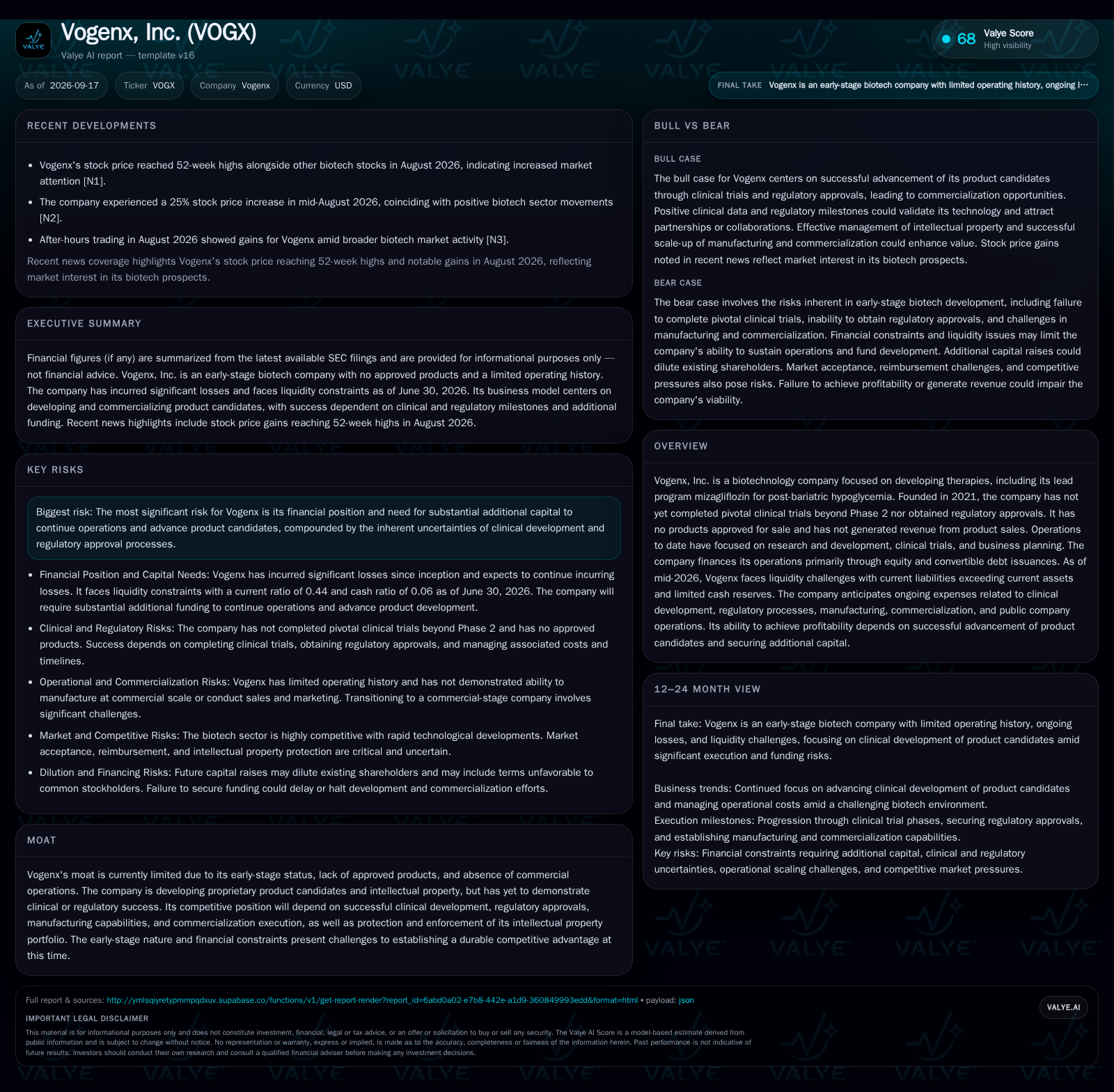
Vogenx, Inc. is an early-stage biotech focused on developing mizagliflozin for post-bariatric hypoglycemia. Despite recent stock price gains, the company’s ability to survive and create value depends on securing substantial new funding and successfully navigating clinical, regulatory, and operational milestones. [S1] [N1] [N2]
Vogenx, Inc. stands at a critical juncture as an early-stage biotech company developing mizagliflozin for post-bariatric hypoglycemia. As of June 2026, Vogenx’s survival depends on securing additional capital and achieving meaningful clinical milestones—each a formidable hurdle in the current biotech funding environment. The question is whether Vogenx can convert scientific ambition into commercial viability before financial constraints force a strategic reset.
Acute Liquidity Pressures and Early Clinical Status Define Vogenx’s Present
Vogenx, Inc. is an early-stage biotechnology company focused on mizagliflozin for post-bariatric hypoglycemia (PBH), but has not yet completed any pivotal clinical trials beyond Phase 2. The company reported a net loss of $860,000 in the first half of 2026, adding to an accumulated deficit of $11.7 million. As of June 30, 2026, Vogenx’s cash reserves stood at $193,000, with current liabilities ($3.19 million) substantially outstripping current assets ($1.41 million), leading to a current ratio of 0.44 and a cash ratio of just 0.06. These figures signal acute liquidity stress, with the company reliant on future equity or convertible debt financing to continue operations. Meanwhile, recent news highlighted a 25% stock price surge in August 2026, but there is no evidence this reflects operational progress. [S1] [N1] [N2]
The acute liquidity pressures faced by Vogenx underscore the critical importance of timing in biotech financing. Given the capital-intensive nature of clinical development, even short delays in securing funding can cascade into operational disruptions, impacting trial timelines and regulatory interactions. Moreover, the reliance on equity and convertible debt financing introduces a feedback loop where deteriorating financial metrics may deter investors, raising the cost of capital and compounding dilution risks. In this context, the company's ability to maintain stakeholder confidence through transparent communication and milestone achievements becomes a pivotal factor in bridging funding gaps and sustaining clinical momentum.
Biotech Value Creation Hinges on Clinical Milestones and Capital Access
Vogenx’s economic model is typical of early-stage biotech: high upfront investment in R&D and clinical trials, with no product revenue until regulatory approval and commercial launch. The company’s lead asset, mizagliflozin, targets a niche indication (PBH) and must first demonstrate efficacy and safety in pivotal trials before any revenue can be contemplated. If successful, value would accrue through direct commercialization or out-licensing to a larger partner, with revenue streams dependent on pricing, market access, and payer reimbursement—variables that are highly uncertain at this stage. Fixed costs (R&D, regulatory, public company costs) dominate, while variable costs would ramp only with manufacturing and sales. The need for substantial additional funding creates dilution risk for shareholders and leaves the company vulnerable to market sentiment swings. Until positive late-stage clinical data or a partnership is secured, Vogenx’s economics remain entirely speculative.
The economic model also hinges on the scalability of commercialization post-approval, which is particularly challenging for niche indications like PBH. Market penetration depends not only on clinical efficacy but also on payer acceptance and physician adoption, which can be influenced by the availability of alternative therapies and the perceived burden of disease. If reimbursement negotiations prove protracted or unfavorable, revenue projections could be materially impacted, altering the risk-reward calculus for investors. Additionally, the timing and structure of potential out-licensing deals can significantly affect value capture, as early-stage partnerships may provide necessary capital but at the expense of future revenue streams and control.
Barriers to Entry Are High, But Competitive Moat Remains Unproven
The biotechnology sector is fiercely competitive, with numerous companies developing therapies for metabolic and post-surgical complications. While Vogenx’s focus on PBH and proprietary development of mizagliflozin could offer some differentiation, its competitive position is unproven. The absence of late-stage clinical data, regulatory validation, or established manufacturing and commercial infrastructure limits any current moat. Larger pharmaceutical companies and other biotechs with more advanced programs or broader metabolic portfolios represent significant competitive threats. Intellectual property could provide defensibility if strong patents are granted and enforced, but this remains to be established. At this stage, switching costs, pricing power, and network effects are not relevant, as no product is on the market.
Intellectual property protection, while potentially a source of competitive advantage, is contingent upon the breadth and enforceability of patents granted. In highly innovative fields, patent challenges and litigation risks can erode exclusivity periods, thereby compressing the window for recouping R&D investments. Furthermore, the competitive landscape is dynamic; emerging scientific insights or novel therapeutic modalities could rapidly shift market expectations and standards of care. This fluidity necessitates that Vogenx not only focus on clinical validation but also continuously monitor competitor pipelines and adapt its development strategy to preserve relevance and differentiation.
Clinical and Regulatory Breakthroughs Could Unlock Value—If Funding Is Secured
The most optimistic scenario for Vogenx involves the successful completion of pivotal clinical trials for mizagliflozin, yielding robust efficacy and safety data for PBH. Such results could catalyze regulatory approvals, attract strategic partnerships, or even acquisition interest from larger biopharma players seeking metabolic disease assets. If Vogenx can secure sufficient capital to complete these trials—potentially through non-dilutive grants, licensing deals, or a favorable equity raise—the company could transition from a cash-burning R&D entity to a value-creating, late-stage biotech. Evidence that would confirm this scenario includes: the announcement of a fully funded Phase 3 trial, positive interim or top-line data, a partnership with a major pharma, or a successful fundraising round at favorable terms. Conversely, delays in trial initiation, inability to secure funding, or negative data readouts would quickly falsify this upside.
Incremental Progress Amid Ongoing Funding and Execution Risks
The most plausible trajectory for Vogenx is a period of incremental clinical progress, punctuated by ongoing capital raises and operational challenges. Operational risks, including the ability to recruit patients, manage trial execution, and navigate regulatory hurdles, remain high. This base case assumes slow but steady progress, with no near-term inflection point until substantial clinical milestones are achieved. Evidence supporting this scenario would include regular but modest clinical updates, continued shareholder dilution, and persistent liquidity warnings in filings. A scenario shift—up or down—would be triggered by either a breakthrough funding/clinical event or a material operational setback.
Liquidity Crisis or Clinical Failure Could Force Restructuring or Wind-Down
The adverse scenario centers on Vogenx’s inability to secure timely funding or achieve positive clinical results, leading to a cash crunch and potential cessation of operations. With just $193,000 in cash and liabilities far exceeding assets, the company is at risk of running out of funds before reaching key clinical milestones. If capital markets remain unfavorable or if existing investors are unwilling to provide bridge financing, Vogenx could be forced to halt development, restructure, or pursue asset sales at distressed valuations. A failed or inconclusive clinical trial would further erode the investment case and could precipitate a wind-down. Evidence that would confirm this scenario includes missed payroll, default on obligations, a going concern warning, or an announced strategic review focused on liquidation or asset sale.
Milestones and Conditions That Will Determine Vogenx’s Trajectory
Announcement of new funding rounds or non-dilutive financing to support ongoing operations and clinical development.
Initiation and timely enrollment of pivotal (Phase 3) clinical trials for mizagliflozin, including any interim data disclosures.
Updates on regulatory interactions, such as feedback from the FDA or other agencies regarding trial design or approval pathways.
Partnerships or licensing agreements with established pharmaceutical or biotech companies.
Changes in cash runway disclosures or working capital projections in quarterly filings.
Any material dilution events—such as large equity raises, convertible note issuances, or reverse stock splits.
Disclosure of intellectual property progress, such as new patent grants or settlements, if provided.
Evidence of operational scaling, such as hiring for manufacturing or commercial roles, if disclosed.
Disclaimer: This is research-only, informational analysis and not investment advice. It may include AI-generated interpretation and general industry context. Always verify important details using primary sources.

Comments