
Innovation Beverage Group: Financial Strain, Strategic Shifts, and the Search for Viability in Beverage and Beyond
Persistent internal control weaknesses, financial restatements, and Nasdaq compliance challenges underscore an urgent need for operational and strategic stabilization.
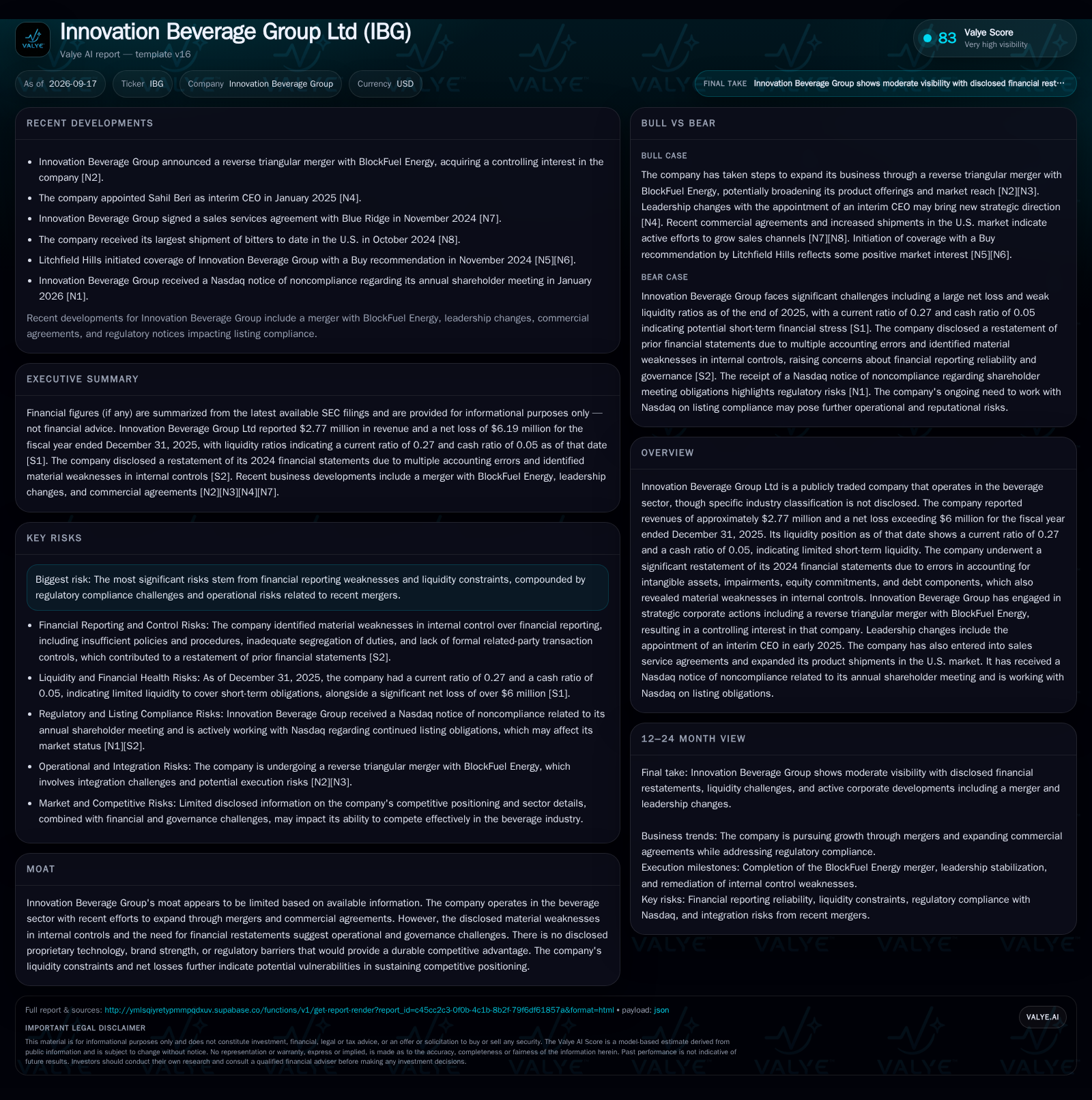
Recent moves—such as a reverse merger with BlockFuel Energy, expanded U.S. bitters shipments, and new sales agreements—signal a push for growth and diversification. However, material weaknesses in internal controls, restated financials, and active Nasdaq listing compliance issues raise serious questions about sustainability and governance. The company's future likely hinges on its ability to restore financial credibility, secure funding, and realize meaningful commercial traction from its evolving strategy. [S1] [S2] [N2] [N7] [N8]
Despite these headwinds, the company is pushing forward with new commercial initiatives—including a reverse merger into energy, expanded U.S. product shipments, and fresh sales partnerships. The coming quarters will test whether these moves can generate enough momentum to offset structural weaknesses and restore stakeholder confidence, or whether mounting financial and governance risks will overwhelm turnaround ambitions.
Acute Financial Stress and Strategic Actions Define the Near-Term Outlook
Innovation Beverage Group reported revenues of $2,772,241 and a net loss of $6,194,217 for the fiscal year ended December 31, 2025, resulting in basic and diluted losses of $13.09 per share [S1]. These losses are paired with a current ratio of only 0.27 and a cash ratio of 0.05, underscoring severe short-term liquidity limitations as of year-end [S1].
The company’s 2024 financials were restated due to errors involving intangible assets, impairments, and unrecorded equity and debt elements, with material weaknesses identified in multiple areas of internal control [S2].
Recent strategic maneuvers include a reverse triangular merger with BlockFuel Energy, the appointment of an interim CEO, and an agreement with Blue Ridge to expand sales, alongside the largest U.S. shipment of bitters to date [N2] [N4] [N7] [N8].
Innovation Beverage Group is working with Nasdaq to address continued listing obligations following its restatement and compliance notices [S2] [N1].
Revenue Model, Cost Structure, and the Challenge of Scaling Profitably
At its core, Innovation Beverage Group’s business economics appear to depend on beverage sales—potentially spirits, bitters, or specialty drinks—augmented by new commercial agreements and, more recently, diversification into adjacent sectors through acquisition. The reported $2.77 million in 2025 revenue is modest relative to the beverage industry’s capital and marketing demands [S1]. Without evidence of high-margin proprietary products or a recurring-revenue framework, gross margins may be constrained by manufacturing, distribution, and sales channel costs.
The company’s net loss of over $6 million signals that fixed costs—including SG&A, compliance, and likely marketing—far exceed gross profit, and that operating leverage is not yet achieved [S1]. The company reported cash and liquidity metrics for the period; these figures do not by themselves establish operating runway, investment capacity, financial flexibility, or financing capacity.
The reverse merger with BlockFuel Energy introduces a new business line, which could alter capital requirements and margin structure. If BlockFuel contributes higher-margin or recurring revenue streams, this could ease the burden on the beverage segment. Conversely, integration costs and distraction risk may exacerbate existing inefficiencies if the new segment is not accretive in the near term.
Sector Dynamics, Barriers, and the Company’s Place in a Fragmented Landscape
The beverage sector is intensely competitive, with entrenched global players and a proliferation of craft and specialty brands. Established producers benefit from scale, distribution relationships, and brand loyalty, while new entrants often face customer acquisition challenges and thin margins.
Innovation Beverage Group’s disclosed commercial agreements and expanded U.S. shipments suggest attempts to grow through partnerships rather than direct channel dominance [N7] [N8]. However, there is no evidence of a differentiated brand, proprietary product, or regulatory moat. Material internal control weaknesses and a need for financial restatement further erode trust—potentially limiting access to capital, partners, and premium distribution channels.
The BlockFuel Energy merger may reflect a strategic pivot or an effort to access a less saturated, higher-margin market. However, sector diversification also risks dilution of focus and resource allocation at a time when core beverage operations remain unprofitable and under-resourced.
How Commercial Execution and Strategic Diversification Could Drive a Turnaround
A plausible bull case for Innovation Beverage Group is that recent commercial initiatives—such as the Blue Ridge sales agreement and the largest U.S. bitters shipment—translate into sustained revenue growth and improved gross margins as scale is achieved [N7] [N8]. If the BlockFuel Energy merger delivers a stable, cash-generative business line, this could provide both diversification and the liquidity needed to support beverage operations.
Restoring internal controls and reporting confidence is critical. If the company demonstrates improved financial governance and regains Nasdaq compliance, it could rebuild trust with investors and unlock access to additional capital.
Evidence confirming this scenario would include sequential revenue growth from new channels, improved gross or operating margins, positive operating cash flow, and clear disclosures of remediation in internal controls. Early signs of synergy or new revenue from BlockFuel would further support the upside thesis.
Stabilization Efforts Confront Persistent Operational and Financial Headwinds
The most likely outcome is a prolonged period of stabilization, with management focused on restoring financial credibility, shoring up liquidity, and attempting to extract incremental growth from existing commercial agreements. Revenue may trend upward modestly if U.S. shipments and sales partnerships deliver, but the scale is likely insufficient to offset high fixed costs and the drag of compliance and integration expenses.
The BlockFuel Energy merger may provide some new revenue, but integration risk and potential capital needs could limit near-term benefit. Governance and reporting weaknesses will require time and investment to remediate, during which investor skepticism and Nasdaq compliance risk may persist.
Evidence supporting this scenario would be modest but steady revenue gains, slow progress on internal control remediation, and ongoing but incomplete resolution of regulatory and listing risks. Inability to raise new capital or unlock operating leverage would reinforce the base case.
Liquidity Crisis, Loss of Listing, and the Risk of Strategic Drift
The bear case centers on the company’s severe liquidity constraints and ongoing net losses. If commercial agreements fail to deliver meaningful revenue or margin improvement, the company may exhaust its cash position, leading to payment defaults, supplier or partner disruptions, or forced asset sales.
Failure to remediate internal control weaknesses or resolve Nasdaq listing issues could result in delisting, further limiting access to capital markets and eroding stakeholder confidence. The strategic pivot via the BlockFuel merger could compound risks if it diverts focus or fails to provide positive cash flow.
Confirmation of this scenario would include additional restatements, missed regulatory deadlines, negative working capital trends, discontinued operations, or public disclosure of going concern warnings.
Milestones and Metrics That Will Reveal Whether Turnaround Efforts Can Take Hold
Quarterly revenue growth from both beverage and BlockFuel segments—if disclosed—would help test whether commercial initiatives are translating into scale.
Gross margin trends, especially evidence of improvement from new sales agreements or product mix shifts.
Operating cash flow, rather than just reported net income, to gauge whether the business is moving toward self-sufficiency.
Disclosure of progress on internal control remediation, including auditor statements or Nasdaq correspondence regarding compliance.
Evidence of successful integration and early revenue or margin contribution from BlockFuel Energy.
Updates on Nasdaq listing status, including resolution or escalation of noncompliance notices.
Retention and expansion of commercial relationships or sales agreements, particularly with U.S. distributors or partners.
Disclaimer: This is research-only, informational analysis and not investment advice. It may include AI-generated interpretation and general industry context. Always verify important details using primary sources.

Comments