
Upexi, Inc.: Solana-Centric Treasury Strategy Faces Volatility, Yield Ambition, and Capital Allocation Crossroads
With nearly all its digital assets staked in Solana and a treasury strategy reliant on both yield and token appreciation, Upexi stands at the intersection of crypto-asset management and capital market dynamics. Ongoing net losses, substantial capital raises, and a disciplined custody approach shape its risk and reward profile as it seeks sustainable scale.
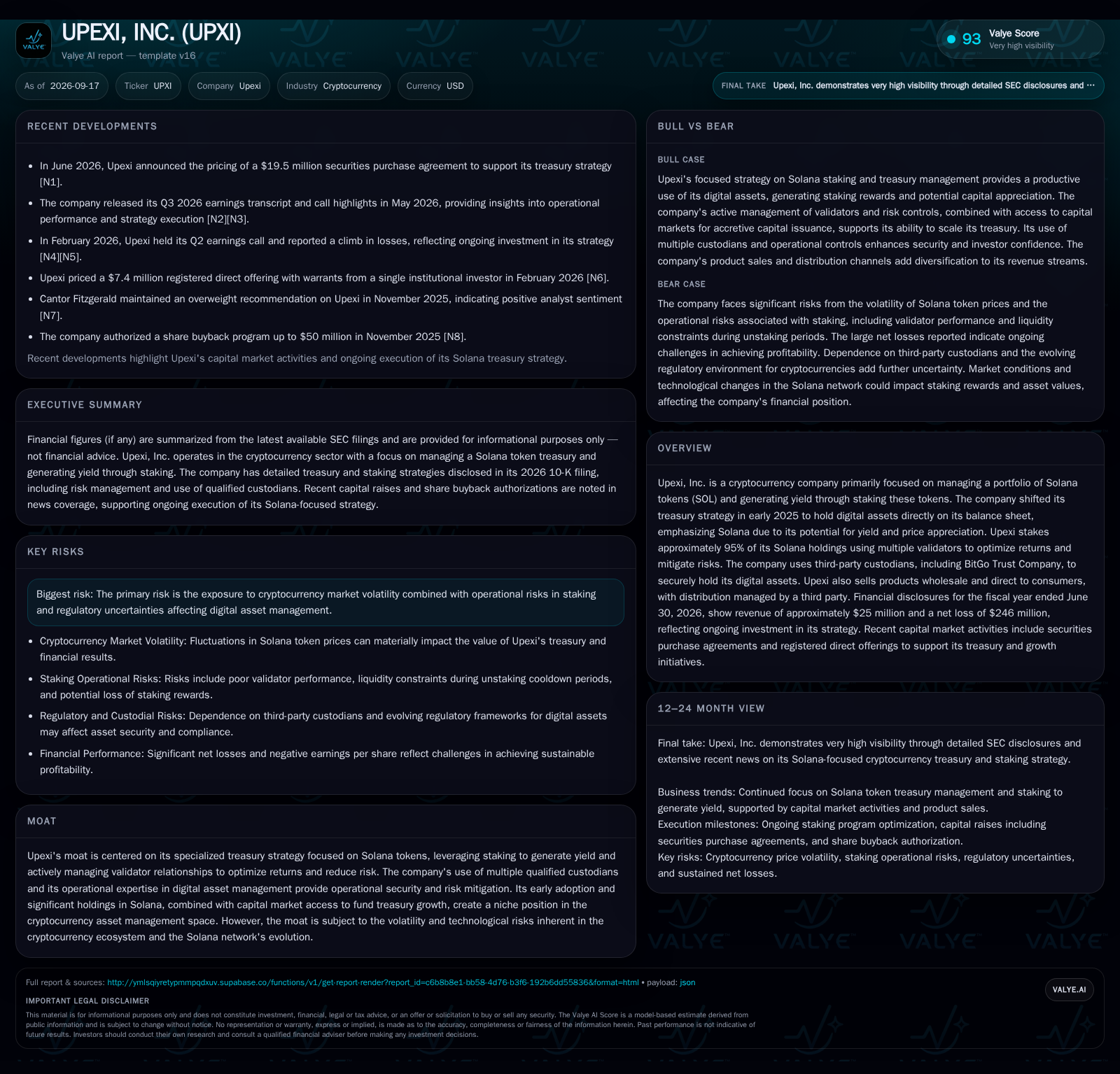
Upexi, Inc. is executing a concentrated Solana-based digital asset treasury strategy—staking 95% of its SOL holdings to generate yield while relying on third-party custodians for security. Recent material net losses and active capital-raising highlight both the volatility and capital needs inherent in this model. The company's financial trajectory will hinge on Solana price dynamics, staking economics, and its ability to optimize capital deployment and risk management. [S1] [N1] [N6]
Upexi, Inc. is pursuing a bold but high-risk play in the cryptocurrency space: maximizing yield and potential price appreciation through an actively managed Solana treasury. By staking nearly all its SOL holdings, the company seeks to harness both network rewards and capital gains. However, persistent net losses, significant capital market activity, and exposure to crypto volatility underscore the uncertain path to sustainable value creation. As Upexi navigates validator selection, custody, and capital allocation, the company must balance operational discipline with the unpredictable tides of digital asset markets.
Recent Financial Performance and Capital Actions Reshape Upexi’s Risk Profile
Upexi reported revenue of $24,998,028 and a net loss of $246,064,698 for the fiscal year ended June 30, 2026, with basic and diluted EPS of -$3.87. This sharp loss reflects the dual impact of cryptocurrency market volatility and substantial ongoing investment in its treasury strategy. [S1]
To support its balance sheet and ongoing operations, Upexi completed a $19.5 million securities purchase agreement in June 2026 and a $7.4 million registered direct offering with warrants in February 2026. These capital raises highlight both the external funding required to sustain the strategy and the confidence of at least some institutional investors. [N1] [N6]
A $50 million share buyback authorization, announced in November 2025, provides optionality for capital allocation, though actual execution will depend on liquidity and broader strategic priorities. [N8]
Approximately 95% of Upexi’s Solana tokens are staked, with the company actively managing validator selection and custody through BitGo Trust and other qualified custodians to optimize yield and reduce operational risk. [S1]
Staking Economics: Yield, Price Exposure, and Operating Leverage Dynamics
Upexi’s core economic engine is the combination of Solana staking rewards and potential price appreciation of SOL tokens. Staking rewards provide a recurring yield, but the effective return is both a function of network-level staking rates and the market price of SOL. If SOL appreciates, both the underlying asset value and the yield (in USD terms) rise; if it falls, the opposite occurs.
The company’s cost base likely includes digital asset custody, validator fees, and technology/operational expenses required to manage staking and treasury risk. Fixed costs may be relatively modest compared to the notional value of the assets, but exposure to token price swings means operating leverage is extreme: gains or losses on SOL holdings can dwarf operating revenues from other business lines.
Upexi’s capital needs are substantial, as evidenced by recent equity raises. This reflects both the capital-intensity of building a large digital asset treasury and the requirement to maintain liquidity buffers for operational and risk-management purposes. The company reported a cash ratio of 0.1 for the period. [S1]
The presence of product sales (wholesale and direct-to-consumer) adds supplementary revenue streams, but the economics of these segments are not disclosed. If these activities are low-margin or capital-light, they may provide diversification but are unlikely to drive overall profitability absent substantial growth or operational leverage.
Niche Position in Crypto Treasury Management—But Limited Structural Moat
Upexi’s specialization in Solana treasury management and staking gives it a focused position within the broader crypto asset management landscape. Its operational controls—such as multi-validator staking and qualified third-party custody—help mitigate some technical and operational risks.
However, the competitive landscape is crowded, with other crypto asset managers, funds, and proprietary trading entities also pursuing staking yields and token appreciation. The barriers to entry for digital asset treasury management are relatively low, as staking infrastructure and custody services are increasingly commoditized.
Upexi’s ability to differentiate may depend on its scale, validator selection expertise, and risk management discipline. However, unless it can demonstrate superior risk-adjusted returns or access to proprietary deal flow (e.g., early-stage token allocations, unique validator relationships), its moat remains vulnerable to both crypto-native competitors and traditional asset managers entering the space.
Substitute products include staking-as-a-service offerings, DeFi yield protocols, and diversified digital asset funds. Investors and customers may shift capital rapidly in response to relative performance, risk, and regulatory developments.
If Solana’s Price Surges and Staking Yields Remain Attractive, Treasury Model Could Deliver Outsized Gains
In a favorable scenario, Solana’s price appreciates substantially while network staking yields remain robust. Upexi’s large, staked SOL position would generate increasing USD-denominated returns, potentially transforming balance-sheet strength and compressing net losses—or even flipping to profitability.
If the company can further optimize validator selection, reduce operational costs, and allocate capital efficiently (for example, by buying back shares at a discount to NAV), investor returns could be further amplified.
Confirmation of this scenario would come from: 1) sustained growth in net asset value per share; 2) rising staking income and narrowing net losses; 3) efficient deployment of raised capital into yield-generating assets; and 4) evidence that operational costs do not scale linearly with asset growth.
Falsification would occur if: Solana underperforms major crypto benchmarks, staking yields compress due to network saturation or protocol changes, or operational/custody failures result in loss of funds or persistent high costs.
Volatile Asset Values and Ongoing Capital Needs Define the Most Likely Path
The most plausible trajectory is one of continued volatility in both asset values and financial performance. Upexi may experience periods of strong staking income and asset appreciation—interspersed with drawdowns when SOL prices fall or network yields decline.
Operationally, the company is likely to continue raising capital opportunistically to support its treasury and manage liquidity. Net losses may persist unless crypto markets sustain a major bull cycle or product sales grow meaningfully.
Base case confirmation would be: 1) regular capital raises to manage liquidity; 2) stable or slightly improving net losses but no clear path to profitability; 3) periodic adjustments to staking strategy and custody arrangements in response to market conditions.
Falsification would occur if either: a) Upexi delivers multiple quarters of positive net income driven by staking and asset appreciation; or b) suffers a material operational failure or regulatory setback that impairs asset security or access.
Adverse Market Moves or Staking Disruptions Could Trigger a Liquidity Squeeze
In a negative scenario, Solana’s price declines sharply or experiences prolonged underperformance relative to other digital assets. Staking yields could also fall due to protocol changes, network congestion, or validator performance issues.
If this coincides with increased regulatory scrutiny or a major custody/validator incident (e.g., loss of staked assets, extended network outage), Upexi could face a severe liquidity crunch—particularly given its modest cash ratio and ongoing net losses.
The need to raise dilutive equity or liquidate assets at depressed prices could erode shareholder value and threaten business continuity.
This scenario would be confirmed by: 1) sharp declines in reported net asset value; 2) emergency or highly dilutive capital raises; 3) public disclosures of custody or staking incidents; and 4) regulatory actions negatively impacting digital asset holdings or operations.
Milestones and Metrics That Will Test Upexi’s Solana Treasury Thesis
Quarterly changes in net asset value (NAV) per share, reflecting both SOL price movements and effective staking yields, would help measure the core thesis.
Staking income reported as a percentage of total digital assets—if disclosed—would clarify yield generation versus price-driven returns.
Operational expense trends in relation to asset growth: does overhead scale efficiently as Solana holdings increase?
Dilution from new capital raises versus deployment into yield-generating assets—tracking share count and capital allocation discipline.
Any changes in custody arrangements or disclosures of security incidents involving digital assets would directly test operational risk controls.
Regulatory developments affecting digital asset custody, staking, or treasury management—particularly any U.S. policy shifts impacting Solana.
Validator performance and risk metrics, including downtime, slashing events, or concentration risk—if disclosed by management.
Growth or profitability in the company’s product sales segments, offering potential diversification or margin improvement.
Disclaimer: This is research-only, informational analysis and not investment advice. It may include AI-generated interpretation and general industry context. Always verify important details using primary sources.

Comments