
VitaSpring Biomedical: Proprietary Stem Cell Ambition Confronts Acute Financial and Execution Barriers
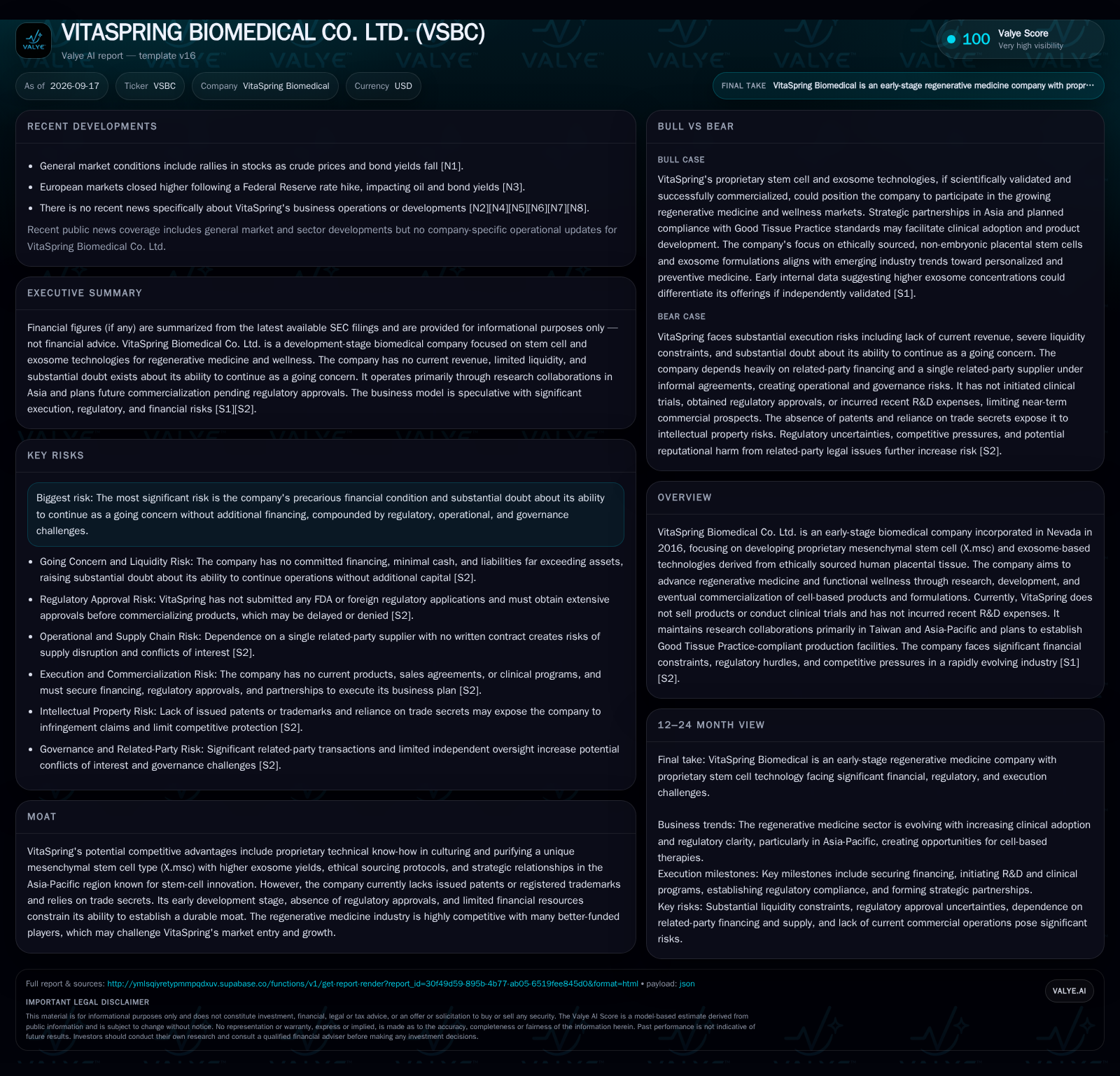
VitaSpring Biomedical’s promise in regenerative medicine rests on unproven proprietary stem cell and exosome technologies, but the company’s survival is threatened by severe liquidity shortfalls, lack of clinical progress, and dependence on informal related-party arrangements.
Its future hinges on securing outside capital, validating scientific claims, and overcoming operational and governance risks before any commercial opportunity can be realized. [S1] [S2]
VitaSpring Biomedical Co. Ltd. positions itself as an innovator in regenerative medicine, targeting the frontier of stem cell and exosome-based therapies derived from human placental tissue. Yet, despite the promise of its proprietary X. msc technology and ambitions to establish GMP-compliant manufacturing and regulatory pathways, the company’s reality is defined by financial distress, lack of clinical or commercial progress, and acute reliance on informal related-party relationships. With no revenue, no recent R&D investment, and substantial doubt about its ability to continue as a going concern, VitaSpring’s future depends on its ability to secure funding, validate its technology, and overcome structural risks before it can even enter the competitive fray. [S1] [S2]
Liquidity Crisis and Pre-Commercial Status Shape Present Reality
As of July 31, 2026, VitaSpring Biomedical reported no cash or cash equivalents, current assets of just $14,822, and current liabilities exceeding $2.2 million, resulting in a current ratio of 0.01. This extreme liquidity shortfall, coupled with a net loss of $155,817 for the latest six-month period and a stockholders’ deficit of over $4.6 million, led management to express substantial doubt about the company’s ability to continue as a going concern. [S2]
VitaSpring has not generated any revenue, has not incurred research and development expenses in recent fiscal years, and has not initiated clinical trials or obtained regulatory approvals for its stem cell or exosome products. All product supply is sourced from a single related-party supplier based in Taiwan under an oral agreement, with no formal contract or exclusivity, compounding both operational and governance risks. [S2]
The company’s technology remains at the preclinical stage, with internally generated data indicating higher exosome yields from its proprietary X. msc process, but without independent validation or published peer-reviewed results. [S1]
Commercial Model Contingent on Regulatory and Clinical Milestones
VitaSpring’s intended business model is highly speculative and contingent on multi-stage success: it envisions generating revenue through the eventual sale of stem cell and exosome products, contract manufacturing, research services, licensing, and collaborative partnerships. However, none of these revenue streams are currently active, and no product or service is commercially available. [S1]
In the regenerative medicine industry, successful commercialization typically requires significant upfront investment in R&D, clinical trials, regulatory filings, and manufacturing scale-up. VitaSpring has not incurred recent R&D expenses or initiated clinical programs, suggesting minimal fixed cost absorption and no progress toward clinical validation. Variable costs would likely be dominated by cell sourcing, processing, quality control, and regulatory compliance if operations were to begin. The company’s lack of cash and heavy reliance on related-party advances signal a near-absolute dependence on external capital to fund even basic operating and developmental milestones. [S2]
Operating leverage in this sector can be substantial if a product achieves regulatory approval and market adoption, but VitaSpring is not positioned to benefit from such dynamics until it resolves fundamental liquidity and execution barriers.
Absence of IP and Clinical Progress Weakens Defensibility Against Established Players
VitaSpring operates in a highly competitive and fragmented regenerative medicine landscape, populated by many better-funded biotech firms, academic spinouts, and established biopharma companies. While its focus on ethically sourced, non-embryonic placental stem cells and exosome formulations aligns with sector trends, the lack of issued patents or trademarks exposes it to the risk of competitive imitation and IP challenges. [S1] [S2]
The company’s proprietary advantage is currently limited to trade secrets and process know-how, which are difficult to defend or monetize without regulatory exclusivity or strong intellectual property. Its early collaborations in the Asia-Pacific region could provide access to scientific networks or trial sites, but do not confer commercial advantage without clinical or regulatory progress.
Compounding these structural weaknesses are the lack of clinical trials, absence of regulatory filings, and dependence on a single related-party supplier, all of which leave VitaSpring vulnerable to both operational disruption and competitive displacement by better-resourced incumbents.
Breakthrough Validation and Strategic Capital Could Catalyze Value Creation
The most constructive scenario for VitaSpring would involve securing external capital sufficient to stabilize its balance sheet, followed by rapid initiation of rigorous preclinical and clinical studies that independently validate the efficacy and safety of its X. msc and exosome technologies. Positive third-party results could unlock strategic partnerships, non-dilutive grant funding, or licensing deals, particularly in the Asia-Pacific region where regulatory frameworks for regenerative medicine are evolving.
Successful establishment of GMP-compliant manufacturing and submission of regulatory applications, coupled with the issuance of key patents or exclusive licensing arrangements, would further enhance VitaSpring’s defensibility and market opportunity.
Evidence confirming this scenario would include public announcements of significant equity or grant funding, initiation of formal clinical programs, third-party validation or peer-reviewed publication of scientific results, and the execution of strategic collaboration or licensing agreements.
Prolonged Preclinical Stasis and Funding Uncertainty Remain the Default Outlook
Absent a step-change in funding or clinical progress, VitaSpring is likely to remain in a state of operational suspension, with ongoing liquidity distress and no meaningful advancement toward commercial readiness. The company may continue to seek related-party financing or attempt small-scale bridge capital raises, but without a clear pathway to clinical validation or regulatory engagement, these efforts may only delay rather than resolve existential risks.
The most plausible near-term trajectory is continued financial strain, intermittent R&D activity (if funding is secured), and a protracted search for formal partnerships or licensing opportunities. The absence of IP filings, regulatory submissions, or product sales would confirm this scenario, as would persistent related-party dependence and lack of independent scientific validation.
Liquidity Exhaustion and Governance Risks Could Trigger Insolvency or Dissolution
If VitaSpring fails to secure new external funding imminently, the company faces the real prospect of insolvency, forced asset sales, or outright dissolution. The lack of committed financing, coupled with liabilities that vastly exceed assets, leaves it with virtually no margin for operational error.
Operationally, continued reliance on a single unwritten supplier relationship exposes VitaSpring to abrupt supply interruptions or disputes, especially given the absence of formal contracts or exclusivity. Governance lapses—including material weaknesses in internal controls and related-party conflicts—could further impair the company’s ability to raise capital or attract credible partners.
Evidence confirming this scenario would include bankruptcy filings, asset sales, delisting notifications, or public disclosures of failed financing efforts. Any further deterioration in supplier relationships or legal/regulatory setbacks would accelerate this path.
Milestones That Will Clarify VitaSpring’s Survival and Commercialization Prospects
Announced equity or convertible note financings that materially extend operating runway.
Initiation of preclinical or clinical studies, particularly any that are independently validated or published in peer-reviewed journals.
Submission of regulatory applications (e.g., IND filings with the FDA or regional equivalents in Asia-Pacific).
Execution of formal supply agreements or diversification of the supplier base to reduce related-party and operational risk.
Filing or issuance of patents and trademarks related to the X. msc process or exosome formulations.
Public disclosure of third-party collaborations with academic, hospital, or biopharma partners.
Material improvements in internal controls or the appointment of experienced independent directors to strengthen governance.
A useful metric would be any disclosed burn rate projections or runway estimates tied to new financing events.
Disclaimer: This is research-only, informational analysis and not investment advice. It may include AI-generated interpretation and general industry context. Always verify important details using primary sources.

Comments