
CTT Pharmaceutical Holdings: Limited Disclosure, Persistent Losses, and the High Bar for Survival
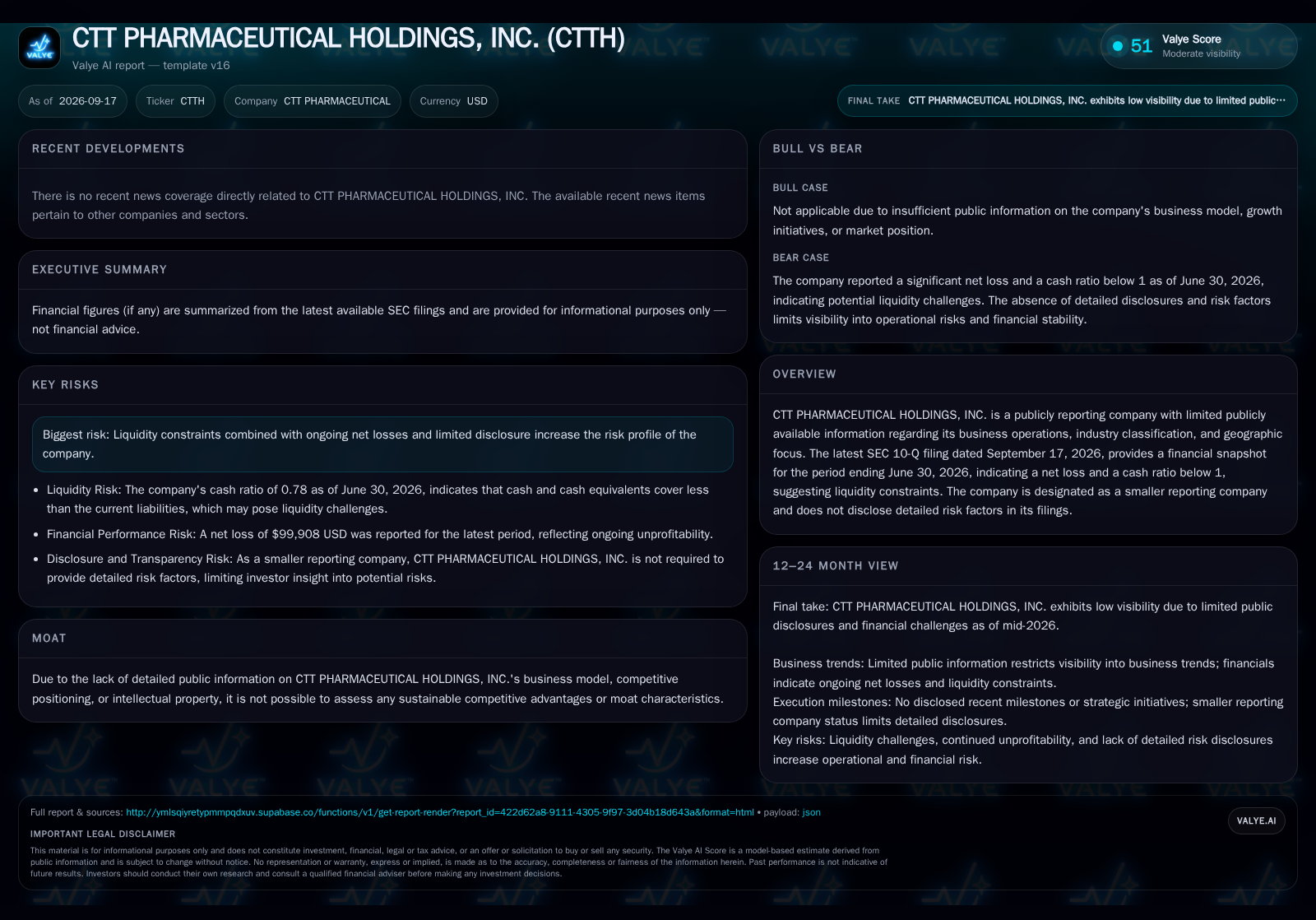
CTT Pharmaceutical Holdings’ mid-2026 financials reveal persistent net losses, a cash ratio below 1, and a lack of business transparency. The company’s future now hinges on its ability to secure new funding, clarify its business model, or demonstrate commercial traction—none of which are currently visible.
CTT Pharmaceutical Holdings, Inc. With minimal public disclosure and no recent business milestones, the company’s short-term viability is unclear, and prospective value creation depends on securing capital and proving operational relevance. [S1]
The absence of any operational disclosures or strategic updates leaves investors in the dark regarding its business prospects, commercial model, or even sector focus. In this environment, the company’s survival will likely depend on its capacity to obtain new capital or articulate a credible business plan—neither of which is in evidence as of September 2026.
Acute Liquidity Pressure and Ongoing Losses Define the Present Reality
The company reported cash and liquidity metrics for the period; these figures do not by themselves establish operating runway, investment capacity, financial flexibility, or financing capacity. Coupled with a net loss of $99,908 for the period, this signals a business under acute financial stress, with little margin for error. The lack of any disclosed business operations, revenue streams, or customer relationships further amplifies the uncertainty. Without new funding or a material change in operations, the company faces a heightened risk of insolvency or operational discontinuity in the near term. [S1]
Unclear Revenue Model and the Economics of Survival
CTTH’s SEC filings do not describe a current business line, revenue model, or product mix. In the absence of disclosed revenue, it is plausible that the company is pre-revenue, dormant, or in a transition phase. For a small-cap pharmaceutical or biotech entity, the typical economic model relies on raising external capital to fund R&D, regulatory filings, or early-stage commercialization, with high fixed costs and long lead times before revenue generation. Operating leverage, when present, is usually negative at this stage—costs persist regardless of revenue, and cash burn is the dominant pattern. Without new capital infusions or a pivot to a less capital-intensive business model, the company’s economics will likely be dictated by expense minimization and survival rather than scaling or margin expansion.
The economics of survival for a small pharmaceutical entity are heavily influenced by the capital intensity of its development pipeline and the timing of regulatory milestones. If CTTH is indeed pre-revenue, its burn rate relative to available capital becomes a pivotal metric, as prolonged negative cash flow without clear inflection points can erode investor confidence and limit access to funding. Additionally, the lack of a disclosed revenue model suggests that the company may not yet have validated its commercial strategy, which could affect its ability to negotiate partnerships or licensing agreements. In this context, the company’s ability to pivot towards less capital-intensive activities, such as out-licensing or strategic collaborations, might extend its operational runway and improve financial sustainability.
Furthermore, the pharmaceutical sector’s long development cycles and regulatory uncertainties compound the challenges faced by companies like CTTH. The absence of disclosed milestones or timelines makes it difficult to gauge the likelihood of near-term value creation events, such as clinical trial readouts or regulatory submissions, which are often critical to attracting investment. Without such catalysts, the company’s valuation and access to capital may remain constrained. Consequently, operational discipline—particularly in managing fixed costs and prioritizing projects with the highest potential return on investment—becomes essential to prolong survival and position the company for eventual growth or value realization.
Opaque Market Position Leaves Competitive Dynamics Unclear
CTTH provides no public information about its products, intellectual property, commercial partners, or target markets. In the pharmaceutical and biotech space, competitive advantages are typically built around patented technology, regulatory exclusivity, or proprietary platforms. However, without any disclosed assets or active development programs, there is no basis to assess whether CTTH holds—or could develop—any such moat. The company’s lack of transparency also makes it difficult to evaluate the threat of substitutes, competitive entry, or market share erosion. In this context, the most relevant competitor cohort would be other micro-cap or pre-revenue life sciences firms, many of which face similar funding and disclosure challenges.
In the pharmaceutical and biotech sectors, competitive positioning is often closely tied to the uniqueness and defensibility of a company’s intellectual property portfolio. Without clear disclosure of patents, proprietary platforms, or exclusive licenses, assessing CTTH’s competitive moat is speculative at best. The absence of such information raises questions about the company’s ability to differentiate itself in a crowded market where technological innovation and regulatory exclusivity are key drivers of sustainable advantage. Additionally, the lack of transparency inhibits evaluation of the company’s potential to form strategic alliances or attract licensing partners, which are often critical mechanisms for smaller firms to leverage external resources and accelerate development.
Moreover, the competitive landscape in the micro-cap pharmaceutical space is characterized by significant volatility and high failure rates, which can amplify investor risk. Companies without clear competitive advantages or disclosed pipelines may struggle to maintain relevance or secure financing, especially when competing against better-capitalized peers with more advanced development programs. The opacity surrounding CTTH’s market positioning also impedes analysis of potential substitute products or emerging technologies that could erode future market opportunities. In this environment, the company’s strategic options may be limited to either securing niche partnerships or pursuing restructuring efforts to preserve value amid competitive pressures.
What a Turnaround Would Require: Secured Funding and a Public Path to Value
A favorable outcome for CTTH would likely be catalyzed by one of two events: (1) a successful capital raise that extends liquidity beyond immediate obligations, or (2) the public unveiling of a credible business initiative—such as a new intellectual property asset, licensing deal, or commercial partnership. Confirmation of this scenario would include announcements of new financing, disclosed use of proceeds, or evidence of a viable product pipeline. Falsification would be the continued absence of such disclosures, further balance sheet deterioration, or regulatory filings indicating doubts about going concern status.
Status Quo: Drifting Without Strategic or Financial Visibility
There is no evidence of active commercial engagement or operational milestones. This scenario would be confirmed by further filings showing stagnant or declining cash, persistent net losses, and the absence of new business updates. It would be challenged by any material capital raise, partnership, or operational disclosure that signals a shift in strategy or execution.
Liquidity Exhaustion and Potential Loss of Corporate Viability
This could lead to default, creditor action, or voluntary dissolution. Confirming evidence would include going concern warnings in future filings, missed payments, or the initiation of bankruptcy or delisting processes. The scenario would be partially falsified if the company were to announce a bridge financing, debt restructuring, or asset sale that extends its operational runway.
Milestones and Disclosures That Could Alter the CTTH Thesis
Any announcement of a capital raise, debt facility, or external funding event would materially alter the near-term outlook.
Detailed disclosure of a current business model, product candidate, or strategic partnership would provide insight into possible future revenue streams.
Filing of a going concern warning or indication of missed payments would confirm acute financial distress.
Evidence of a new management team or board refresh could suggest a pivot or recapitalization effort.
A useful metric would be cash burn rate and monthly operating expenses, if disclosed, to assess runway.
Any regulatory communication suggesting investigation, delisting, or compliance issues would signal downside risk.
Disclosure of intellectual property assets or patent filings would help clarify the company’s potential for value creation.
If disclosed, identification of any large shareholders or insider transactions could reveal confidence or distress.
Disclaimer: This is research-only, informational analysis and not investment advice. It may include AI-generated interpretation and general industry context. Always verify important details using primary sources.

Comments