
Paramount Gold Nevada: Advancing Grassy Mountain Through Approvals and Financing
The next phase will test the project's economics, funding strategy, and resilience to gold price swings.
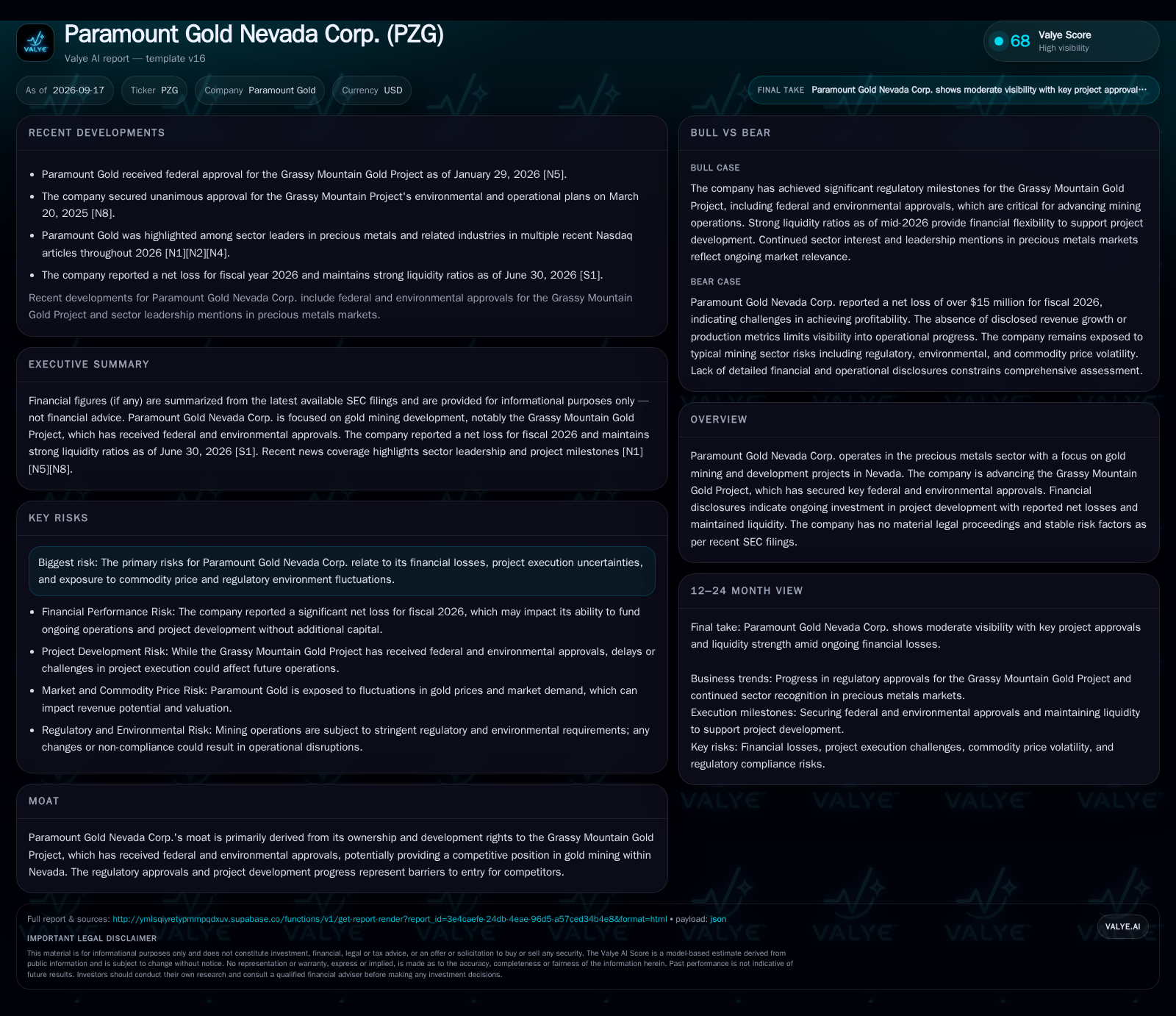
Paramount Gold Nevada Corp. received both federal and environmental approvals for its flagship Grassy Mountain Gold Project as of early 2026, clearing key regulatory hurdles [N5] [N8]. The company reported a net loss of $15.6 million for fiscal 2026, but retained a reported current ratio and cash position as of June 30, 2026 [S1]. With no material legal or risk changes, the thesis now hinges on execution, funding, and the ability to navigate commodity cycles and development risks.
Paramount Gold Nevada Corp. has reached a pivotal stage in its corporate journey: it has secured federal and environmental approvals for its flagship Grassy Mountain Gold Project, clearing the most significant regulatory hurdles that typically stall mining ventures in the United States. With nearly $10 million in cash and no material legal or risk changes, the company is positioned to advance development. However, the transition from paper approvals to physical operations—and ultimately positive cash flow—remains unproven. Paramount’s ability to fund, build, and operate the project in a volatile gold market will define its value proposition over the next several years.
Regulatory Progress and Financial Health Define Upcoming Phases
The most consequential recent developments for Paramount Gold Nevada are the federal and environmental approvals received for the Grassy Mountain Gold Project, with federal clearance as of January 2026 and unanimous environmental approval in March 2025 [N5] [N8]. These milestones remove the largest regulatory obstacles to project development and are prerequisites for securing project financing, attracting partners, or commencing construction. On the financial side, the company reported a net loss of $15.56 million for the year ended June 30, 2026, consistent with the capital-intensive and pre-revenue phase of mining project development [S1]. The company reported cash and liquidity metrics for the period; these figures do not by themselves establish operating runway, investment capacity, financial flexibility, or financing capacity. [S1] There have been no material legal proceedings or risk factor changes reported, suggesting a relatively stable external environment [S1] [S2]. These facts establish that Paramount is poised for the next, more capital-intensive stage, but has not yet demonstrated operational or financial self-sufficiency.
Economic Drivers and Capital Requirements from Permitting to Production
Paramount Gold’s business model is fundamentally tied to the successful development and operation of the Grassy Mountain Gold Project. In the mining sector, project economics are driven by upfront capital expenditures (CAPEX) for mine construction and development, followed by variable costs of extraction, processing, and site management. Revenue realization is typically back-loaded: only after commercial production begins does the company generate operating cash flow.
The company’s current net loss and cash outflows reflect the high fixed costs and lack of offsetting revenue typical of the permitting and early development stage [S1]. Once construction commences, Paramount would likely require substantial external funding—either through equity, debt, or a joint venture—to cover CAPEX until the mine is operational. The project’s economics will ultimately depend on achievable ore grades, recovery rates, all-in sustaining costs (AISC), and realized gold prices. High fixed costs and operating leverage mean that small changes in gold prices or project delays can have outsized impacts on profitability.
Approvals Enhance Entry Prospects but Stop Short of Defensibility
The primary source of competitive advantage for Paramount Gold is its regulatory progress: the Grassy Mountain Gold Project is one of the few U.S. gold mining ventures to clear both federal and environmental hurdles in recent years [N5] [N8]. This confers a significant barrier to entry, as permitting is often the most time-consuming and uncertain phase for mining newcomers. However, the company’s competitive position remains conditional on execution—until the project is built and producing, it does not enjoy the cost advantages or cash flows that established producers wield.
Paramount competes with a wide range of precious metals developers and producers, from junior exploration companies to large integrated miners. Larger peers benefit from diversified asset bases and more established funding channels. The risk of substitution is low for gold itself, but high for investor attention and capital, as many projects vie for limited sector funding. If Paramount can successfully transition to production, it could leverage first-mover status and regulatory momentum in Nevada. Until then, its advantage is primarily in project optionality rather than in operating scale or cost structure.
Value Potential Hinges on Construction Timing and Gold Price Trends
The most favorable outcome for Paramount Gold would be a successful transition from regulatory approval to financed construction, followed by on-budget completion and ramp-up of the Grassy Mountain mine. In this scenario, the company would secure the necessary capital—potentially through strategic partnerships, royalty/streaming deals, or project finance—without excessive shareholder dilution or onerous debt.
If gold prices remain robust or trend higher during the buildout and early production phase, the project’s economics could become highly attractive due to operating leverage. Early evidence confirming this scenario would include announcements of construction commencement, project financing agreements on competitive terms, and updates indicating on-time/on-budget progress. Production guidance and initial ore grades meeting or exceeding feasibility study assumptions would further validate the upside case. Share price appreciation and increased sector coverage could follow if Paramount demonstrates tangible de-risking of the project.
Funding Efforts and Pre-Construction Steps Outline Base Expectations
The most plausible near-term scenario is a period of measured advancement, where Paramount Gold focuses on securing project financing, conducting additional technical studies or site preparations, and managing ongoing corporate costs. The company may pursue multiple funding avenues, balancing the trade-offs between equity dilution, debt service, and potential joint venture structures.
Progress may be incremental, with extended timelines before full-scale construction begins. The project’s pace will likely be sensitive to gold price trends and capital market conditions: weak gold prices or risk-off investor sentiment could delay financing or force less favorable deal terms. Evidence confirming this scenario would include periodic updates on financing efforts, continued cash burn consistent with pre-construction activities, and the absence of major construction or production milestones. This path does not preclude eventual success but reflects the typical tempo and uncertainty of single-asset mining development.
Execution Challenges and Capital Shortfalls Could Undermine Outcomes
The adverse scenario for Paramount Gold centers on an inability to secure sufficient or affordable project financing, leading to delays, cost overruns, or even project suspension. Extended periods of pre-revenue cash burn could erode the company’s liquidity, forcing distressed asset sales or highly dilutive equity raises. If gold prices decline materially during this period, investor appetite for new mining projects could collapse, compounding funding difficulties.
Confirmation of this scenario would come from negative cash flow trends, warnings about ‘going concern’ status, failed or highly dilutive capital raises, or announcements of delays and cost escalations. Adverse developments in permitting or regulatory compliance, while not currently indicated, could also reintroduce risk. In this scenario, the project’s option value deteriorates, and the company may struggle to realize meaningful value for shareholders.
Critical Events Guiding Paramount Gold’s Move Toward Operational Status
Announcements of project financing agreements, including the structure (debt, equity, streaming, or joint venture) and terms, will be critical to assess the feasibility and shareholder impact of moving to construction.
Initiation of construction activities at the Grassy Mountain Gold Project, accompanied by progress updates, would provide tangible evidence of operational momentum.
Updates on projected and actual capital expenditure (CAPEX) figures, as well as any cost overruns or schedule delays, would help test the robustness of project planning.
Guidance on expected production volumes, ore grades, and all-in sustaining costs (AISC), if disclosed, would allow investors to model the project’s potential cash flow profile.
Disclosure of additional permitting or regulatory milestones—such as water rights, local approvals, or reclamation plans—would indicate continued de-risking.
Major gold price movements or shifts in sector funding conditions could materially affect project economics and financing access.
Any new legal, environmental, or community challenges to the Grassy Mountain Project would represent potential setbacks in project execution.
Disclaimer: This is research-only, informational analysis and not investment advice. It may include AI-generated interpretation and general industry context. Always verify important details using primary sources.

Comments