
Hong Yuan Holding Group: Integrated Retail Ambition Meets Financial Constraints in Chinese Consumer Markets
The company’s pivot to a loan-based store funding model, consolidation of Chinese subsidiaries, and multi-channel sales ambitions create both operational leverage potential and heightened execution risk.
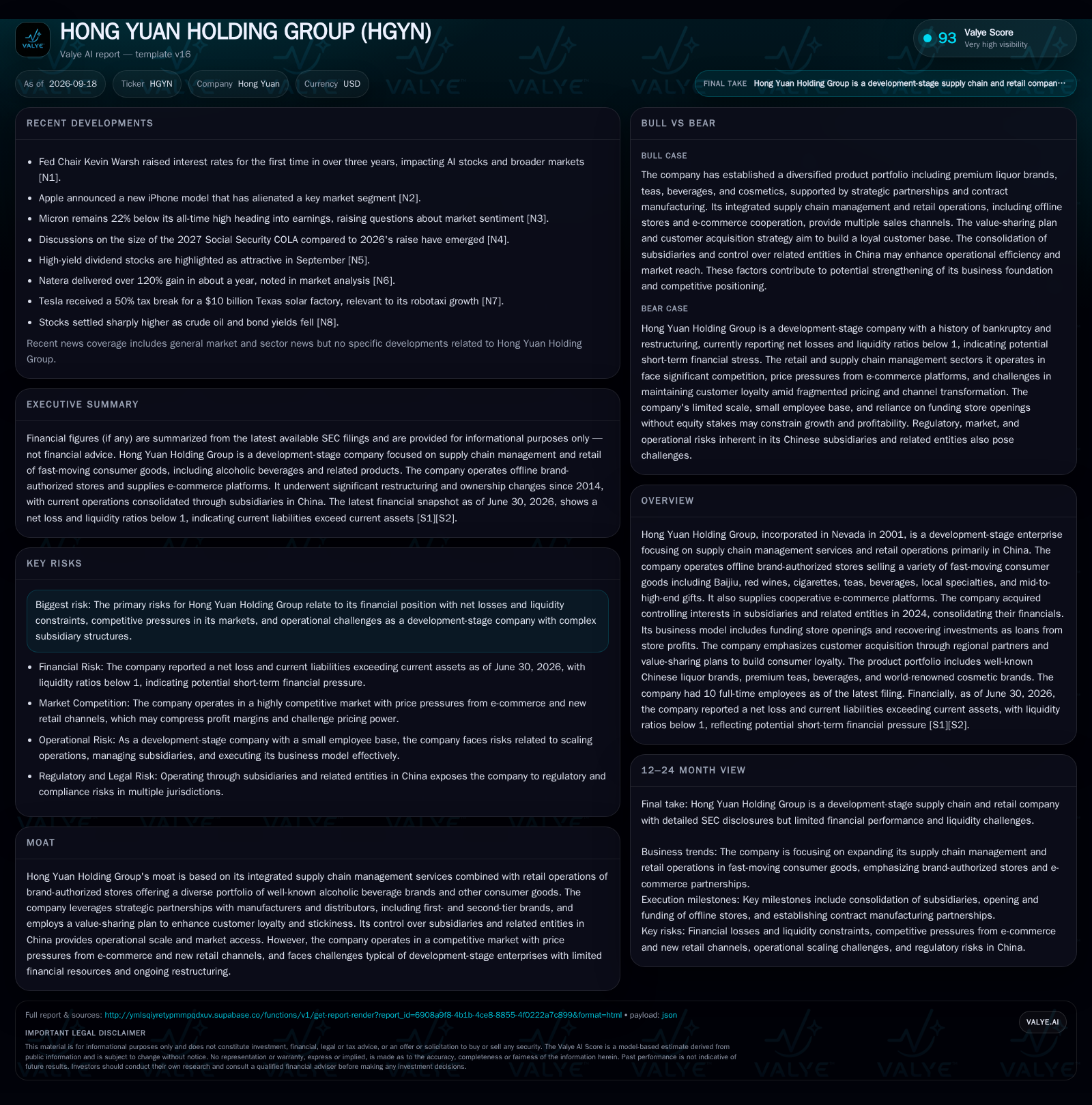
Hong Yuan Holding Group is a development-stage company consolidating supply chain and retail operations in China, emphasizing premium liquor, tea, and gift categories. The central thesis is whether its strategic integration and channel expansion can outpace persistent cash constraints and intense market competition. [S1] [S2]
Hong Yuan Holding Group is attempting to carve out a differentiated position in the Chinese consumer goods space by integrating supply chain management with retail operations, focusing on high-demand categories like Baijiu, premium teas, and branded gifts. The company’s recent pivot to a loan-based store funding model and consolidation of subsidiaries signal strategic intent to scale quickly and efficiently. The outcome hinges on the company’s ability to translate its multi-channel, partnership-driven approach into sustainable margins and customer loyalty in a fiercely competitive landscape. [S1] [S2]
Recent Financials and Strategic Shifts Define Hong Yuan’s Immediate Landscape
Hong Yuan Holding Group’s most recent financial snapshot, as of June 30, 2026, reveals a net loss of $94,404, current assets of $602,914 against current liabilities of $776,996, a current ratio of 0.78, and a cash ratio of just 0.02. The company reported cash and liquidity metrics for the period; these figures do not by themselves establish operating runway, investment capacity, financial flexibility, or financing capacity. [S2]
In June 2025, the company transitioned to a loan-based model for funding the opening of brand-authorized stores—recovering investments as loans from store profits rather than holding equity stakes. This structural change is aimed at accelerating store openings while reducing direct risk, but also potentially limits upside from high-performing locations. [S1]
The October 2024 acquisition of Hongyuan International Holding Group Co., Ltd. (Hongyuan HK) and consolidation of related Chinese subsidiaries marks a strategic attempt to integrate upstream supply chain resources and expand market access, effectively broadening operational scope. [S1]
The company remains in a development-stage posture, with 10 full-time employees and ongoing efforts to build out its retail and supply chain management platform. [S1]
How the Model Could Generate Cash: Retail, Supply Chain, and Funding Mechanics
Hong Yuan’s core commercial mechanics revolve around supply chain integration and multi-channel retail sales of fast-moving consumer goods (FMCG), with a focus on premium categories such as Baijiu, wine, tea, and branded gifts. Revenue could be generated through wholesale and internet sales to e-commerce partners, as well as direct sales through offline brand-authorized stores.
The new loan-based funding model for store openings shifts the company’s role from owner-operator to quasi-lender and service orchestrator. Instead of holding equity in stores, Hong Yuan recoups its initial outlay as loans repaid from store profits. If the stores succeed, this could provide a relatively capital-light, recurring income stream, but the company is exposed to store-level profit variability and may face delays or defaults if locations underperform. [S1]
Gross margin potential will depend on the company’s ability to secure preferential terms from manufacturers and distributors—especially for first- and second-tier brands—and on the proportion of private label or contract-manufactured goods, which may offer better economics.
Operating leverage could in theory be achieved as the store network and e-commerce partnerships scale, allowing fixed costs (management, logistics, IT) to be spread over a larger revenue base. However, the small employee base and development-stage status suggest high fixed costs relative to current sales, limiting near-term margin expansion.
Assessing Market Position: Channel Breadth, Brand Access, and Structural Headwinds
Hong Yuan’s competitive ambition lies in offering a broad portfolio of premium and mid-tier brands, leveraging supply chain relationships for access to well-known Chinese liquor, tea, and gift products. The ability to source from both top-tier suppliers and private-label manufacturers could, in principle, enable flexible pricing and product differentiation. [S1]
The company’s multi-channel approach—combining offline stores with e-commerce partnerships—is a rational response to China’s rapidly evolving consumer landscape, where online-to-offline integration and digital engagement are increasingly essential.
However, the FMCG and specialty retail sectors in China are intensely competitive, with dominant e-commerce platforms, direct-to-consumer brands, and established physical retailers all vying for share. Price transparency, rapid product cycles, and aggressive discounting by larger players compress margins and make customer acquisition expensive.
Hong Yuan’s value-sharing and loyalty initiatives may help mitigate churn, but the small scale and limited marketing resources raise questions about the ability to build brand equity or defend customer relationships against better-capitalized rivals.
If Channel Integration and Store Expansion Drive Scale: What Success Looks Like
A favorable outcome for Hong Yuan would see the company’s integrated retail and supply chain model succeeding in rapidly scaling its network of brand-authorized stores and deepening e-commerce partnerships. The loan-based funding model could enable the opening of many stores with limited direct capital at risk, while efficient supply chain management and strong relationships with manufacturers allow for attractive product margins.
Confirmation of this scenario would require evidence of accelerating store openings, robust loan repayment rates from store partners, and rising sales volumes across both offline and online channels. Improvements in gross margin percentage and a shift toward positive operating cash flow would further support the thesis.
Additional upside could materialize if Hong Yuan successfully leverages its access to premium brands and private-label products to capture a defensible niche, building customer loyalty through value-sharing programs and differentiated offerings.
Falsification would come from stagnant or shrinking store counts, poor loan recovery, persistent net losses, or inability to scale e-commerce partnerships.
Gradual Expansion Tempered by Cash Constraints and Competitive Pressures
The most plausible near-term trajectory is for Hong Yuan to achieve modest expansion of its store network and e-commerce relationships, but at a pace dictated by cash availability and operational bandwidth. The loan-based funding model may enable some growth, but execution risks—such as delays in loan repayments, store-level underperformance, and limited brand differentiation—likely keep the business in a cash-constrained, break-even or loss-making position.
In this scenario, operating leverage is slow to materialize due to the company’s small scale and fixed cost base. Margin improvement is limited by supplier pricing, intense channel competition, and the need to spend on customer acquisition and retention. Regulatory and operational complexity in China—especially as it relates to consolidated subsidiaries—adds friction and risk.
Confirmation would come from a steady (but not rapid) increase in store count, stable or slightly improving liquidity ratios, and a gradual narrowing of net losses. Falsification would involve further deterioration in liquidity, declining store or partner numbers, or the need for additional restructuring.
Liquidity Shortfall or Execution Missteps Force Retrenchment
A negative scenario would see Hong Yuan’s liquidity position deteriorate further—perhaps due to slower-than-expected sales, poor loan recovery from stores, or rising operational costs. With current liabilities already exceeding current assets and a minimal reported cash balance, even minor disruptions could precipitate payment difficulties or force asset sales.
Failure to attract and retain capable regional partners or store operators could stall expansion, while inability to secure attractive terms from suppliers may erode margins. Regulatory or compliance setbacks in China could further disrupt operations or trigger unexpected costs.
Confirmation of this scenario would involve a shrinking store count, rising payables, employee attrition, and/or disclosure of additional funding needs or restructuring measures. Persistent net losses, declining liquidity ratios, or adverse auditor commentary would also be warning signs.
Tracking the Thesis: Milestones and Metrics for Hong Yuan’s Multi-Channel Playbook
Evidence of accelerated store openings and the number of active brand-authorized stores funded under the loan-based model would help test the pace of network expansion (if disclosed).
Loan repayment rates and default rates from store partners will be crucial for assessing the sustainability of the funding model and capital recycling potential.
Gross margin percentage over time, especially as the product mix shifts between first/second-tier brands and private label offerings, would clarify unit economics.
Total sales volume and revenue growth across both offline and e-commerce channels, as reported, would indicate demand traction and channel effectiveness.
Updates on relationships with key suppliers, manufacturers, and e-commerce partners would provide insight into bargaining power and supply chain resilience.
Employee headcount and turnover rates, if disclosed, would offer indirect signals about operational scaling and internal strain.
Any disclosures of regulatory investigations, compliance actions, or legal proceedings involving Chinese subsidiaries would be material to operational continuity and risk.
Disclaimer: This is research-only, informational analysis and not investment advice. It may include AI-generated interpretation and general industry context. Always verify important details using primary sources.

Comments