
GridAI Technologies: Acute Liquidity Pressure Meets Strategic Repositioning After Merger and Technology Shift
The company's future hinges on its ability to secure capital, execute customer agreements, and prove adoption in a competitive and capital-intensive space.
The company’s repositioning from biopharma to grid optimization software remains unproven, with its survival and upside potential tied to new capital, timely commercialization, and customer adoption in a highly competitive sector. Execution and capital access risks remain paramount. [S1] [S2]
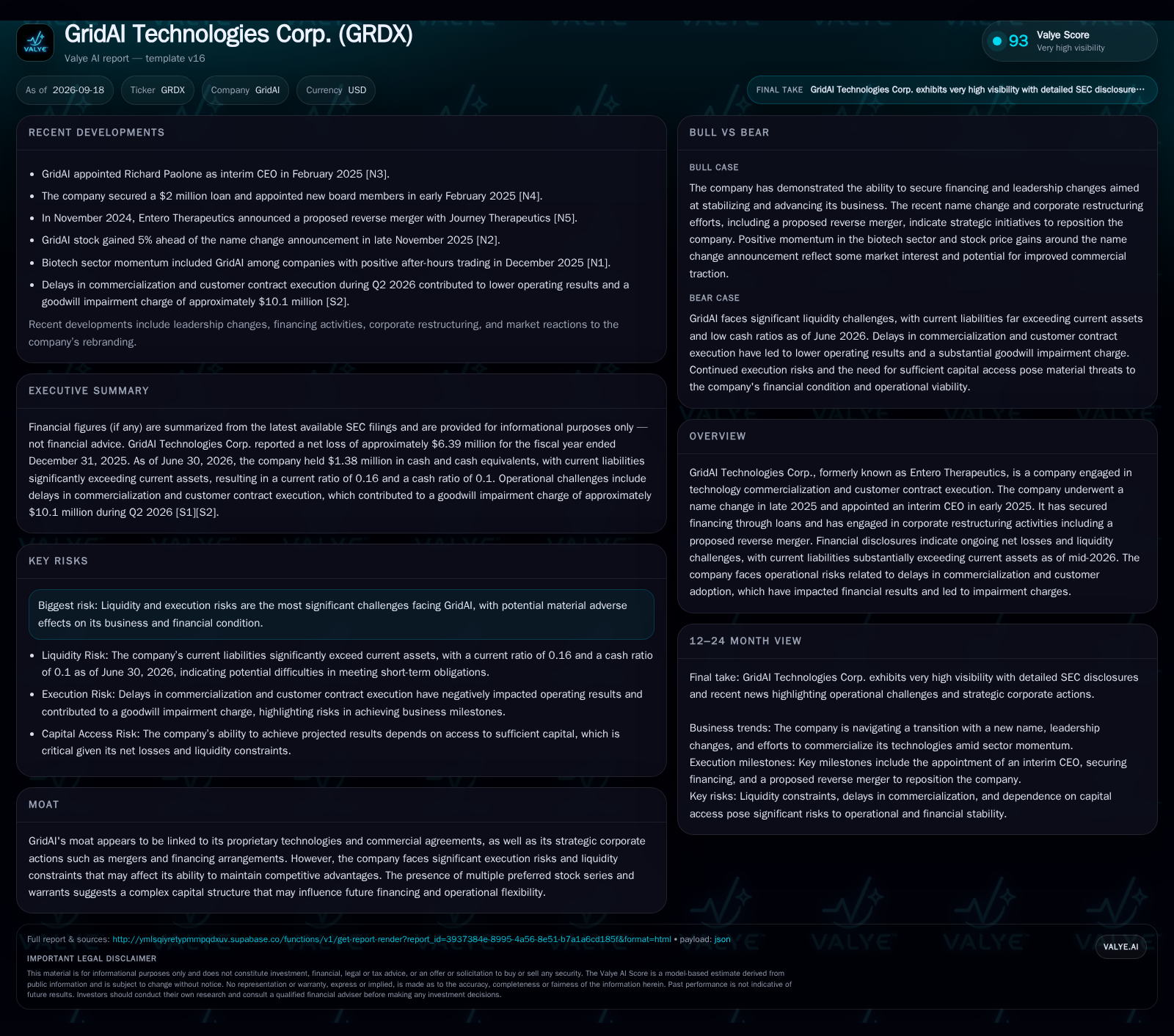
GridAI Technologies Corp. stands at a precarious crossroads, having recently rebranded and shifted its strategic focus from biopharmaceutical development to energy orchestration and grid optimization software. With current liabilities vastly outstripping assets, and a major goodwill impairment reflecting operational setbacks, GridAI’s next chapters will be driven by its ability to secure fresh capital, land and execute customer contracts, and prove that its grid optimization technology can achieve meaningful adoption in a competitive market. [S1] [S2]
Liquidity Crisis and Delayed Execution Define the 2026 Operating Reality
As of June 30, 2026, GridAI Technologies reported cash and cash equivalents of just $1.38 million, set against current liabilities of $14.1 million, yielding a current ratio of 0.16 and a cash ratio of 0.1. This acute liquidity mismatch points to immediate challenges in meeting short-term obligations and underscores the company’s vulnerability to operational disruption if new capital is not secured. [S2]
Operationally, delays in commercialization and customer contract execution during Q2 2026 led to underperformance versus projections and triggered a $10.1 million goodwill impairment charge. This impairment signals that expected future cash flows from acquired businesses or technologies have fallen well short of original expectations, raising questions about the company’s ability to realize value from its recent strategic pivots. [S2]
GridAI’s net loss for the fiscal year ended December 31, 2025, was $6.39 million, and the company reported negative earnings per share (-$2.01) for the quarter ended June 30, 2026, highlighting persistent operating losses. [S1] [S2]
Transitioning Business Model: From Biopharma Burn to Grid Optimization Hurdles
GridAI’s current economics reflect a company in transition, with legacy biopharmaceutical activities winding down and a new focus on grid orchestration and optimization software. Historically, the biopharma segment required significant R&D spend with a long runway to commercial returns—a model often characterized by high burn rates, milestone-dependent funding, and binary value inflection around clinical results.
The grid optimization segment, while less capital-intensive than drug development, still demands substantial upfront investment in software development, integration, and customer onboarding. Revenue realization may be delayed by lengthy sales cycles—especially with utility and industrial customers—and pilot-to-scale transitions. Pricing power in this space is often constrained by entrenched incumbents, regulatory hurdles, and the need to demonstrate reliability and cost savings at scale before broad adoption. Unless GridAI can secure volume contracts or recurring SaaS-style revenue, margin expansion and operating leverage will be difficult to achieve.
The company’s capital structure, with multiple preferred stock series and warrants outstanding, could complicate future financing and dilute existing shareholders in efforts to raise new capital. [S1] [S2]
Competitive Landscape: Can GridAI Carve Out a Niche in a Crowded, High-Stakes Sector?
GridAI faces formidable competition in both grid optimization and energy orchestration, where established players, well-funded startups, and large enterprise software providers compete for contracts with utilities and industrials. Incumbents often benefit from long-standing customer relationships, integration expertise, and proven reliability—a critical consideration for mission-critical infrastructure. The sector also sees rapid technological change, with advances in AI, IoT, and distributed energy management increasing the bar for differentiation.
GridAI’s potential moat may rest on proprietary algorithms, integration capabilities, or unique commercial agreements, but these advantages remain unproven pending large-scale customer adoption. Execution risk is elevated for new entrants, as switching costs for utility customers are high and pilots may not convert to material contracts without demonstrated ROI. The company’s legacy biopharma assets are unlikely to offer any near-term competitive edge in the new strategic direction.
If Commercialization Accelerates and Capital Arrives: A Path to Relevance
A favorable scenario for GridAI would involve successful execution of customer contracts, proof of technology adoption in real-world grid or industrial settings, and the closing of new funding rounds to address short-term liquidity. Evidence of recurring revenue from SaaS or managed services, coupled with positive case studies or pilot-to-contract conversions, would validate the business model shift.
The upside could be further supported if the company leverages sector momentum—such as increased grid modernization spending or regulatory tailwinds for clean energy integration—to accelerate adoption. Early customer wins or partnerships with established players would help overcome credibility gaps and could enable operating leverage as fixed costs are absorbed over a growing revenue base.
Confirmation of this scenario would come from disclosed multi-year customer agreements, recurring revenue growth, and a demonstrable improvement in liquidity—such as a successful equity raise or non-dilutive funding event. Falsification would be evident if customer wins remain elusive, cash burn persists, or new capital is not secured.
Restructuring and Survival: Proving Out the Model Under Constraint
The most plausible near-term outcome is a period of operational triage, where GridAI seeks bridge financing or asset sales to extend runway while focusing on landing initial commercial contracts in its new grid optimization segment. Under this scenario, the company may secure short-term funding at dilutive terms, possibly through the issuance of additional preferred shares or warrants, while continuing to report operating losses until customer adoption materializes.
Management will likely prioritize demonstrating early traction with pilot projects, building a pipeline of potential deals, and stabilizing the organization after recent leadership turnover. Any signs of cost containment, improved working capital management, or incremental contract wins would support the baseline thesis. The scenario would be falsified by continued contract execution delays, inability to secure even bridge capital, or further impairment charges signaling failed integration.
Liquidity Exhaustion and Execution Failures: Risk of Restructuring or Dissolution
The adverse scenario is defined by a failure to raise new capital before cash runs out, continued delays in customer contract execution, and the inability to convert pilots into revenue-generating agreements. This would likely force GridAI to pursue aggressive restructuring, asset sales, or even bankruptcy protection if obligations cannot be met.
Further goodwill or asset impairments would highlight the inability to realize value from strategic pivots, and any loss of key personnel or board instability could accelerate negative outcomes. In this scenario, existing shareholders would face substantial dilution or total loss of capital, and the company’s grid optimization ambitions would likely be absorbed by a competitor or liquidated.
Milestones and Metrics That Will Determine GridAI’s Strategic Viability
Material customer contract announcements, especially those with multi-year terms or recurring revenue components, would help validate the commercialization thesis.
Disclosure of new capital raises—equity, debt, or non-dilutive funding—would be critical to assessing near-term solvency and the company’s ability to weather operating losses.
Evidence of pilot-to-commercial conversion rates, if disclosed, would test the company’s ability to move from proof-of-concept to scalable revenue.
Gross margin and operating expense trends: improvements would indicate progress in cost management and potential for eventual operating leverage.
Updates on board and executive team stability, including permanent CEO appointment and retention of key technical talent, would reduce governance risk.
Any further impairment charges or asset write-downs would signal continued underperformance or failed integration of acquired assets.
Customer adoption metrics—such as active deployments, contracted megawatts, or software seats—would provide concrete evidence of market traction, if disclosed.
Resolution of outstanding preferred stock and warrant overhang, or terms of new financing, would clarify the dilution risk for existing shareholders.
Disclaimer: This is research-only, informational analysis and not investment advice. It may include AI-generated interpretation and general industry context. Always verify important details using primary sources.

Comments