
BlossomHill Therapeutics: EGFR-Mutant Lung Cancer Ambition Hinges on BH-30643 Progress and Clinical Risk Management
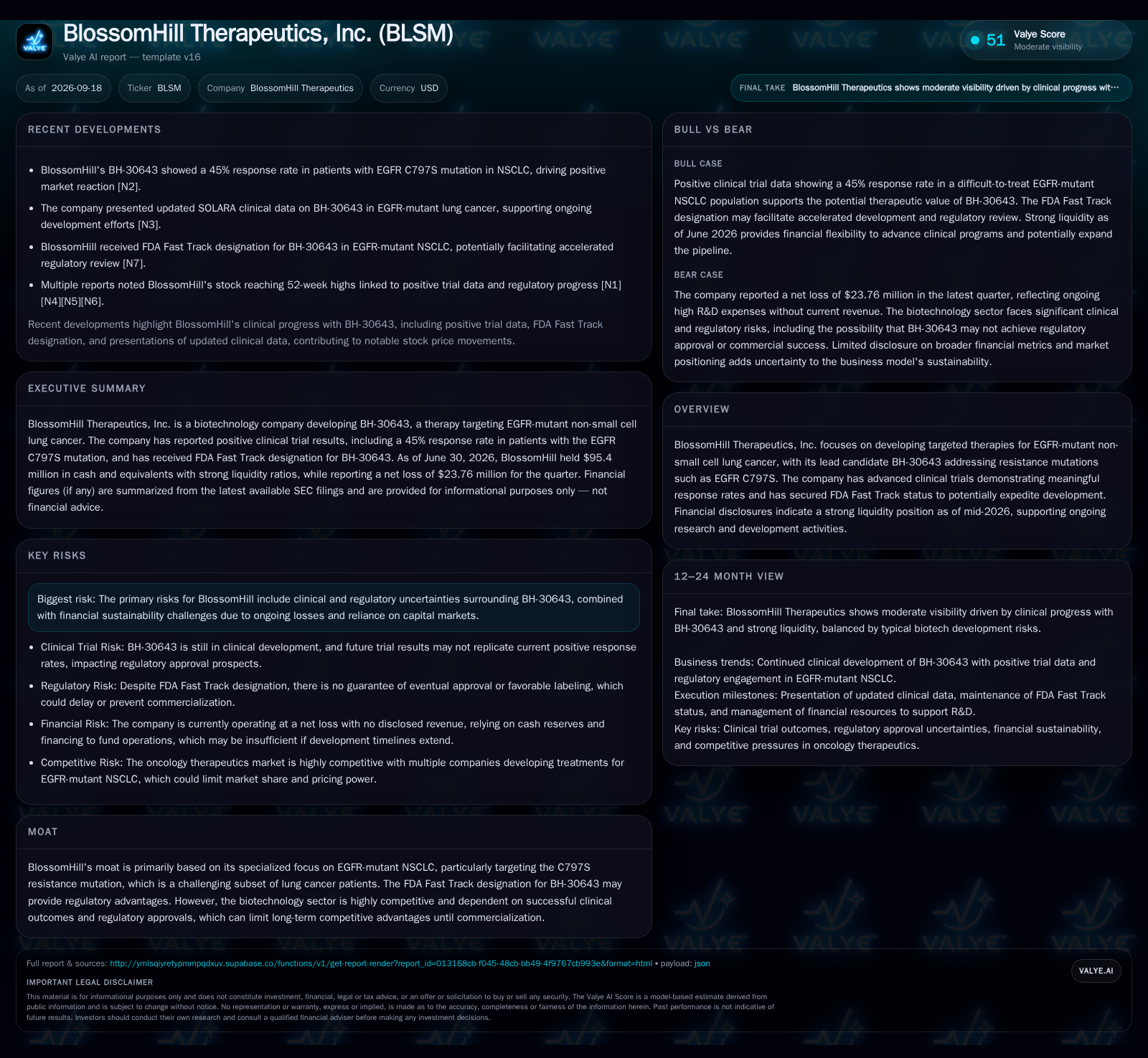
BlossomHill Therapeutics advances its lead candidate, BH-30643, for EGFR C797S-mutant NSCLC, posting a notable 45% clinical response rate and securing FDA Fast Track status.
The next inflection points will be pivotal trial results and clarity on the commercial potential of BH-30643. [S1] [N2] [N7]
BlossomHill Therapeutics, Inc. is at a critical juncture, propelled by promising early results for its lead compound, BH-30643, which targets the challenging EGFR C797S mutation in non-small cell lung cancer (NSCLC). A 45% clinical response rate and FDA Fast Track designation highlight both the drug’s potential and the company’s near-term prospects.
Recent Clinical and Regulatory Milestones Define the Opportunity
BlossomHill Therapeutics’ recent trajectory is framed by three pivotal facts. First, its lead candidate, BH-30643, achieved a 45% response rate in clinical trials for patients with EGFR C797S-mutant NSCLC—a difficult-to-treat cancer population with limited options. This result, reported in September 2026, has drawn positive market attention and validates the underlying therapeutic hypothesis. Second, the company secured FDA Fast Track designation for BH-30643, potentially enabling a more expedited regulatory review process and earlier engagement with regulators. Third, as of June 30, 2026, BlossomHill reported $95.4 million in cash and equivalents, with a current ratio of 5.42 and a cash ratio of 5.12, underscoring its liquidity position as it advances development. These facts collectively define BlossomHill’s near-term value proposition and set the stage for its next phase of risk and opportunity. [S1] [N2] [N7]
Unpacking the Economics of a Pre-Revenue Oncology Pipeline
As a clinical-stage biotechnology company, BlossomHill’s current business model is characterized by heavy R&D investment, no product revenue, and reliance on equity financing or partnerships to fund operations. The 45% response rate for BH-30643 is a promising efficacy signal, but until regulatory approval and market launch, all expense is essentially investment in intangible assets (data, IP, milestones). The company’s net loss of $23.76 million in the June 2026 quarter reflects these sector norms, where fixed costs (clinical operations, regulatory, G&A) dominate until commercialization. Should BH-30643 reach market, potential economics hinge on the size of the EGFR-mutant NSCLC population, pricing power (often high for targeted oncology therapies), and uptake in later lines of therapy. Commercialization would introduce operating leverage: fixed infrastructure costs would be spread over revenue, but variable costs (manufacturing, distribution, commercialization, royalties) would rise. If BlossomHill remains independent, it may need to build or partner for commercial capabilities. If it is acquired, value realization could come via milestone payments or royalties. The current liquidity position gives the company time to reach key data readouts, but further fundraising may be necessary unless a partnership or out-licensing deal is struck.
Competitive Dynamics in Targeted Oncology and the EGFR Space
BlossomHill is operating in a highly competitive oncology landscape, particularly in the EGFR-mutant NSCLC segment where large pharmaceutical companies and emerging biotechs are all vying for differentiation. The company’s competitive advantage derives from its focus on the C797S resistance mutation—a patient subset underserved by existing EGFR inhibitors. If BH-30643 continues to show strong efficacy and safety, it could capture share in later-line settings or as part of combination regimens. However, barriers remain: established players have greater resources, broader pipelines, and commercial infrastructure. Rapid innovation cycles in oncology mean that alternative mechanisms of resistance or next-generation EGFR inhibitors could emerge, potentially eroding first-mover advantage. Intellectual property protection, data exclusivity, and speed to market will be critical. The FDA Fast Track designation offers a regulatory edge, but only if BlossomHill can maintain momentum and avoid clinical or regulatory setbacks.
Intellectual property protection remains a cornerstone of competitive positioning. Beyond primary composition-of-matter patents, secondary patents covering formulation, dosing regimens, or method-of-use claims can extend exclusivity and deter generic or biosimilar entrants. However, these protections are often contested, and patent litigation or challenges can introduce uncertainty and delay commercialization. The strength and breadth of BlossomHill’s patent portfolio, combined with its ability to enforce rights, will influence not only market exclusivity duration but also licensing and partnership negotiations. A robust IP position can also enhance valuation in potential acquisition scenarios, providing leverage in deal structuring.
If Clinical Success Catalyzes Approval and Commercial Uptake
In the upside scenario, additional trial data for BH-30643 confirm or improve upon the 45% response rate, with a manageable safety profile. The FDA Fast Track process enables efficient regulatory engagement, leading to priority review and potential accelerated approval. Commercial launch—whether independently or via partnership—targets a receptive prescriber base and achieves rapid physician adoption, given limited alternatives for C797S-mutant NSCLC. BlossomHill leverages pricing typical of targeted oncology drugs, supporting strong initial revenue and operating leverage. Confirmation would come from: robust pivotal trial data, regulatory acceptance for filing, positive advisory committee or FDA feedback, and early indicators of prescriber interest or payer coverage. Falsification would result from: trial failure, unexpected safety signals, regulatory delays, or weak early demand.
Clinical Progression with Sector-Standard Delays and Dilution
The most plausible path is that BlossomHill continues to advance BH-30643 through the clinic, encountering the typical hurdles of oncology drug development: slower-than-hoped enrollment, incremental data updates, and ongoing cash burn. The company may need to raise additional capital prior to commercialization, likely through equity or partnership. Regulatory review follows standard timelines, with approval and launch occurring several years out, contingent on positive pivotal data. Competition intensifies, but BH-30643 carves out a niche in the C797S population. BlossomHill’s valuation remains sensitive to clinical milestones and financing risk. Confirmation would come from continued positive trial updates, successful fundraising or partnership, and regulatory progress. Falsification would include negative clinical news, inability to raise capital, or loss of regulatory momentum.
Adverse Outcomes: Clinical Failure or Prolonged Development Risk
The principal risk is that BH-30643 fails to replicate early efficacy or encounters safety issues in larger or later-stage trials, leading to discontinuation or a requirement for additional studies. Regulatory hurdles could slow or halt the program if endpoints are missed or data are insufficient. Financially, extended timelines without revenue would force BlossomHill to seek dilutive financings or strategic alternatives. Increased competition or a shift in the treatment paradigm (e.g., new resistance mechanisms, superior agents) could further erode potential market share. Downside confirmation would include adverse clinical events, regulatory setbacks, or a rapid increase in cash burn without offsetting capital inflows. Falsification would require clear, positive progress on all major clinical and regulatory fronts.
Upcoming Developments That Will Shape BlossomHill’s Value Proposition
Additional clinical trial readouts for BH-30643, especially pivotal or confirmatory studies, will be critical to assess efficacy and safety beyond early-phase data.
Updates on the regulatory timeline, including FDA meeting outcomes, acceptance of regulatory filings, or movement toward accelerated approval, if disclosed.
R&D cash burn rate and quarterly liquidity trends, as further losses without new financing or partnership could signal increased dilution risk.
Any disclosure of partnership or licensing activity, which could provide non-dilutive funding and validate commercial interest.
Competitive pipeline developments in EGFR-mutant NSCLC, particularly new entrants targeting C797S or alternative resistance mutations.
Intellectual property status and duration of exclusivity for BH-30643, including patent grants or challenges, if disclosed.
Progress or setbacks in expanding the pipeline beyond BH-30643, signaling whether BlossomHill can build a multi-asset portfolio.
Management commentary on commercialization strategy—whether the company plans to launch independently, seek a partner, or pursue M&A.
Disclaimer: This is research-only, informational analysis and not investment advice. It may include AI-generated interpretation and general industry context. Always verify important details using primary sources.

Comments