
Plum III Merger Corp.: Structure, Financial Base, and the Quest for Business Model Definition
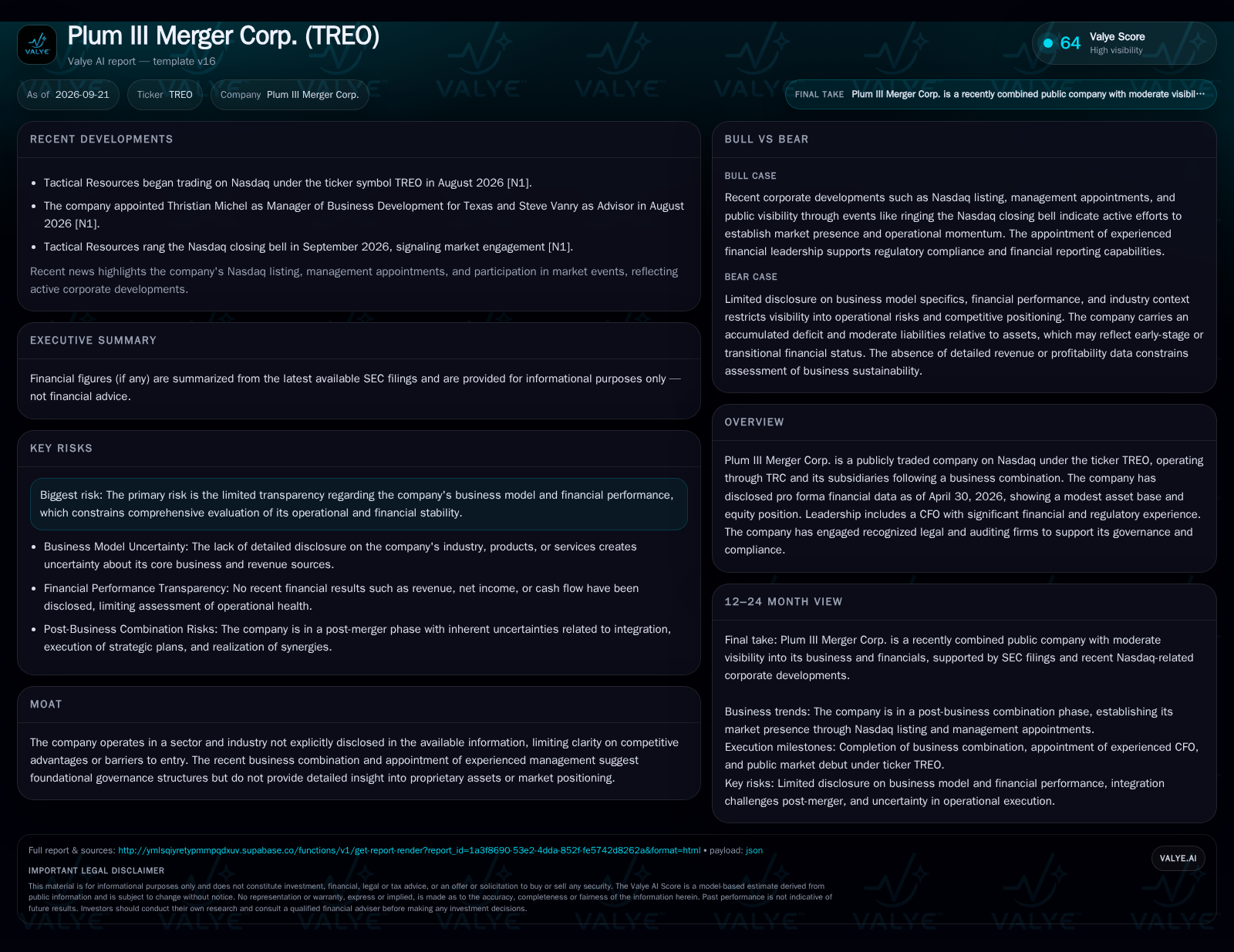
Plum III Merger Corp. has completed its business combination, now operating as a publicly traded entity under the ticker TREO. With moderate pro forma assets and equity, experienced financial leadership, and a Nasdaq debut, the company’s next phase hinges on revealing its commercial focus and demonstrating operational traction.
Plum III Merger Corp. (TREO) now trades on Nasdaq following a multi-entity business combination. The company reports $8.3 million in cash, $39.2 million in assets, $25.4 million in liabilities, and $13.8 million in equity as of April 30, 2026. An experienced CFO is in place, and the company is visibly establishing governance and public market presence. However, the absence of disclosed revenue, industry details, or operational milestones leaves the core business model and near-term strategy opaque. The central question is whether management can articulate and execute a credible commercial plan before financial runway or investor patience wanes. [S1]
Plum III Merger Corp. (Nasdaq: TREO) emerges from a complex, multi-step business combination with a modest balance sheet, experienced financial leadership, and an active push for public visibility. Yet, beneath the surface of new governance and Nasdaq listing, the company’s commercial identity and operational direction remain notably opaque. With no clear disclosure of business lines, revenue sources, or sector focus, Plum III Merger Corp. stands at a strategic crossroads: the near-term challenge is to define—and convincingly execute—a business model that justifies its public market status before its potential financial flexibility or investor goodwill erodes.
Key Developments: From Private Combination to Public Listing
Plum III Merger Corp. finalized its business combination and began trading on Nasdaq as TREO in August 2026. The pro forma balance sheet as of April 30, 2026, shows $8.3 million in cash and cash equivalents, $39.2 million in total assets, $25.4 million in liabilities, and total equity of $13.8 million. Man Ching (Jenny) Shen was appointed CFO, bringing experience in financial reporting and regulatory compliance. The company has engaged top-tier legal and audit firms, suggesting a focus on governance and compliance. These steps establish a baseline for public company operations, but the absence of disclosed revenue or business activity leaves the core commercial thesis undefined. [S1]
Commercial Mechanics: What Could Drive Value Creation?
With no public disclosure of products, services, or industry, the underlying economics of Plum III Merger Corp. remain conjectural. The pro forma financials reveal a modest capital base and accumulated deficit, which is typical for companies newly formed via business combination or SPAC structures. If operating as an early-stage platform, the company may face substantial fixed costs related to compliance, public reporting, and management, with variable costs and revenue drivers wholly dependent on its eventual sector and commercial model. The key economic levers could include the ability to scale revenue quickly relative to fixed costs, prudent cash management, and the potential for operating leverage if a recurring-revenue or asset-light model is pursued. The company reported cash and liquidity metrics for the period; these figures do not by themselves establish operating runway, investment capacity, financial flexibility, or financing capacity. [S1]
A critical consideration in assessing the company’s potential value creation lies in the scalability of its underlying economic model. If Plum III Merger Corp. pursues a business that can leverage technology or digital platforms, it may benefit from high gross margins and low incremental costs per additional customer or user, enabling operating leverage as revenues grow. Conversely, if the company’s model depends on physical assets, inventory, or labor-intensive services, fixed costs and capital expenditures could constrain margin expansion and cash flow generation. The presence or absence of recurring revenue streams—such as subscription fees, service contracts, or licensing arrangements—would materially influence predictability and valuation multiples. Therefore, identifying whether the business model emphasizes asset-light, recurring revenue or capital-intensive, transactional operations is pivotal for projecting financial sustainability.
Another dimension involves the company’s cost structure flexibility in response to market conditions. In early-stage or platform businesses, variable costs tied directly to revenue can provide a natural hedge against demand fluctuations, preserving cash during downturns. However, if fixed overheads—such as compliance, public company reporting, and administrative expenses—constitute a significant portion of total costs, the company may face a high cash burn rate absent rapid revenue ramp-up. This dynamic underscores the importance of prudent capital allocation and disciplined expense management during the transition from private to public operations. Moreover, the ability to access additional financing on favorable terms, contingent on demonstrated operational progress, would be a crucial enabler of sustained development and market confidence.
Competitive Landscape: Positioning Without a Defined Market
The current lack of clarity on sector, customer base, or product offering means Plum III Merger Corp.'s competitive position is undefined. If the company ultimately operates in a technology, industrial, or resource segment—as is common with SPAC-derived entities—key competitors would likely include both established incumbents and similarly structured new entrants. The main short-term advantage may be access to public capital and experienced governance, but these are table stakes rather than enduring moats. Without evidence of proprietary technology, regulatory barriers, or network effects, it is not possible to assert a defensible competitive edge. The company’s ability to attract investor, partner, or customer interest will depend on how quickly and convincingly it can articulate a differentiated value proposition and demonstrate early traction.
How Rapid Strategic Clarity Could Unlock Value
The most favorable outcome would see management swiftly articulate a compelling commercial focus—such as a differentiated technology platform, high-growth service, or asset acquisition strategy—and demonstrate early operational milestones. If the company secures anchor customers, strategic partnerships, or delivers initial revenue, it could leverage its public listing for further capital raises and scale. Confirmation would come from timely disclosure of a clear business model, sector focus, and initial financial or operational results. Evidence might include customer wins, contract announcements, or product launches. Falsification would be indicated by continued disclosure gaps, lack of business development, or rapid cash burn without commercial progress.
Most Likely Trajectory: Prolonged Uncertainty and Gradual Operational Progress
The middle path envisions Plum III Merger Corp. taking several quarters to clarify its business model, with incremental updates as management aligns strategic plans post-combination. Modest progress could include initial partnerships, small-scale commercial pilots, or preliminary revenue, but with limited visibility into scale or long-term viability. This scenario would be confirmed by partial disclosures—such as sector identification, pipeline development, or modest revenue recognition—without full clarity on sustainable economics. It may be falsified if the company fails to provide substantive updates or if operational costs quickly erode the current cash position.
Risks of Strategic Drift and Financial Attrition
The adverse scenario is one where Plum III Merger Corp. fails to convert its public market status into a credible commercial trajectory. If management cannot articulate a clear business plan, or if integration and execution risks stall progress, the company could experience rapid cash depletion, loss of investor confidence, and potential delisting risk. This would be confirmed by persistently vague disclosures, absence of operational milestones, and a declining cash balance with no offsetting revenue. Warning signs would include management turnover, inability to attract partners or customers, and regulatory scrutiny over disclosure practices.
What Will Determine Whether Plum III Merger Corp. Becomes More Than a Shell?
Public disclosure of sector focus, commercial strategy, or business line—any specifics on what the company actually does or plans to do.
Initial revenue recognition or signed commercial agreements, if disclosed, to test operational traction.
Updates on cash burn relative to disclosed operating expenses, to gauge the effective financial runway.
Announcements of anchor customers, partnerships, or strategic alliances that would validate market interest.
Management’s articulation of a medium-term capital allocation plan—further fundraising, acquisitions, or organic investment.
Evidence of regulatory or exchange scrutiny regarding ongoing disclosure sufficiency or compliance.
Turnover in senior management, which could signal either strategic redirection or instability.
Quarterly updates or investor communications that clarify progress against stated milestones, if disclosed.
Disclaimer: This is research-only, informational analysis and not investment advice. It may include AI-generated interpretation and general industry context. Always verify important details using primary sources.

Comments