
SANGRIX INC.: Strategic Pivot to AI Infrastructure Amid Persistent Financial Opacity
With a recent brand overhaul and stated transition to AI infrastructure, SANGRIX INC.
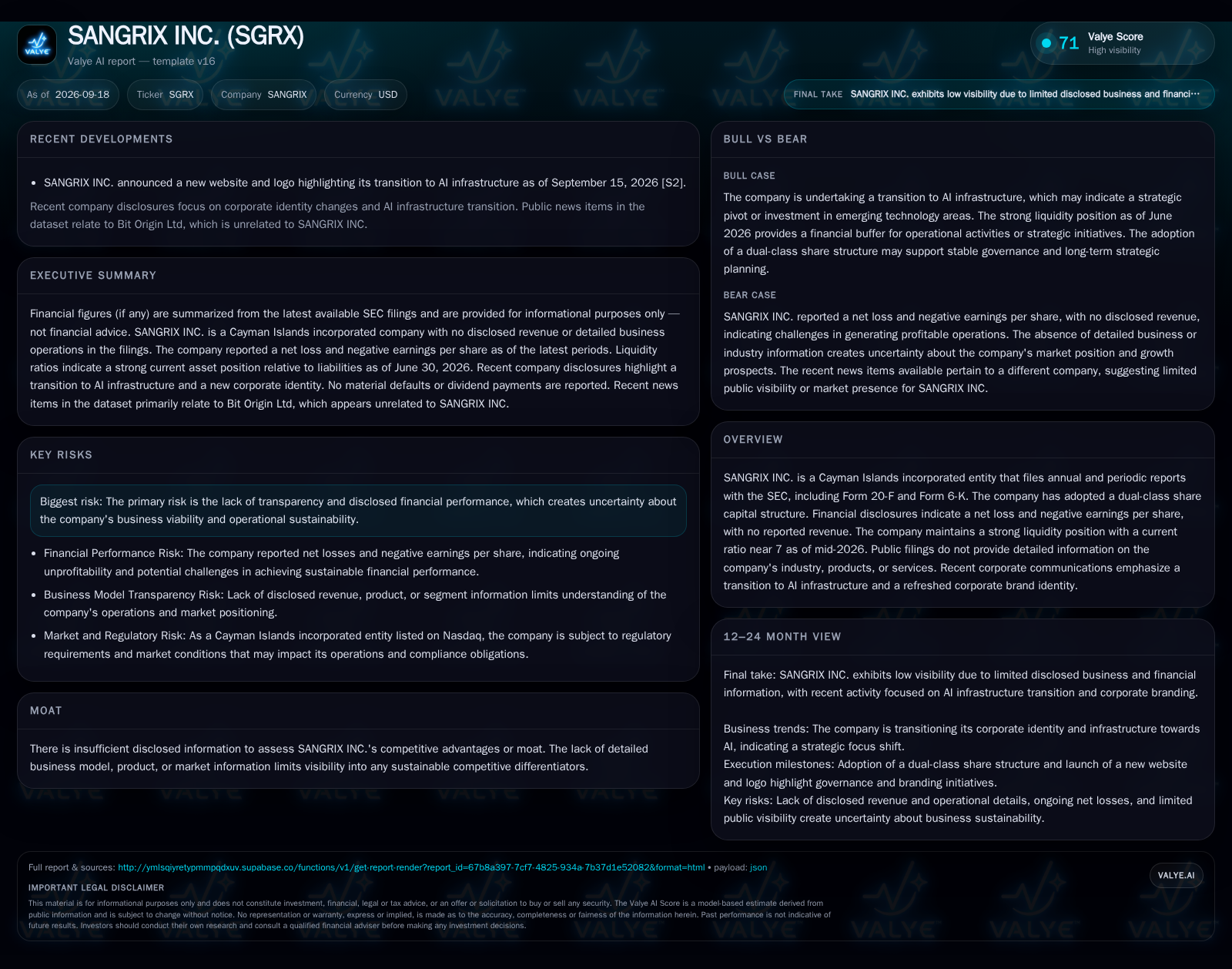
SANGRIX INC. has rebranded and announced a shift toward AI infrastructure. Despite a robust current ratio and low near-term liabilities, the company discloses no revenue and continues to report net losses. The lack of operational details and business clarity makes it challenging to assess the probability of a successful pivot or to benchmark progress against industry peers. The next phase depends on tangible execution in AI and improved transparency to validate the strategic direction and business viability. [S1] [S2]
SANGRIX INC.
Recent Financials and Corporate Initiatives Set the Stage for a Strategic Crossroads
As of June 30, 2026, SANGRIX INC. reported $1.57 million in cash and cash equivalents against current liabilities of $1.46 million, resulting in a current ratio of 6.98 and a cash ratio of 1.08. This suggests that, at least in the short term, the company is not under immediate liquidity pressure. However, it also reported a net loss of $2.81 million for the period ending December 31, 2024, and negative earnings per share (-$70.43 as of June 2026), with no revenue disclosed in SEC filings. The lack of any reported top-line activity is highly unusual for a public company at this stage and raises questions about the nature and maturity of its operations. [S1]
On the strategic front, SANGRIX INC. announced a new website and logo in September 2026, explicitly tying these changes to a transition toward AI infrastructure. This pivot, while potentially promising, is not yet supported by disclosed business lines, customers, or revenue streams. The adoption of a dual-class share structure in March 2025 could consolidate control among insiders, affecting governance dynamics as the company undertakes this shift. [S2] [S1]
Potential Revenue Models and Economic Leverage in an AI Infrastructure Play
With no disclosed revenue or operational metrics, SANGRIX INC.'s business economics remain opaque. If the company is pursuing an AI infrastructure business, plausible models could include offering cloud-based AI compute resources, developing proprietary AI hardware, or providing platform-as-a-service (PaaS) or infrastructure-as-a-service (IaaS) solutions. Each of these models typically involves significant upfront capital investment in hardware, data centers, and engineering talent, with the possibility of high operating leverage if the company can scale customer usage over a largely fixed asset base.
The economics of AI infrastructure businesses are often characterized by high fixed costs (data centers, R&D, infrastructure buildout) and low marginal cost per incremental customer—suggesting that, if SANGRIX can attract meaningful volume, it could achieve substantial gross margin expansion. Pricing in this sector is generally usage-based, and customer stickiness can be enhanced by deep integration with customer workflows and APIs. However, absent any disclosed contracts, pricing strategies, or customer relationships, it is unclear how SANGRIX plans to monetize its AI infrastructure or what its cost structure actually entails.
Capital needs for scaling infrastructure are substantial. The company reported cash and liquidity metrics for the period; these figures do not by themselves establish operating runway, investment capacity, financial flexibility, or financing capacity.
Assessing Competitive Dynamics Without Business Line Transparency
The absence of disclosed products, customers, or markets means SANGRIX INC.'s competitive position is indeterminate. If the company is targeting the AI infrastructure sector, it would face formidable competitors ranging from hyperscale cloud providers (such as Amazon AWS, Microsoft Azure, and Google Cloud) to specialized AI hardware and platform startups. These incumbents benefit from scale, deep technical talent, and extensive customer relationships.
Potential sources of differentiation for a new entrant might include proprietary hardware innovation, region-specific data center advantages, unique AI algorithms, or a focus on underserved verticals. However, without information on SANGRIX's technology stack, go-to-market approach, or target customer segments, it is not possible to assess whether the company possesses or is developing any defensible moat.
Switching costs in AI infrastructure can be high if customers commit to proprietary APIs or data storage, but establishing such stickiness requires both technical credibility and proven product-market fit—neither of which can currently be verified for SANGRIX.
How a Successful AI Pivot Could Unlock Growth—If Execution Follows
The most optimistic scenario for SANGRIX INC. is that the recent rebranding and stated AI infrastructure focus reflect genuine operational progress—such as product launches, customer pilots, or strategic partnerships—that have not yet been disclosed. If the company is able to deliver a differentiated AI platform or infrastructure service, it could tap into robust market demand for AI compute, data storage, or model deployment, especially as enterprises seek alternatives to established cloud vendors.
Upside would be confirmed by the emergence of concrete milestones: commercial product releases, customer acquisition announcements, revenue initiation, or partnership deals with recognized technology firms. Early customer wins or reference deployments would be especially powerful in demonstrating that SANGRIX is more than a concept-stage company. Further evidence could include hiring of technical leadership with AI infrastructure credentials or public disclosure of a technology roadmap.
Conversely, continued absence of operational milestones or persistent lack of revenue would strongly falsify this upside thesis.
Likely Trajectory: Prolonged Pre-Revenue Phase with Incremental Strategic Steps
Given current disclosures, the most plausible scenario is that SANGRIX INC. remains in a pre-revenue, development-focused phase, using its liquidity to fund early-stage initiatives while refining its business model. The dual-class structure suggests management is seeking to maintain strategic flexibility during this period, possibly to attract partners or investors without ceding control.
In this scenario, the company may incrementally release updates on its AI infrastructure vision—such as non-binding memoranda of understanding, technical prototypes, or limited customer pilots—while deferring significant revenue generation until core technology and market fit are established.
Confirmation would come from gradual increases in disclosure—such as segment reporting, pipeline updates, or initial revenue recognition—whereas continued opacity, cash burn acceleration, or governance disputes would undermine confidence in this base trajectory.
Execution Risks and Prolonged Opacity Threaten Business Viability
The most adverse scenario is that SANGRIX INC.'s pivot to AI infrastructure remains largely nominal, with no substantive progress toward actual commercial operations. In this case, the company might continue to consume cash without delivering products, attracting customers, or establishing a viable go-to-market model.
This downside would be confirmed by ongoing net losses, continued lack of revenue or operational disclosures, and the absence of independent validation (such as third-party partnerships or customer testimonials). Other warning signs could include abrupt management turnover, disputes among shareholders or directors, or regulatory actions related to disclosure or governance.
If the company is unable to articulate a credible business plan or demonstrate tangible progress within a reasonable timeframe, investor confidence could erode irreversibly.
Milestones That Will Clarify Whether SANGRIX’s AI Transition Is Real or Rhetorical
Any initial revenue recognition—if disclosed—would be a pivotal indicator of operational traction and market acceptance.
Disclosure of specific products, services, or customer segments targeted by the AI infrastructure initiative would help test the credibility of the strategic pivot.
Updates on capital expenditures or infrastructure investments would indicate commitment to scaling and operational execution.
Announcements of customer pilots, commercial contracts, or strategic partnerships would provide external validation of business progress.
Changes in technical leadership or the addition of executives with AI infrastructure backgrounds would suggest a deepening of operational capability.
Segment reporting or increased transparency in SEC filings—especially around business model mechanics—would reduce uncertainty and help benchmark progress.
Any signals of governance friction, such as board resignations or shareholder disputes, would be warning flags for execution and strategic risk.
Disclaimer: This is research-only, informational analysis and not investment advice. It may include AI-generated interpretation and general industry context. Always verify important details using primary sources.

Comments