
Neuphoria Therapeutics: Strategic Pause, Partner Leverage, and the Crucial Role of the Scancell Merger
With its lead CNS asset on hold after a Phase 3 setback and internal R&D sharply curtailed, Neuphoria Therapeutics is navigating a strategic inflection point—relying on partnered program economics, preserving cash, and hinging its future on the successful completion of a merger with Scancell Holdings.
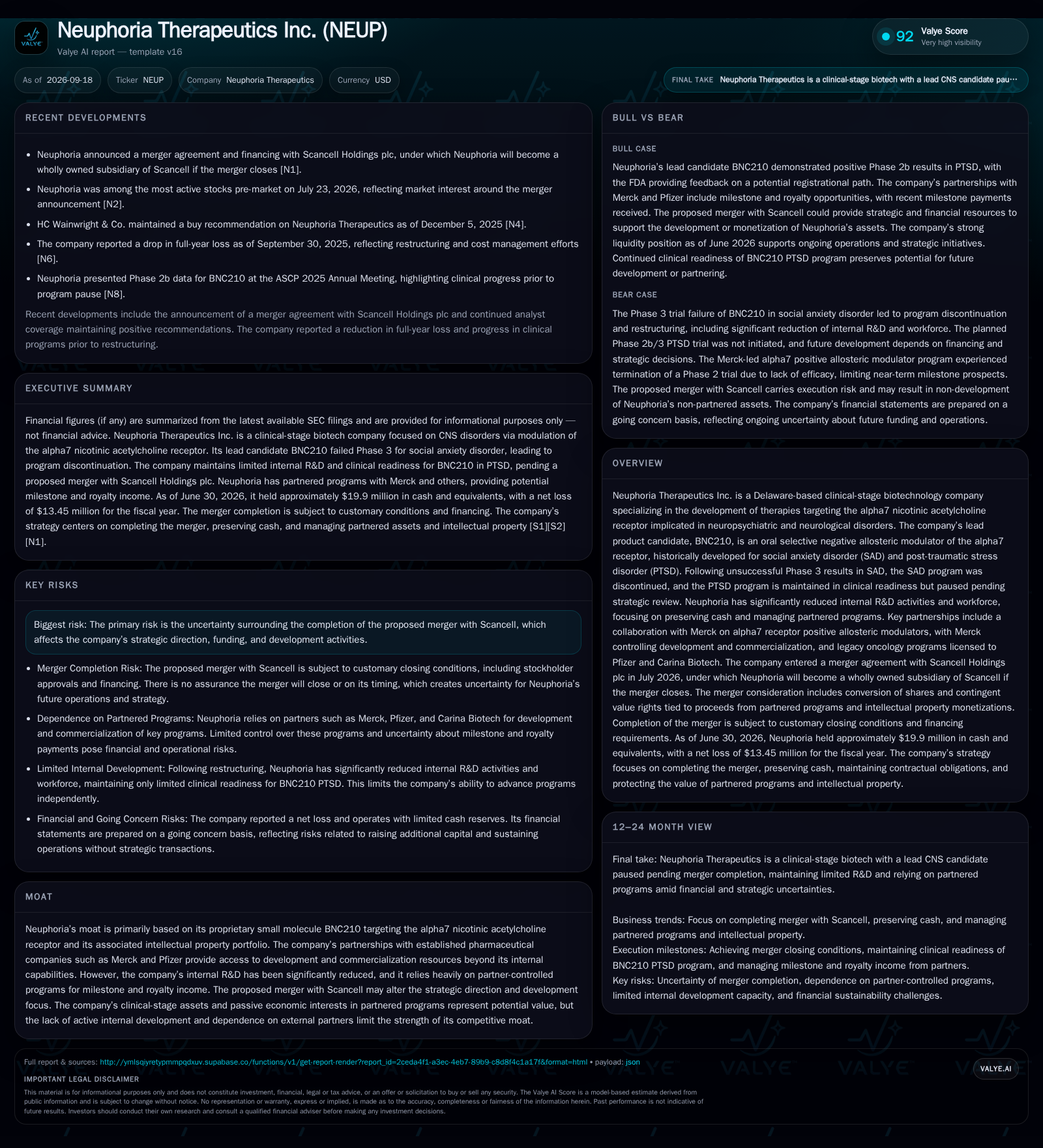
Neuphoria Therapeutics has halted new clinical development after BNC210 failed in Phase 3 for social anxiety disorder, leaving the PTSD program on pause and internal R&D minimal. The company depends on milestone and royalty income from partnered programs (notably with Merck and Pfizer) but has little direct control over their pace or outcome. Neuphoria’s near-term direction and value realization now rest on closing a merger with Scancell Holdings, with future economics shaped by contingent value rights and the trajectory of partner-led projects [S1] [N1].
Neuphoria Therapeutics, once a clinical-stage biotech with aspirations in central nervous system (CNS) disorders, has been forced to pivot after a pivotal clinical failure. With its lead candidate BNC210 discontinued in social anxiety disorder and the PTSD program put on hold, the company has slashed operating expenses and now hinges its future on a merger with Scancell Holdings. Neuphoria’s remaining value proposition is a blend of contingent payments from legacy partnered programs and the possibility of future asset monetization, but it has little direct control over development timelines or outcomes. The critical question is whether the merger can close—and if so, whether the combined entity can unlock value from a complex set of externally managed assets and intellectual property [S1] [N1].
From Clinical Ambition to Strategic Pause: What Has Changed for Neuphoria?
Neuphoria Therapeutics has undergone a fundamental shift in its business trajectory over the past year. The company’s lead asset, BNC210—an oral negative allosteric modulator of the alpha7 receptor—failed to meet primary or secondary endpoints in its pivotal Phase 3 trial for social anxiety disorder (SAD), resulting in the discontinuation of the SAD program and the cancellation of further trials [S1] [S2]. The PTSD program for BNC210 remains on clinical hold, with the company explicitly pausing new development to focus on strategic alternatives. In parallel, Neuphoria has dramatically reduced its operating footprint, terminating leases, retaining only one full-time employee, and outsourcing essential functions. The company’s cash and equivalents stood at $19.9 million as of June 30, 2026, with minimal ongoing R&D spend and a net loss of $13.45 million for the year [S1]. The near-term focus is now on completing a merger with Scancell Holdings, with any future value for shareholders tied to contingent rights based on monetization of partnered programs and intellectual property [N1].
Partnered Program Economics and the Implications of an Asset-Light Model
Neuphoria’s economics have shifted from those of a traditional clinical-stage biotech to an asset-light, royalty- and milestone-dependent model. With internal R&D sharply curtailed and only minimal infrastructure retained, the primary sources of potential future cash flow are milestone payments and royalties from out-licensed and partnered programs. Notably, Neuphoria has a collaboration with Merck on alpha7 receptor positive allosteric modulators (PAMs), but Merck’s lead program, MK-1167, was terminated after interim Phase 2 results, and another candidate (MK-4334) is only in early clinical stages [S1]. The company has received milestone payments (including $15 million in early 2025), but future income is entirely dependent on the progress and prioritization decisions of its partners. Additional legacy programs, such as a KAT6 oncology asset licensed to Pfizer and a CAR-T program with Carina Biotech, could theoretically generate passive income, but these too are out of Neuphoria’s direct control and are at early or uncertain development stages.
Operating leverage is now minimal—the company has reduced its fixed cost base to the essentials for public company compliance and asset management. With little active development, cash burn should remain low barring any new initiatives. However, this model provides little upside without successful asset monetization or partner-led clinical progress, and exposes Neuphoria to long periods of inactivity and value drift if partners delay or discontinue programs.
Has Neuphoria’s Moat Eroded or Simply Changed Form?
Neuphoria’s historical competitive position rested on proprietary small molecule programs targeting the alpha7 receptor, an area of significant but challenging CNS drug development. The intellectual property portfolio and first-mover status in certain mechanism classes provided a modicum of moat, especially when paired with validation from partnerships with major pharmaceutical companies. However, with internal development halted and little prospect of near-term proprietary clinical progress, the company’s competitive defensibility is now largely a function of its existing IP and the strategic choices of its partners.
The dependence on partner-controlled programs (notably Merck and Pfizer) means Neuphoria’s fate is tied to external R&D priorities and competitive dynamics at those larger firms. In the CNS space, competition from both small molecules and emerging modalities (such as neuromodulation, digital therapeutics, and next-generation biologics) is intense, and the alpha7 mechanism has historically been high-risk with mixed clinical results across the industry. The proposed merger with Scancell could theoretically combine portfolios and resources, potentially improving negotiating leverage or enabling new partnering configurations, but until the transaction closes, Neuphoria’s position remains structurally weak compared to active CNS drug developers.
Unlocking Value Through Partnered Milestones and a Successful Scancell Combination
The most favorable scenario for Neuphoria’s stakeholders rests on two interlinked mechanisms: (1) successful completion of the Scancell merger, and (2) one or more partnered programs progressing to value-creating milestones. If the merger closes, Neuphoria shareholders would receive Scancell American Depositary Shares and contingent value rights (CVRs) tied to net proceeds from partnered assets and IP monetizations [N1]. Should Merck, Pfizer, or Carina Biotech achieve clinical or commercial milestones, Neuphoria (and thus Scancell or CVR holders) could receive significant cash infusions. The economics could be further enhanced if the combined entity finds a strategic buyer or partner for the paused BNC210 PTSD program, especially given its FDA Fast Track designation.
Evidence that would confirm this scenario includes: regulatory or clinical progress by partner-controlled programs, public disclosure of new out-licensing transactions or asset sales, and the successful close of the Scancell merger with favorable terms for legacy Neuphoria shareholders. Falsification would come from merger failure, partner program discontinuations, or a lack of milestone events over an extended period.
Stalled Internal Development, Asset Stewardship, and a Waiting Game for Partner Progress
The most plausible outcome is a prolonged period of operational stasis, with Neuphoria (or its successor) focused on stewardship of its partnered assets, maintaining minimal cash burn, and pursuing the merger as the primary strategic objective. In this scenario, the company neither initiates new internal development nor realizes near-term milestone income from partners, instead preserving its remaining cash while awaiting external triggers.
Confirmation of this scenario would include continued low operating expenses, lack of new clinical trial initiations, and progress reports focused on merger completion and partner updates rather than proprietary R&D. Falsification would be indicated by unexpected initiation of internal programs, significant fundraising for new development, or a major asset transaction outside of the merger structure.
Merger Failure, Asset Attrition, and the Risk of Value Dissipation
The chief risk to Neuphoria is that the Scancell merger fails to close, leaving the company with limited cash, minimal operating infrastructure, and no clear path to value creation. In this case, the company would likely be forced to seek additional financing under unfavorable terms, sell or out-license remaining assets at distressed prices, or wind down operations entirely. Because all major partnered programs are controlled by third parties, Neuphoria would have little ability to accelerate timelines or influence outcomes, and a lack of near-term milestones could lead to further value erosion.
Confirmation of this downside would come from public merger termination disclosures, rapid cash burn without new income, asset impairments, or a going-concern qualification that signals imminent financial distress. Falsification would require a successful merger transaction or an unexpected windfall from existing partnered programs.
Milestones and Triggers That Will Shape Neuphoria’s Post-Merger Value Proposition
Progress and closing of the merger with Scancell Holdings, including satisfaction of stockholder and financing conditions.
Announcements of new milestone or royalty payments from Merck, Pfizer, or Carina Biotech—particularly any clinical-stage advancements or regulatory submissions.
Updates on the status and monetization efforts for the BNC210 PTSD program, especially if a new partner or acquirer is identified.
Operating expense and cash burn trends, which will test the sustainability of the asset-light model if disclosed.
Public disclosure of contingent value right (CVR) terms and any adjustments to legacy shareholder economics post-merger.
Material changes in the status or value of Neuphoria’s intellectual property portfolio, including new patents, expirations, or legal disputes.
Regulatory or partnership developments in the CNS alpha7 receptor space that could affect the perceived value of Neuphoria’s remaining pipeline, even if not directly tied to current programs.
Disclaimer: This is research-only, informational analysis and not investment advice. It may include AI-generated interpretation and general industry context. Always verify important details using primary sources.

Comments