
Thunder Bridge Capital Partners V: Pre-Deal Realities, Funding Mechanics, and the Strategic Stakes of the SPAC Lifecycle
The next phase will test the team’s ability to identify, negotiate, and close a transaction before capital, regulatory, and market windows close.
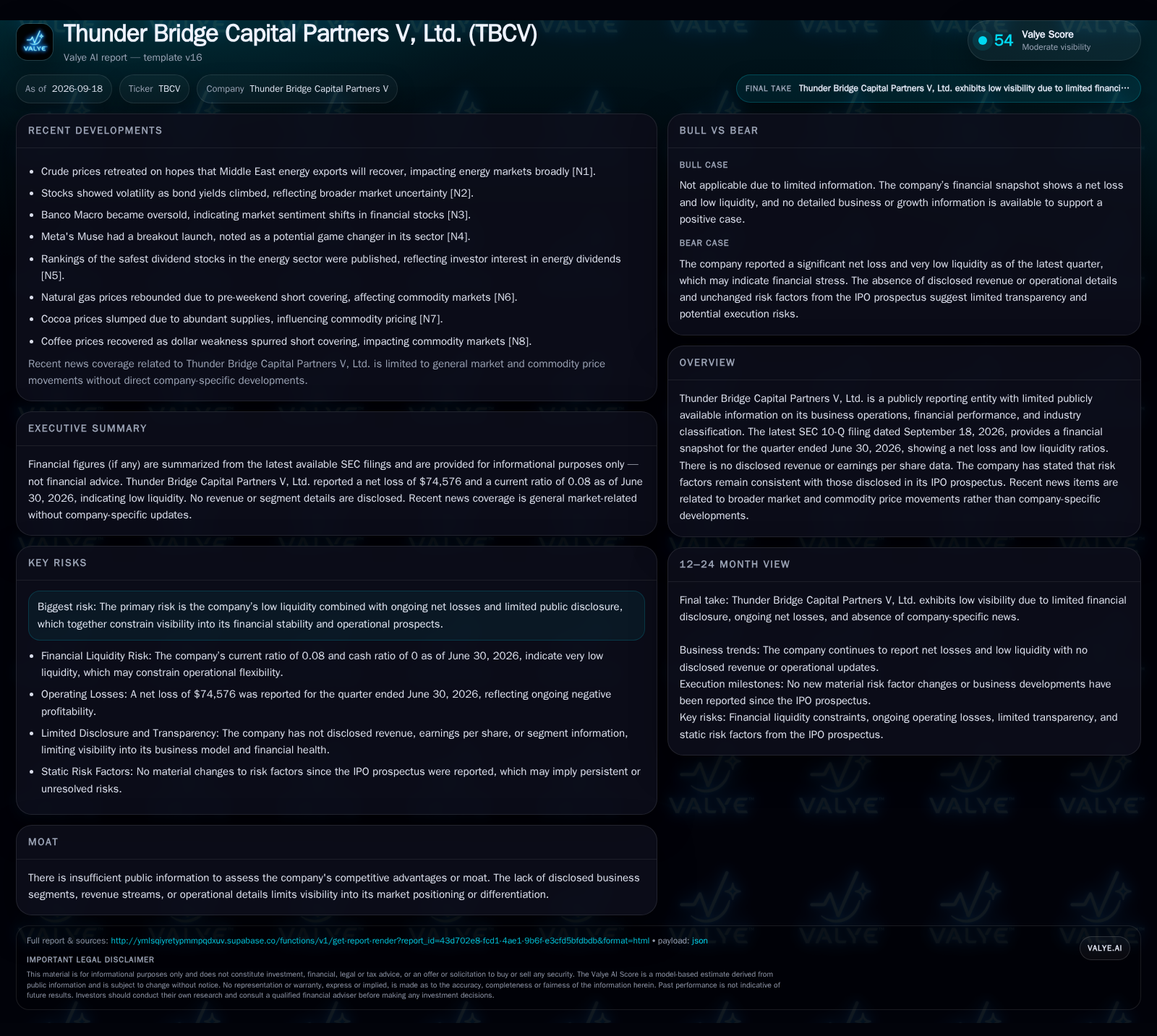
Thunder Bridge Capital Partners V, Ltd.(TBCV) is a newly public SPAC that reported no revenue and a net loss of $74,576 in its most recent quarter, with a critically reported current ratio of 0.08 and just $226 in cash pre-IPO. The company completed its IPO after the reporting period, raising capital to pursue a business combination. The main thesis hinges on its ability to secure and close a compelling acquisition before deadlines or market shifts erode the value proposition [S1].
Thunder Bridge Capital Partners V, Ltd. (TBCV) exemplifies the high-wire act of the SPAC model: pre-IPO, it operated with negligible cash and no revenue, reporting a net loss of $74,576 and a working capital deficit as of June 30, 2026. With the IPO completed after that date, TBCV now holds a pool of capital in trust, but its future is defined by its ability to identify, negotiate, and close a business combination before structural time limits or adverse market shifts intervene.
Acute Pre-IPO Liquidity, No Revenue, and Post-Quarter IPO Set the Stage
As of June 30, 2026, Thunder Bridge Capital Partners V, Ltd. reported $226 in cash, current assets of $20,226, and current liabilities of $244,236, resulting in a current ratio of 0.08 and a cash ratio of zero. The company posted a net loss of $74,576 for the quarter, entirely attributable to organizational and administrative costs, with no revenue generated [S1]. These figures reflect the typical pre-IPO financial condition of a SPAC, where operational activity is limited to formation and compliance. Importantly, TBCV completed its IPO after the reporting quarter, raising capital to pursue its core purpose: executing a business combination. This transition from acute liquidity stress to being capitalized for acquisition is the pivotal event defining the company's near-term trajectory [S1].
The acute pre-IPO liquidity constraints observed are emblematic of the SPAC lifecycle's front-end capital dynamics, where initial funding is minimal and operational activity focuses on entity formation and regulatory compliance rather than revenue generation. The transition from this constrained state to a capitalized post-IPO status represents a critical inflection point, but also introduces timing risk: the SPAC’s operational runway is effectively bounded by regulatory deadlines and market conditions that may shift unfavorably before a suitable target is secured. Understanding this temporal pressure is essential to evaluating the SPAC’s strategic posture and risk profile.
SPAC Economics: Trust Structure, Sponsor Incentives, and the Binary Outcome
Thunder Bridge Capital Partners V, Ltd. is structured as a special purpose acquisition company (SPAC), meaning its economics are defined by the capital raised in its IPO, the trust account holding those proceeds, and the incentives of its sponsor. Until a business combination is completed, TBCV generates no revenue and incurs only administrative expenses. The trust account—funded from the IPO at $10.00 per unit—typically accrues interest, which may be used to pay limited expenses but is otherwise earmarked for a future acquisition or for return to shareholders if no deal occurs. The sponsor’s upside is tied to the completion of a combination (via founder shares or warrants), but absent a transaction, sponsor capital and effort are lost. Operating leverage is minimal pre-deal; the decisive variable is the scale and quality of the eventual target. If a deal is consummated, the resulting economics will depend on the acquired company’s business model, margins, and capital needs—not TBCV’s legacy structure.
The trust structure central to SPAC economics creates a unique alignment of incentives and constraints. While the trust account safeguards investor capital, it also imposes a quasi-fiduciary duty to preserve principal, limiting the SPAC’s ability to deploy funds outside of the acquisition context. Sponsor incentives, often structured through founder shares and warrants, are contingent on deal completion, creating a binary payoff that can drive aggressive deal sourcing but also heighten risk-taking. The absence of operating leverage pre-deal means that the SPAC’s value is almost entirely contingent on the acquired business’s fundamentals post-merger, underscoring the importance of rigorous target evaluation. Furthermore, the cost structure—primarily administrative and legal expenses—acts as a drag on sponsor economics, increasing the urgency to consummate a transaction within the allotted timeframe.
SPAC Market Dynamics: Competition for Targets and Structural Counterforces
TBCV competes in a crowded SPAC market, where numerous blank check companies vie for a finite pool of attractive private targets. Competitive pressure comes not only from other SPACs but also from private equity, direct listings, and traditional IPO routes. Key differentiators may include sponsor reputation, deal-making track record, and the ability to offer favorable terms to targets. However, counterforces are substantial: regulatory scrutiny, redemption risk (shareholders redeeming for trust value), and market fatigue with underperforming post-merger SPACs all raise the bar for successful combinations. In this environment, sponsor alignment, deal sourcing networks, and the ability to navigate complex negotiations become the primary sources of potential advantage.
In the competitive SPAC market, the scarcity of high-quality private targets intensifies pressure on sponsors to differentiate through network effects and deal structuring acumen. Given the proliferation of SPAC vehicles, sponsors with deeper sector expertise or proprietary deal flow may secure preferential access to attractive opportunities. However, external factors such as heightened regulatory scrutiny and investor skepticism regarding SPAC performance introduce structural headwinds. Redemption risk, in particular, can materially reduce available acquisition capital, forcing sponsors to negotiate more favorable terms or seek supplemental financing. These dynamics necessitate a strategic balance between deal attractiveness to target companies and investor confidence, with successful sponsors adept at managing these competing demands to optimize transaction outcomes.
A Successful Business Combination Unlocks Value—If Execution and Market Timing Align
The most favorable outcome for TBCV is the identification and closing of a high-quality business combination within the required timeframe. This scenario requires the sponsor to leverage its network and expertise to source a target with strong growth prospects, scalable economics, and public-market appeal. Confirmation would come from a merger announcement with a credible, well-underwritten private company, accompanied by limited redemptions and positive market reception. The thesis would be further validated if the post-merger entity demonstrates robust revenue growth, operating leverage, and access to incremental capital. Falsification would occur if TBCV fails to reach a deal or if the chosen target is met with high redemption rates, poor trading, or adverse post-merger performance.
Deal Sourcing and Execution Define the Probable Trajectory
The most plausible path is that TBCV, now funded post-IPO, enters a period of active target identification and due diligence. Administrative costs continue to erode sponsor capital, but trust proceeds remain sequestered for a transaction or redemption. The base scenario assumes TBCV will announce a letter of intent or definitive agreement with a private company within the customary SPAC timeline (typically 18-24 months from IPO). The quality of the target, redemption rates, and market conditions at deal announcement will determine whether the transaction creates value for public shareholders. Evidence confirming this scenario would be a deal announcement, S-4 filing, and limited redemptions. Falsification would be a lack of progress toward a deal or repeated extensions without substantive updates.
Failure to Secure a Compelling Deal or Adverse Market Shifts Could Force Liquidation
The adverse scenario is that TBCV is unable to secure an attractive business combination before its permitted window expires, due to competition for targets, market volatility, or target unwillingness. In this case, the company would be required to liquidate, returning the trust proceeds to shareholders and leaving the sponsor with sunk costs and no upside. Additional downside risks include excessive shareholder redemptions (which can shrink deal proceeds and undermine transaction viability), regulatory or legal hurdles, or the selection of a target whose business deteriorates before or after the merger. Confirmation would be repeated extensions, lack of substantive deal progress, or a liquidation announcement. Falsification would be timely deal execution with manageable redemptions.
Milestones That Will Determine Whether TBCV’s SPAC Ambition Succeeds
Announcement of a letter of intent or definitive agreement with an acquisition target—this is the primary catalyst that will test sponsor execution and deal quality.
Filing of a merger proxy or S-4 registration statement, which would signal concrete progress toward transaction close.
Shareholder redemption rates at the time of deal vote—high redemptions could signal lack of confidence or undermine deal economics.
Market reaction and trading volume following a deal announcement, which would reflect public investor sentiment toward the proposed combination.
Updates on regulatory or legal review of the proposed merger, as delays or adverse findings could threaten deal completion.
Disclosed terms of the business combination, including valuation, sponsor promote structure, and earnout provisions, if available.
Management commentary or public filings discussing extensions, deal search progress, or liquidation risk—these would illuminate timeline pressure and strategic intent.
Any indication of additional sponsor capital infusions or backstop arrangements, which could shore up deal certainty if public redemptions are high.
Disclaimer: This is research-only, informational analysis and not investment advice. It may include AI-generated interpretation and general industry context. Always verify important details using primary sources.

Comments