
Kroger’s Diversification Playbook: Data Leverage, Private Labels, and the Race to Digital Profitability
Kroger’s Q2 2026 results highlight the durability of its diversified model—spanning private labels, retail media, and digital—but also reveal the pressures of soft sales and a challenged liquidity position. The company’s ability to convert its customer data and scale into higher-margin alternative profit streams is now as critical as the grocery aisles themselves.
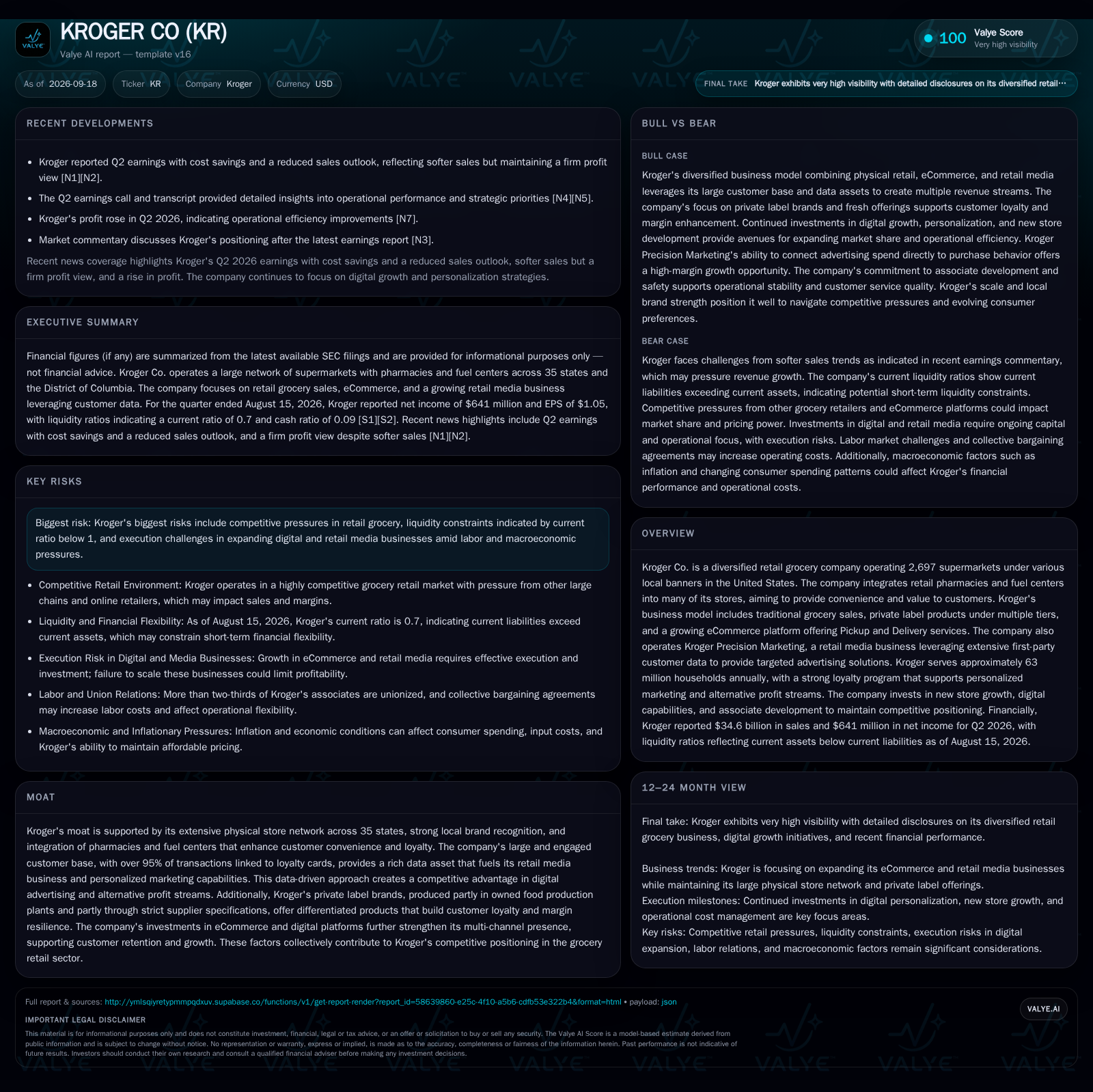
Kroger remains one of the largest US grocers with 2,697 supermarkets, a significant private label business, and a retail media arm leveraging first-party data. The thesis now hinges on Kroger’s ability to drive higher-margin digital and media profits while defending core grocery share against intensifying competition and macro headwinds. [S1] [S2] [N1] [N2]
Kroger stands at a pivotal juncture: its massive physical footprint and deep customer data reservoir provide both a buffer and a springboard as traditional grocery margins come under pressure. The Q2 2026 results illustrate this duality—profits held firm thanks to cost control and media growth, but softer sales and a stretched current ratio spotlight the company’s exposure to competitive and macroeconomic headwinds. As retail media and digital personalization shift from side bets to core profit drivers, Kroger’s ability to execute on alternative revenue streams will determine whether it can outpace rivals and weather the evolving grocery landscape. [S1] [S2] [N1] [N2]
Kroger’s Q2 2026: Profitability Holds as Sales Soften and Liquidity Tightens
For the quarter ended August 15, 2026, Kroger reported $34.6 billion in sales, $641 million in net income, and basic/diluted EPS of $1.05. Operating profit for the quarter reached $971 million. [S2]
Recent news coverage underscores this tension: while Kroger’s Q2 profit rose and cost savings contributed to margin resilience, management cut its sales outlook and acknowledged softer top-line performance. This signals that operational efficiency is offsetting sales headwinds for now, but liquidity and revenue growth warrant heightened scrutiny. [N1] [N2] [N7]
How Kroger Makes Money: Grocery Margins, Private Label, and Data-Driven Profit Streams
Kroger’s core revenue engine remains traditional grocery retail, supported by pharmacies and fuel centers integrated into over half its stores. Gross margins in conventional grocery are structurally thin—typically ranging from 2-4% net—due to fierce price competition and high fixed cost leverage (labor, logistics, rent, and shrink).
The company’s private label business (‘Our Brands’) is a margin enhancer, accounting for over $39 billion in 2025 sales with more than 13,000 SKUs. In-house production at 33 facilities covers 20% of these units, allowing for greater control over quality, margin capture, and supply chain flexibility. Private labels typically yield higher gross margins than national brands, and their scale at Kroger supports both customer loyalty and profitability. [S1]
Kroger Precision Marketing exemplifies the company’s shift toward alternative, higher-margin profit streams. By leveraging first-party loyalty data (capturing over 95% of transactions), Kroger monetizes targeted advertising and digital promotions—businesses with structurally higher operating margins than core grocery. The retail media segment’s economics benefit from low incremental costs, as the data and digital infrastructure are already in place.
eCommerce (Pickup and Delivery) is both a growth lever and a margin challenge. While digital engagement increases customer touchpoints and basket size, fulfillment and last-mile costs can erode margins unless offset by automation, scale, or delivery fees. [S1] [S2]
Defending Share in a Fragmented Grocery Market: Data, Loyalty, and the Threat from Digital Natives
Kroger’s competitive position is anchored by its 2,697-store network, strong local banners, and deep integration of pharmacies and fuel centers. This physical presence enables the company to attract mass-market traffic and cross-sell high-frequency categories. The loyalty program—linking over 95% of transactions—creates a defensible moat through data-driven personalization and targeted offers, increasing retention and basket size.
Private labels further differentiate Kroger from pure-play discounters and premium grocers, providing customers with value tiers and exclusive products. In-house manufacturing deepens this moat by insulating Kroger from national brand pricing wars and supply shocks.
However, competitive threats are intensifying. National and regional grocers, warehouse clubs, and dollar stores continue to pressure price points and local share. Meanwhile, eCommerce-first players and delivery platforms (e.g., Amazon, Walmart, Instacart) are scaling digital grocery and last-mile fulfillment, eroding traditional advantages in convenience and selection.
Retail media is a newer battleground, with Amazon and Walmart both leveraging their own vast data sets and digital ecosystems. Kroger’s ability to scale its media business and maintain data privacy trust will determine whether it can sustain above-average margins in this arena.
If Alternative Profit Streams Scale: How Retail Media and Loyalty Data Could Unlock Margin Expansion
The bullish scenario for Kroger hinges on its success in shifting mix toward higher-margin profit streams—specifically, retail media, loyalty-driven personalization, and private label penetration. If Kroger Precision Marketing continues to attract major CPG advertising spend, leveraging its first-party data to drive measurable sales lift, this could materially expand operating margins even if core grocery sales remain pressured.
Further upside could come from digital engagement: if eCommerce adoption accelerates and the company can improve the economics of Pickup and Delivery (e.g., via automation or higher basket sizes), digital channels could become accretive to profit rather than a margin drag.
Confirmation of this scenario would include: rapid growth in retail media revenue and profitability (if disclosed), an increasing share of private label in total sales, and evidence that digital/loyalty initiatives are driving higher customer retention or wallet share. Sustained or expanding operating margins and above-peer return on invested capital would further validate the thesis.
Multi-Channel Stability with Margin Pressure: Navigating Flat Sales, Tight Liquidity, and Incremental Media Growth
The most plausible outcome is that Kroger sustains stable but modest sales growth, with private label and retail media providing incremental margin support but not fully offsetting ongoing grocery margin compression. The store network continues to anchor customer traffic, but share gains are limited by intensifying competition and consumer price sensitivity.
Digital and eCommerce channels grow but remain margin-dilutive without major advances in fulfillment efficiency or delivery economics. Retail media contributes positively to profitability, but faces increasing competition from larger digital ecosystems.
Liquidity constraints (current ratio below 1) prompt a cautious approach to capital expenditures and expansion. Labor costs and macroeconomic pressures (inflation, wage negotiations) weigh on operating expenses. Evidence supporting this scenario would be flat-to-low single-digit sales growth, stable or slightly declining operating margins, and continued cost discipline offsetting competitive headwinds.
Margin Squeeze and Liquidity Risk: When Cost Pressures, Weak Sales, and Digital Drag Converge
The bearish scenario is defined by a convergence of persistent sales softness, intensifying price competition, and margin dilution from digital fulfillment and labor inflation. If customer traffic shifts to discount or digital-native channels, or if eCommerce fails to reach scale economics, Kroger could see declining same-store sales and sustained margin compression.
In this scenario, Kroger may be forced to slow capital investment, close underperforming stores, or seek external financing—moves that could further erode competitive positioning.
Confirmation would include: negative same-store sales, shrinking operating profit, rising interest expense or debt levels, and any signals of distressed asset sales or store closures. Failure to grow retail media or private label share would further undermine the bull thesis.
What Will Determine Kroger’s Margin and Growth Trajectory in the Next 18 Months?
Quarterly same-store sales trends (identical store sales growth or decline) would clarify whether Kroger is gaining, holding, or losing share in core grocery.
Retail media revenue and margin contribution (if disclosed) will test whether alternative profit streams are scaling fast enough to offset grocery margin pressure.
Private label (‘Our Brands’) penetration rate as a percentage of total sales—an increasing mix would support both margin resilience and customer stickiness.
Digital engagement metrics: active digital customers, Pickup/Delivery order frequency, and digital basket size (if disclosed) would show whether eCommerce is contributing to growth or eroding margin.
Operating margin trend and return on invested capital to gauge whether cost controls and alternative profits are translating into superior financial outcomes.
Labor cost inflation and union negotiation outcomes—rising costs here could materially affect profitability and capital allocation.
Store network changes: net new store openings or closures, especially in underperforming markets, would indicate management’s confidence in future growth versus retrenchment.
Disclaimer: This is research-only, informational analysis and not investment advice. It may include AI-generated interpretation and general industry context. Always verify important details using primary sources.

Comments