
Narragansett Bancorp: Sparse Disclosure Sets a High Bar for Stakeholder Confidence
With limited transparency, investors and analysts must focus on scenario analysis, disclosure milestones, and signals of underlying business quality.
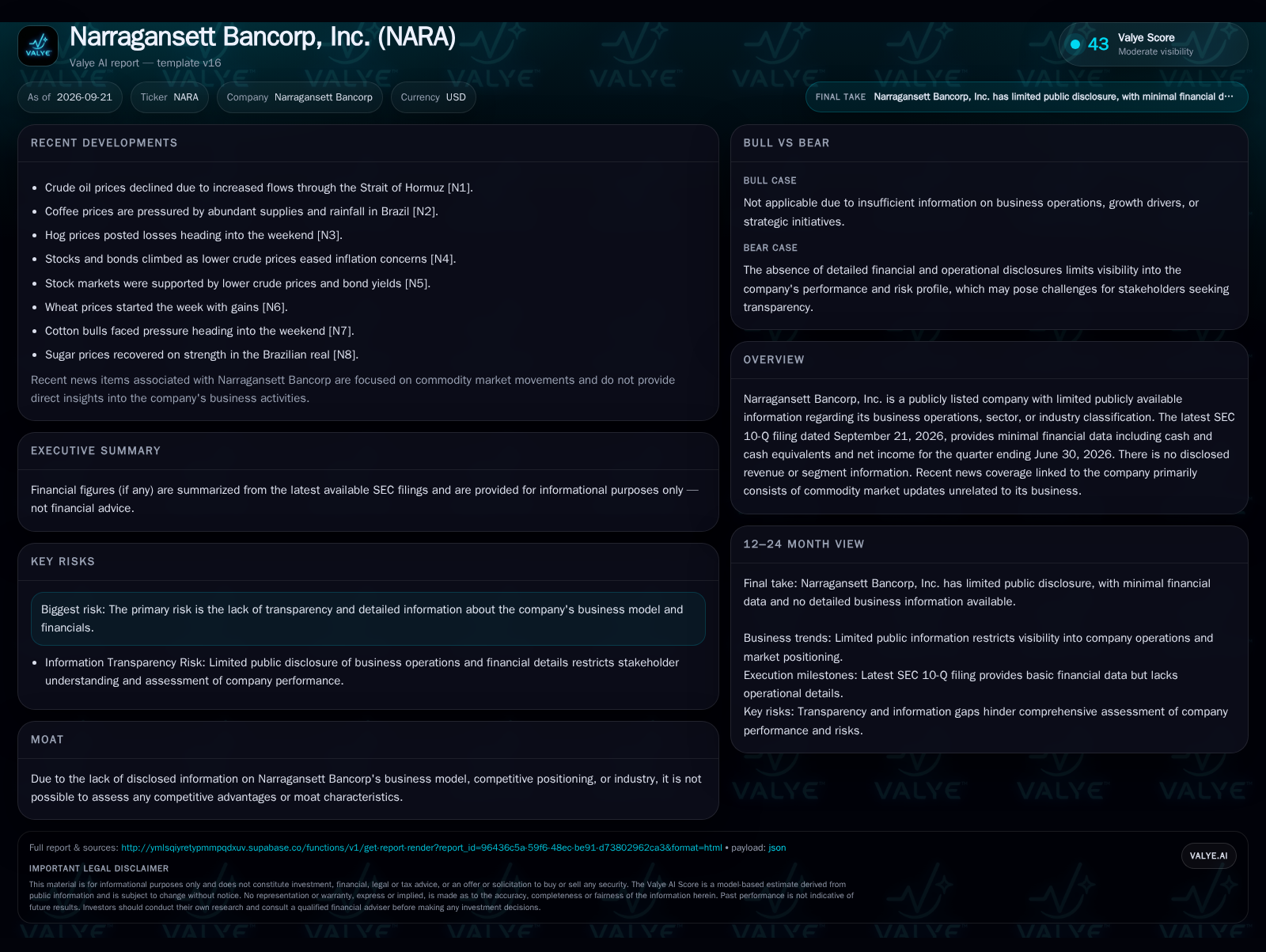
Narragansett Bancorp, Inc. reported $3.47 million in net income and $52.75 million in cash as of June 30, 2026, but provides no segment, revenue, or business model details. This lack of transparency makes it impossible to assess underlying economics, competitive position, or risk. Investors should focus on future disclosure, operational clarity, and signs of sustainable profitability before forming any conviction about the company's prospects. [S1]
Narragansett Bancorp, Inc. presents a rare case on public markets: it reports a quarterly net income of $3.47 million and holds $52.75 million in cash as of June 2026, but offers no information about its business activities, industry, or revenue base. This opacity prevents a substantive assessment of its business model, risk profile, or competitive outlook. For investors and analysts, the central question is not about recent results, but whether the company’s future disclosures will reveal a sustainable, well-managed operation or expose hidden vulnerabilities.
Sparse Financial Disclosure: The Facts and Their Implications
Narragansett Bancorp, Inc. reported $52.75 million in cash and cash equivalents and a net income of $3.47 million for the quarter ending June 30, 2026. However, there is no information on revenue, business segments, sector, or operational activities in the latest SEC 10-Q filing. [S1] This lack of detail means that, while the company is currently profitable and liquid, the sources and sustainability of those profits remain unknown. Without segment or revenue breakdowns, it is impossible to determine if the results are driven by recurring operations, one-time events, or financial engineering. The absence of business context raises acute questions about risk, business quality, and long-term outlook.
The absence of segment or revenue data also complicates the assessment of the company’s capital allocation efficiency and return on invested capital. Without clarity on how resources are deployed across different business lines or geographies, it is difficult to evaluate whether capital is being used optimally to generate sustainable growth. Moreover, the lack of operational detail impedes analysis of cost structure dynamics, such as fixed versus variable expenses, which are critical to understanding scalability and margin resilience under varying economic conditions. This opacity inherently increases the uncertainty premium investors must assign to the company’s valuation.
Unpacking Profitability: What the Numbers Don’t Tell Us
With no disclosed revenue or business line information, the mechanisms behind Narragansett Bancorp’s profitability are completely opaque. If the company operates as a typical bank holding company, net income could stem from net interest margin (the spread between loan and deposit rates), fee-based services, or investment activities. However, without data on loan/deposit composition, interest rate exposure, or non-interest income, it is impossible to assess the durability of current profits, underlying cost structure, or exposure to credit and market risk.
The reported cash position is substantial, but cash alone does not reveal the company’s capital intensity, loan loss reserves, asset quality, or liquidity management practices. If the net income is driven by recurring core operations, the business could demonstrate operating leverage as scale increases. Alternatively, if profits are the result of asset sales, non-recurring gains, or accounting adjustments, the economics could deteriorate quickly in subsequent quarters. In the absence of disclosure, all interpretations remain conditional.
If Narragansett Bancorp’s profits derive primarily from interest income, the net interest margin’s sensitivity to interest rate fluctuations would be a key factor in future earnings volatility. Without disclosure of asset-liability composition or duration mismatches, it is impossible to model interest rate risk or liquidity risk accurately. Similarly, if fee income contributes materially, understanding the stability and growth potential of these fees—whether transactional, advisory, or asset management fees—would be essential to assessing revenue predictability. The absence of cost breakdowns also prevents evaluation of operating leverage, which is critical for profitability expansion as the company scales.
Competitive Moat or Mirage? The Perils of Analyzing in the Dark
Without information on Narragansett Bancorp’s market, customer base, or product mix, it is impossible to benchmark the company against peers or assess the presence of any sustainable competitive advantage. If the company is a traditional bank, its competitive position would typically be shaped by factors such as local market share, deposit franchise strength, cost of funds, and credit underwriting discipline. In specialized finance or niche lending, differentiation could stem from technology, unique customer segments, or regulatory arbitrage.
However, the lack of operational transparency means investors cannot evaluate switching costs, customer retention, pricing power, or the risk of disintermediation by new entrants or fintech platforms. The company’s disclosure practices themselves may be a negative signal for governance and stakeholder alignment, as persistent opacity often correlates with elevated risk or subscale operations.
The competitive landscape for financial institutions is increasingly shaped by regulatory compliance costs, technology adoption, and evolving customer expectations. Without disclosure of investment in digital platforms, cybersecurity, or compliance infrastructure, it is difficult to judge whether Narragansett Bancorp is positioned to compete effectively over the medium to long term. Additionally, the company’s ability to innovate or adapt to fintech disruptions hinges on strategic priorities and capital allocation decisions, none of which are currently visible. This lack of transparency obscures potential competitive advantages or vulnerabilities that would influence the company’s market positioning and growth trajectory.
Unlocking Value Through Transparent Operations and Sustainable Earnings
A favorable path for Narragansett Bancorp would involve the company providing detailed disclosure about its business model, revenue composition, and risk management practices. If future filings reveal that the current net income is driven by stable, recurring banking or financial services operations with prudent risk controls, the company could attract a broader investor base and command a premium valuation. Evidence of a strong deposit franchise, disciplined credit underwriting, and effective cost management would support the case for sustainable profitability.
Confirmation would come from future SEC filings or investor communications disclosing revenue streams, segment performance, loan and deposit mix, credit quality metrics, and management commentary on strategy. A steady or growing trend in core net interest or fee income, with consistent asset quality, would falsify concerns about one-time gains or hidden risks.
Sustained Opaqueness Keeps Stakeholder Confidence in Check
The most plausible scenario, based on current disclosure practices, is that Narragansett Bancorp continues to report only minimal financial data, limiting the ability of investors and analysts to assess performance or risk. In this case, the company may remain a niche or subscale player, with its shares trading at a discount due to the persistent information gap. Stakeholder confidence would likely remain subdued unless and until management commits to greater transparency.
Confirmation of this scenario would occur if future SEC filings continue to omit business description, revenue, or segment details. Market engagement (e.g., analyst coverage or institutional ownership) would likely remain limited, and the company’s valuation could lag peers with comparable financials but higher disclosure standards.
Hidden Weaknesses Surface: The Risk of Negative Surprises
A negative trajectory would be realized if further disclosures—forced by regulatory changes, litigation, or adverse events—reveal that the current profits were driven by non-recurring items, aggressive accounting, or unsustainable business practices.
Red flags would include restatements of prior results, sudden increases in loan loss provisions (if applicable), or the discovery of off-balance-sheet liabilities. A sharp decline in net income, unexplained cash outflows, or regulatory sanctions would be strong evidence that the underlying business is weaker than headline numbers suggest.
Testing the Thesis: Disclosure Events and Underlying Quality Markers
Disclosure of revenue and segment data in future SEC filings would directly test the sustainability and quality of current reported profits.
Detailed information on loan/deposit composition, if disclosed, would clarify risk profile and business model.
Any management commentary or investor presentations explaining business strategy, operations, or risk management would help establish the company’s credibility.
Trends in net income and cash flow over subsequent quarters would indicate whether current profitability is recurring or anomalous.
A useful metric would be credit quality indicators—such as non-performing asset ratios or loan loss provisions—if the company is a bank or lender.
Changes in auditor opinions, restatements, or regulatory actions would signal deeper risks or governance concerns.
An increase in analyst coverage or institutional ownership would suggest improving transparency and market confidence.
Material shifts in cash balance or unexplained capital movements would warrant close scrutiny for hidden vulnerabilities.
Disclaimer: This is research-only, informational analysis and not investment advice. It may include AI-generated interpretation and general industry context. Always verify important details using primary sources.

Comments