
ANAPTYSBIO’s Royalty-Driven Model After the Split: Leverage, Leverage Points, and Legal Uncertainty
Following its 2026 corporate separation, ANAPTYSBIO, INC is now a pure-play royalty entity reliant on GSK’s Jemperli oncology franchise. While the balance sheet is robust and recent profitability is high, the business model’s dependence on a single commercial partner—and ongoing litigation—creates a narrow but highly leveraged risk/reward profile.
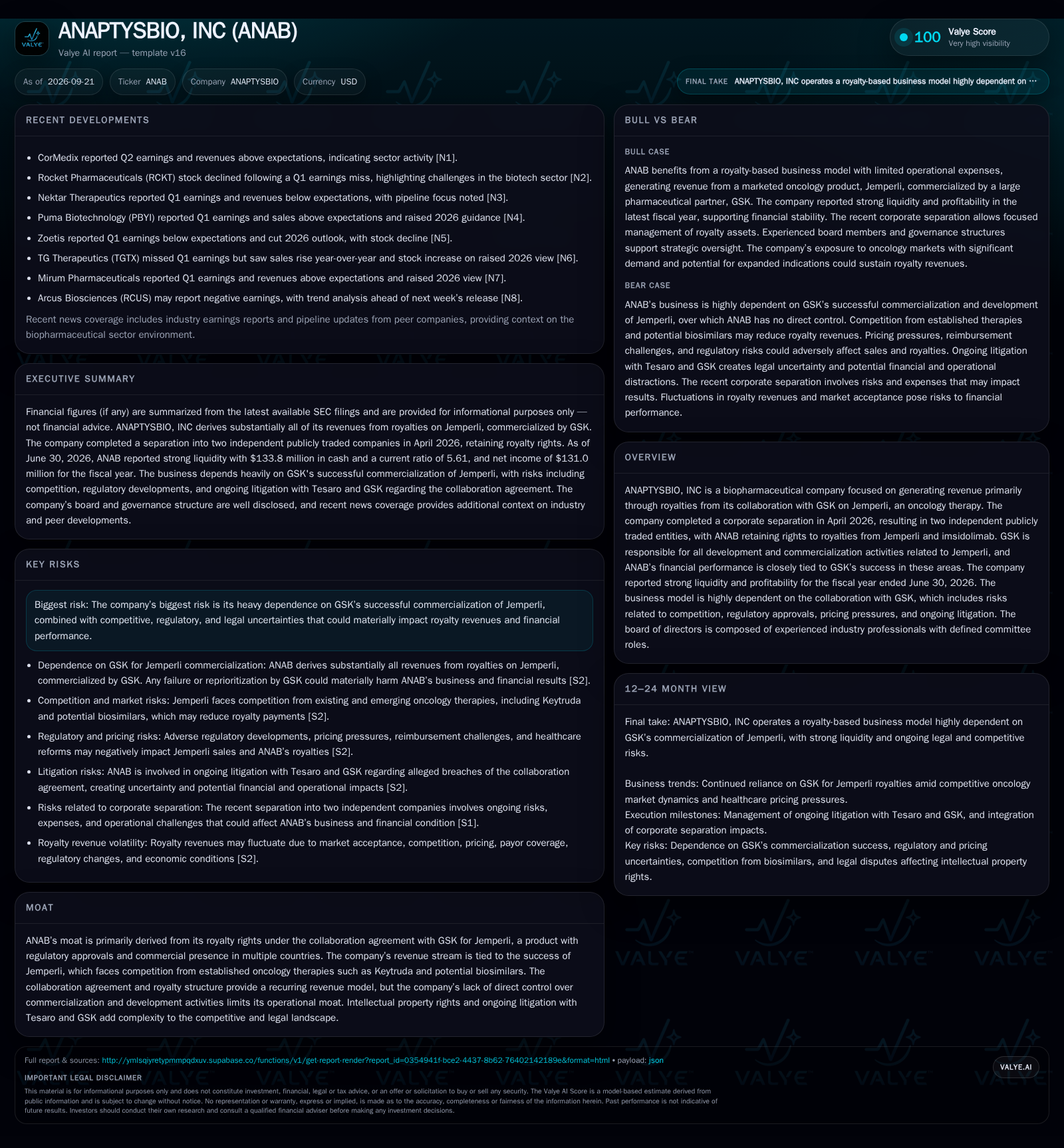
ANAPTYSBIO, INC (ANAB) now operates as a royalty-focused biopharma after its 2026 separation, deriving nearly all revenues from GSK’s commercialization of Jemperli. The company boasts reported liquidity position and profitability, but its fate is tightly bound to Jemperli’s market trajectory and legal clarity around its royalty rights. Any changes in GSK’s execution, market competition, or regulatory environment could swing results sharply.
ANAPTYSBIO, INC’s transformation into a royalty-focused entity following its 2026 corporate separation has created a business with high operating leverage and minimal overhead, but also one with concentrated risk. The company’s financial results are now almost entirely dictated by GSK’s commercial performance with Jemperli, an oncology drug facing stiff competition and evolving regulatory pressures. While ANAB’s liquidity and recent profitability are strong, its lack of control over its revenue engine and the shadow of ongoing litigation mean that small shifts in external factors could have outsized effects on future outcomes.
Royalty Reliance and the Stakes of Recent Restructuring
The most material current fact is ANAPTYSBIO’s completion of its corporate separation in April 2026, which left it as a pure royalty entity retaining rights to Jemperli (commercialized by GSK) and imsidolimab (licensed to Vanda) [S1]. This event fundamentally redefined the company’s business model, stripping away internal R&D and pipeline risk but leaving it exposed to the performance of external partners.
As of June 30, 2026, ANAB reported $133.8 million in cash, a current ratio of 5.61, and net income of $131.0 million for the fiscal year, signaling a business with low capital intensity and strong recent profitability [S2].
However, ANAB is now embroiled in litigation with Tesaro and GSK regarding the Jemperli collaboration, introducing a significant legal risk to its primary royalty stream [S2].
The company’s revenues are almost entirely sourced from royalties on Jemperli, meaning that any market, regulatory, or legal disruption to this product will directly and materially impact ANAB’s financials [S2].
How ANAPTYSBIO’s Revenue Model Amplifies Both Upside and Downside
ANAPTYSBIO’s business is now highly streamlined: its top line is almost exclusively royalty income, primarily from GSK’s sales of Jemperli. The company’s cost structure is correspondingly minimal, with little to no R&D or commercial expense, allowing for substantial operating leverage—almost every additional dollar of royalty revenue drops to the bottom line.
The economics of the model depend on the terms of the collaboration agreement with GSK, which typically involve a percentage royalty (often in the mid-single to low-double digits in comparable industry deals) on net sales. This means ANAB’s revenue is subject to both the magnitude of Jemperli’s global sales and any adjustments for rebates, discounts, or market access hurdles.
The company reported cash and liquidity metrics for the period; these figures do not by themselves establish operating runway, investment capacity, financial flexibility, or financing capacity. [S2] However, this model is inherently vulnerable to concentrated risk: a single product, controlled by a single partner, in a competitive and regulated market.
If Jemperli expands into new indications or geographies—or achieves stronger-than-expected market penetration—ANAB could see significant incremental income with little incremental expense. Conversely, any decline in Jemperli’s fortunes would have an outsized negative impact.
Competitive Realities: Oncology Market Dynamics and the Limits of Royalties
ANAB’s competitive position is unusual: it is not an operator in the oncology market, but a passive beneficiary of GSK’s efforts. Its moat is derived from the contractual royalty rights and, to a lesser extent, any related intellectual property underpinning Jemperli.
Jemperli faces entrenched competition from established checkpoint inhibitors such as Keytruda and Opdivo, which have broader approved indications, deeper commercial resources, and first-mover advantages. New entrants—including potential biosimilars—could further erode market share or compress pricing, both of which would reduce ANAB’s royalty stream.
Because ANAB has no direct control over pricing, market access, or commercialization strategy, it cannot influence outcomes in its favor if GSK’s priorities shift or if competitive threats intensify. This makes the company structurally less resilient to competitive shocks than a fully integrated pharma.
The ongoing litigation with GSK and Tesaro adds to the uncertainty, as any adverse ruling could reduce or jeopardize royalty flows.
What Could Unlock Surprise Upside: Indication Expansion and Royalty Security
A favorable scenario for ANAPTYSBIO would see GSK successfully expanding Jemperli’s label into new oncology indications with large addressable populations, such as earlier-line treatments or tumor types where checkpoint inhibitors are gaining traction. Each new approval could drive a step-change in underlying sales, magnified by ANAB’s high-margin royalty model.
Another upside lever would be the resolution of litigation on terms favorable to ANAB, removing legal overhang and potentially clarifying or even enhancing royalty entitlements.
Upside evidence would include announcements of positive pivotal trial results for Jemperli in new indications, regulatory approvals in major markets, or settlements that confirm and secure ANAB’s royalty rights. Sustained or accelerating growth in reported royalty revenue would also validate this scenario.
A falsifier would be evidence that GSK is de-prioritizing Jemperli, facing regulatory setbacks, or that litigation limits ANAB’s royalty participation.
Steady-State Royalty Flow with Ongoing Legal and Market Friction
The most plausible near-term scenario is a continuation of current dynamics: ANAB receives royalties as Jemperli maintains its existing market segment, with potential for modest growth or contraction depending on competitive intensity, pricing pressure, and payor dynamics.
The ongoing litigation creates an overhang but does not immediately disrupt cash flows if royalties are still being paid pending resolution.
This scenario would be confirmed by stable quarterly royalty receipts, no major litigation developments, and Jemperli retaining its share in approved indications. Evidence against it would include sudden drops in royalty revenue, headline clinical failures, or regulatory changes that sharply impact pricing or reimbursement.
Concentration Risk Realized: What Could Go Wrong for ANAPTYSBIO
A negative turn could occur if Jemperli loses market share to competitors such as Keytruda, faces biosimilar entry sooner than expected, or encounters adverse regulatory or reimbursement decisions that materially reduce sales. Because ANAB’s income is almost entirely derived from this single asset, any such shock would have immediate and severe consequences for profitability and cash flow.
An adverse outcome in the ongoing litigation with GSK and Tesaro could result in a reduction or loss of royalty rights, potentially leading to a collapse in the company’s revenue stream.
Downside evidence would include a sharp decline in quarterly royalty income, legal rulings unfavorable to ANAB, or public indications that GSK is shifting resources away from Jemperli. Any evidence of market-wide pricing compression in oncology would also raise red flags.
Milestones and External Triggers That Will Shape ANAPTYSBIO’s Future
Quarterly royalty revenue from GSK’s Jemperli sales: sustained growth or unexpected volatility would be a leading indicator of future financial health.
Public disclosures or court decisions regarding the ongoing litigation with GSK and Tesaro: outcomes could materially alter the royalty stream.
Announcements of new regulatory approvals or expanded indications for Jemperli: positive news could drive incremental royalty income.
Competitive developments in the PD-1/PD-L1 oncology space, especially new entrants or biosimilar launches: could pressure pricing or market share.
Signals from GSK about prioritization of Jemperli in its oncology portfolio: deprioritization would be a major negative for ANAB.
Changes in healthcare reimbursement or pricing regulations affecting oncology therapies: could impact net sales and thus royalty income.
Evidence of any diversification in ANAB’s royalty base or new asset acquisitions: would reduce single-product risk but is not currently established.
Disclaimer: This is research-only, informational analysis and not investment advice. It may include AI-generated interpretation and general industry context. Always verify important details using primary sources.

Comments