
Mercalot Inc.: Marketplace Ambitions Collide with Acute Liquidity and Execution Hurdles
With minimal operational disclosure and no evidence of scalable network effects, the company’s ability to transition from concept to durable business remains deeply uncertain.
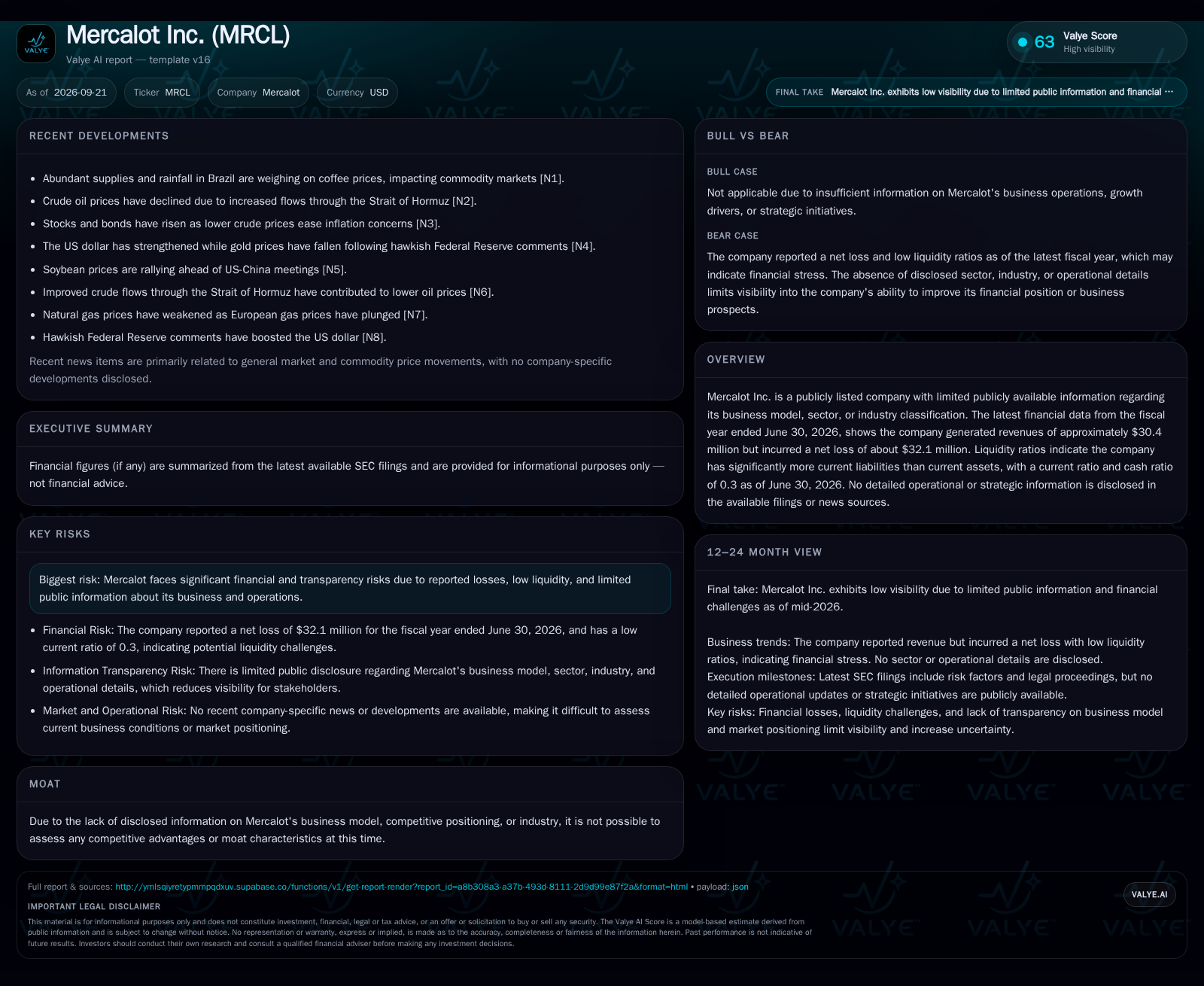
Mercalot Inc. operates an early-stage e-commerce and classifieds platform centered on its SafeDeal Connect app, targeting the Spanish market with aspirations for broader European expansion. For the year ended June 30, 2026, the company reported $30,420 in revenue and a net loss of $32,072, with a cash balance of $30,061 against current liabilities of $100,961, resulting in a current and cash ratio of just 0.3. With no employees and only its officers as active personnel, Mercalot faces acute liquidity pressure and substantial doubt about its ability to continue as a going concern. The lack of operational milestones, customer data, and commercial clarity limits visibility on whether Mercalot can achieve scale or sustainable economics in a competitive sector dominated by entrenched players. [S1] [S2]
Mercalot Inc. targets the digital marketplace sector with its SafeDeal Connect platform, aiming to connect buyers and service providers in Spain and, eventually, across Europe. With no disclosed operational milestones and no evidence of scalable user engagement, Mercalot’s thesis hinges on its ability to secure additional funding and prove out a business model in a crowded, winner-take-most industry.
Mercalot’s Financial Fragility and Strategic Opacity Define the Near-Term Risk Profile
The most material current facts shaping Mercalot’s outlook are its acute liquidity shortfall and lack of operational scale. For the year ended June 30, 2026, Mercalot reported $30,420 in revenue and a net loss of $32,072, with cash and cash equivalents standing at $30,061 versus current liabilities of $100,961. [S1]
Compounding the financial stress is the company’s admission of substantial doubt about its ability to continue as a going concern, as disclosed in its March 2026 10-Q. [S2] The company has no employees beyond its two officers, and there are no disclosed operational milestones, customer traction metrics, or detailed strategic initiatives in the public record. The only tangible asset described is the SafeDeal Connect mobile app, which is positioned as a secure online marketplace for services and goods, initially in Spain.
These realities mean that the company’s survival and any future strategic execution are wholly dependent on its ability to raise additional capital and demonstrate commercial traction.
Marketplace Economics: Early-Stage Realities and the Long Road to Scale
Mercalot’s business model as an online marketplace would, in theory, rely on generating revenue through transaction fees, listing fees, premium services, or advertising. However, the current financials indicate that any such monetization is nascent at best: $30,420 in annual revenue against a loss of $32,072 suggests negligible operating leverage and insufficient scale to absorb fixed costs. [S1]
Marketplaces typically require significant upfront investment—in product development, marketing, and trust-building—to achieve the critical mass necessary for network effects and high-margin scalability. The fact that Mercalot has no employees and is run solely by its officers highlights its extremely low-cost structure, but also limits its capacity to build out product features, customer support, and commercial partnerships.
The company’s stated intention to expand beyond Spain into other European markets would require substantial incremental investment in localization, compliance, marketing, and infrastructure. Without evidence of user growth, retention, or transaction volume, it is unclear whether Mercalot’s revenue is recurring, one-off, or even sustainable in its current market. The absence of disclosed customer acquisition costs, take rate, or gross margin data prevents any robust analysis of unit economics.
In the absence of meaningful operating leverage or a clear path to scale, the business remains highly vulnerable to fixed costs, even if those are currently minimal. The need for ongoing capital infusions is acute, as evidenced by the explicit going concern warning. [S2]
Competitive Landscape: Barriers to Entry and the Challenge of Differentiation
Mercalot enters an intensely competitive sector dominated by established horizontal marketplaces (such as Wallapop, Milanuncios, or OLX in Spain) and global platforms (such as eBay, Facebook Marketplace, and specialized verticals like TaskRabbit or Fiverr for services). These incumbents benefit from entrenched network effects, brand recognition, and robust trust/safety features.
Mercalot’s SafeDeal Connect app is positioned around security and convenience, but there is no evidence of proprietary technology, unique user acquisition strategy, or differentiated service offering beyond standard marketplace features. The platform’s initial focus on the Spanish market is rational, but without critical mass, it risks being a ‘cold start’ marketplace—a classic trap where neither buyers nor sellers have enough incentive to join absent existing activity.
Switching costs for users are typically low in the classifieds and services marketplace segment, as both buyers and sellers can multi-home across platforms. For Mercalot to gain traction, it would need to offer a superior user experience, lower fees, or highly localized trust mechanisms. There is no evidence yet that SafeDeal Connect has achieved any of these advantages.
The absence of disclosed user growth, engagement, or retention metrics further clouds any assessment of competitive positioning. Until Mercalot can demonstrate clear product-market fit or network effects, it remains highly exposed to the entrenched advantages of better-capitalized and more established competitors.
What Could Unlock Value: Proving Product-Market Fit and Attracting Strategic Capital
A favorable trajectory for Mercalot would require both qualitative and quantitative breakthroughs. The most plausible upside chain would begin with clear evidence of accelerating user adoption and engagement in its initial Spanish market—such as sustained growth in active buyers and sellers, transaction volume, and repeat usage.
If Mercalot’s SafeDeal Connect app can establish a credible reputation for safety, reliability, and convenience—potentially supported by positive user reviews or third-party endorsements—it may begin to attract network effects. This, in turn, would support higher take rates or new monetization avenues (e.g., premium listings, escrow services, or insurance partnerships).
Securing a strategic investor or partnership—especially with a local classifieds player, fintech, or logistics partner—could provide both the capital and operational know-how to scale. Confirmation of this scenario would require disclosed user metrics (active users, transaction growth), evidence of repeat business, and a successful capital raise or strategic alliance.
Falsification would be evident if user growth stagnates, monetization fails to materialize, or the company is unable to raise additional funding on acceptable terms.
Absent Traction or Funding, Mercalot Remains in a Holding Pattern
The most likely scenario, given current evidence, is that Mercalot continues to operate at minimal scale, with ongoing losses and limited commercial progress. With no employees, a skeletal cash balance, and no disclosed user or transaction growth, the company is likely to remain dependent on small-scale capital infusions or bridge financing to meet operating expenses.
Without clear product-market fit or demonstrated user traction, efforts to expand beyond the Spanish market may be delayed or deprioritized. The company could attempt cost containment or seek partnerships, but without a compelling value proposition, attracting either users or investors will be difficult.
Confirmation of this scenario would include continued low revenue, persistent losses, lack of operational disclosures, and repeated references to going concern risks. Falsification would require a material increase in revenue, user metrics, or the announcement of a significant investment or partnership.
Liquidity Exhaustion and the Risk of Operational Cessation
The clear adverse scenario is that Mercalot’s acute liquidity constraints result in an inability to meet near-term obligations, forcing the company to halt operations, seek a distressed sale, or pursue insolvency proceedings. [S1]
If Mercalot is unable to raise additional capital or secure alternative funding, it will likely be forced to scale back further, potentially suspending platform operations and development. The absence of employees already suggests an ultra-lean model, but at some point, basic regulatory, legal, and IT expenses cannot be deferred.
This scenario would be confirmed by additional going concern warnings, missed regulatory filings, or explicit disclosure of default, insolvency, or asset sales. Falsification would require evidence of a successful capital raise or a strategic pivot to a less capital-intensive model.
Milestones That Would Test Mercalot’s Marketplace Thesis
Disclosure of active user metrics (monthly active users, new sign-ups, or listings) would help gauge whether Mercalot is gaining traction in its target markets.
Evidence of meaningful transaction volume or repeat usage would indicate emerging network effects and product-market fit.
Announcement of a significant capital raise, strategic partnership, or investment would signal improved financial runway and external validation.
Any material increase in revenue, or a shift toward positive gross margins, would suggest progress toward sustainable economics.
If disclosed, customer acquisition cost (CAC) and user retention/churn metrics would clarify whether Mercalot’s growth can be profitably scaled.
Updates on geographic or vertical expansion—such as new market entries or partnerships with local service providers—would test the scalability narrative.
Disclosure of platform enhancements or unique features aimed at user trust and safety would help differentiate Mercalot in a crowded marketplace.
Any regulatory, legal, or compliance developments impacting platform operations or user trust would be highly relevant, given the company’s cross-border ambitions.
Disclaimer: This is research-only, informational analysis and not investment advice. It may include AI-generated interpretation and general industry context. Always verify important details using primary sources.

Comments