
NAPC Defense: Revenue Generation and Profitability Mask Acute Liquidity Strains and Strategic Ambiguity
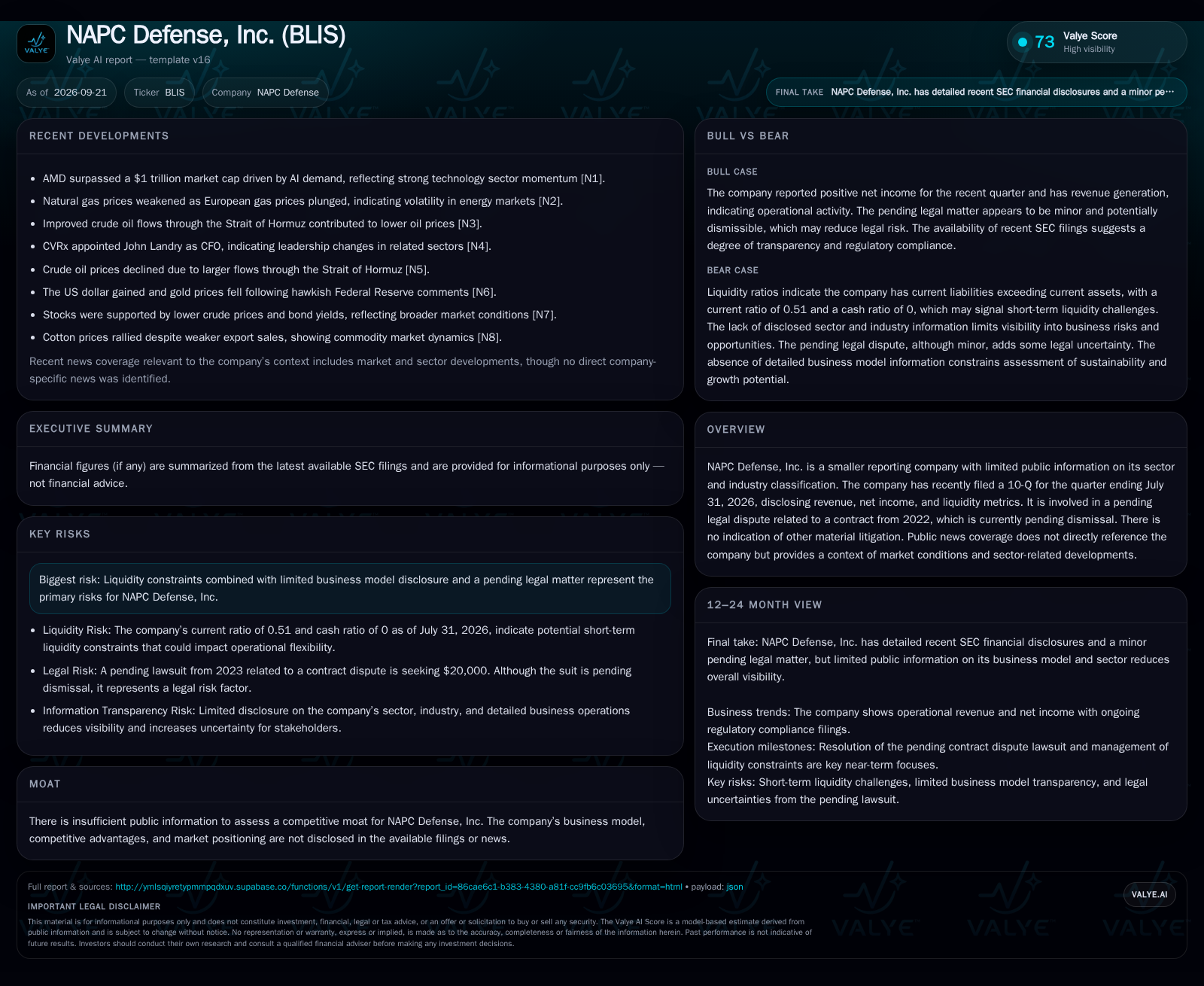
NAPC Defense, Inc. posted positive net income and revenue in its latest quarter, but a stark short-term liquidity shortfall and the absence of disclosed business model details leave the company's sustainability and growth prospects in question.
The company’s lack of sector or industry disclosure, combined with a pending minor legal dispute, raises uncertainty about its operational durability and strategic direction. Key watchpoints include resolution of the legal matter, improvement in liquidity, and greater transparency on business operations and market positioning. [S1]
NAPC Defense, Inc. presents a paradoxical profile: the company reported positive net income and meaningful revenue in its latest quarter, yet its financial disclosures reveal a severe liquidity crunch and offer little transparency into its business model, sector, or competitive landscape. This creates a situation where profitability alone cannot assure sustainability, especially given the acute short-term funding gap and an unresolved, though minor, legal dispute. For stakeholders, the central question is whether NAPC Defense can stabilize its balance sheet and clarify its strategic direction before operational constraints or external shocks undermine its current momentum.
Recent Financial Results Reveal Profitability Amidst Liquidity Stress
In the quarter ending July 31, 2026, NAPC Defense, Inc. reported revenue of $5,288,000 and net income of $775,538, indicating active operations and the ability to generate profit. However, the company’s financial position is sharply constrained: current assets stand at $838,297 against current liabilities of $1,643,249, producing a current ratio of 0.51 and a cash ratio of 0. The company reported cash and liquidity metrics for the period; these figures do not by themselves establish operating runway, investment capacity, financial flexibility, or financing capacity. Additionally, a pending lawsuit from 2023 related to a contract dispute over a 2022 Regulation A offering remains unresolved but is pending dismissal—a minor legal overhang relative to the acute funding gap. No other material litigation is disclosed. [S1]
How NAPC Defense Might Generate Cash Flow: Unpacking Unknowns and Potential Levers
While the company’s topline and net income figures suggest a functioning operational model, the absence of disclosed sector, industry, or product details makes it impossible to determine the underlying revenue mechanics. If NAPC operates in the defense contracting space, typical revenue streams could include government contracts, long-term supply agreements, or project-based work—each with distinct implications for cash flow stability and margin profile.
The reported net income implies at least some degree of cost discipline or high-margin business, but the lack of liquidity hints at either a mismatch between revenue recognition and cash collection, or a business model with significant working capital requirements. For example, if contracts are milestone-based or reimbursement is delayed, the company may be profitable on paper but chronically short of cash. The sharp current-liability overhang suggests either vendor payment delays, short-term borrowing, or accrued expenses.
Further complicating cash flow analysis is the potential impact of contract terms common in defense or government-related sectors, such as progress billing, retainage, or performance-based payments. If NAPC Defense operates under such arrangements, revenue recognition timing may significantly diverge from cash inflows, exacerbating liquidity pressures despite reported profitability. Additionally, the company’s working capital cycle could be influenced by inventory management or subcontractor payments, which if extended, might create a cash conversion lag. Understanding whether the company employs factoring, supply chain financing, or other liquidity-enhancing mechanisms would help clarify the sustainability of cash flow under current operational conditions.
Opaque Market Positioning Raises Questions About Competitive Durability
With no disclosed industry or product line, NAPC Defense’s competitive environment is impossible to specify. If the company is indeed in defense or government services, it would typically face competition from established contractors, specialized technology providers, and potentially new entrants leveraging automation or digital solutions. The size and reporting status suggest NAPC is a niche or lower-tier player, likely reliant on a small number of contracts or clients.
Without information on customer concentration, contract duration, or proprietary capabilities, it is unclear whether NAPC enjoys any switching-cost advantages, recurring revenue streams, or differentiation. The lack of public-facing disclosure may signal either a nascent business model, a highly confidential customer base (as sometimes seen in defense), or simply underdeveloped investor relations. In any case, the absence of visible moat characteristics leaves the company potentially vulnerable to competitive displacement or project losses.
The absence of disclosed customer or contract concentration metrics raises concerns about revenue volatility and bargaining power. If NAPC Defense relies heavily on a limited number of clients or contracts, any loss or delay in renewals could materially impair cash flow and profitability. Conversely, a diversified client base or multi-year contract commitments would provide stability and predictability. Furthermore, without insight into intellectual property or proprietary technology, it is difficult to assess barriers to entry or the company’s ability to maintain competitive advantages in pricing or contract awards. The opacity also hinders evaluation of potential scale economies or operational leverage that might improve margins over time.
Liquidity Infusion and Strategic Clarity Could Unlock Growth Optionality
A favorable scenario requires NAPC Defense to address its immediate liquidity crunch—either through a capital raise, new credit facilities, or acceleration of receivables. If the company can secure additional working capital, maintain contract flow, and resolve the pending legal matter, it could stabilize operations and build credibility with counterparties.
Upside would be further supported by public disclosure of sector, customer, and product details, which could reveal a more stable or defensible business model than currently apparent. Evidence for this scenario would include a subsequent SEC filing reporting increased cash or current assets, a resolved or dismissed lawsuit, and new disclosures clarifying the company’s market focus and revenue mechanics. Progress on these fronts would also improve the company’s ability to attract new contracts or investment, especially if operating leverage is present and scalable.
Survival Hinges on Tight Cash Management and Incremental Transparency
The most plausible trajectory is one in which NAPC Defense continues to operate at or near break-even, managing cash outflows tightly while seeking incremental improvement in working capital. The pending legal matter is likely to be dismissed without material impact, but the underlying liquidity gap could persist unless revenue is converted to cash more quickly or new funding is secured.
In this scenario, the company’s lack of transparency remains a drag on stakeholder confidence, limiting access to capital and potentially constraining business development. Confirmation would come from continued revenue generation and positive net income, but with little improvement in liquidity or business disclosure. Falsification would occur if the company fails to meet its short-term obligations or is forced into restructuring.
In this scenario, the company’s ability to manage payables and receivables becomes critical. Tightening credit terms with customers or negotiating extended payment terms with suppliers could alleviate immediate cash constraints but may strain business relationships or limit growth opportunities. Incremental transparency, such as partial disclosure of product lines or contract types, could gradually improve investor and creditor confidence, enabling modest capital infusions or improved credit terms. However, without meaningful liquidity improvement, the company risks a cycle of operational underinvestment, which could erode future revenue potential even if profitability remains positive on paper.
Acute Liquidity Pressure Triggers Operational Disruption or Creditor Action
If NAPC Defense cannot address its liquidity shortfall, the risk is that vendors, employees, or creditors seek payment remedies, leading to operational disruption or legal escalation.
A negative scenario could see the company default on obligations, lose critical contracts or customer relationships, or become subject to additional litigation. Evidence would include missed payments, new legal proceedings, or an SEC filing disclosing going-concern risk or insolvency. In this environment, even a minor unresolved legal dispute could become material if counterparties lose confidence in the company’s ability to perform.
Operational Viability Hinges on These Concrete Developments
Resolution or dismissal of the Delmar lawsuit and any subsequent material litigation developments.
A quarterly increase in reported cash or current assets, indicating improved liquidity.
Disclosure of sector, industry, or customer concentration in future filings or investor materials, which would clarify business model durability.
Evidence of new contract wins, backlog growth, or recurring revenue streams, if disclosed.
Changes in current liabilities or evidence of refinancing, short-term borrowing, or vendor payment renegotiation.
Any SEC disclosure of going-concern warnings or covenant breaches.
Management or board commentary (if disclosed) on strategic priorities, liquidity management, or capital-raising plans.
A useful metric would be cash conversion cycle or days sales outstanding, to assess working capital efficiency if later disclosed.
Disclaimer: This is research-only, informational analysis and not investment advice. It may include AI-generated interpretation and general industry context. Always verify important details using primary sources.

Comments