
Kindcard, Inc.: Alternative Payments Ambition Meets Acute Liquidity and Competitive Pressures
Kindcard’s upgraded platforms and strategic partnerships position it to serve underbanked merchants with closed-loop payment and gift card solutions.
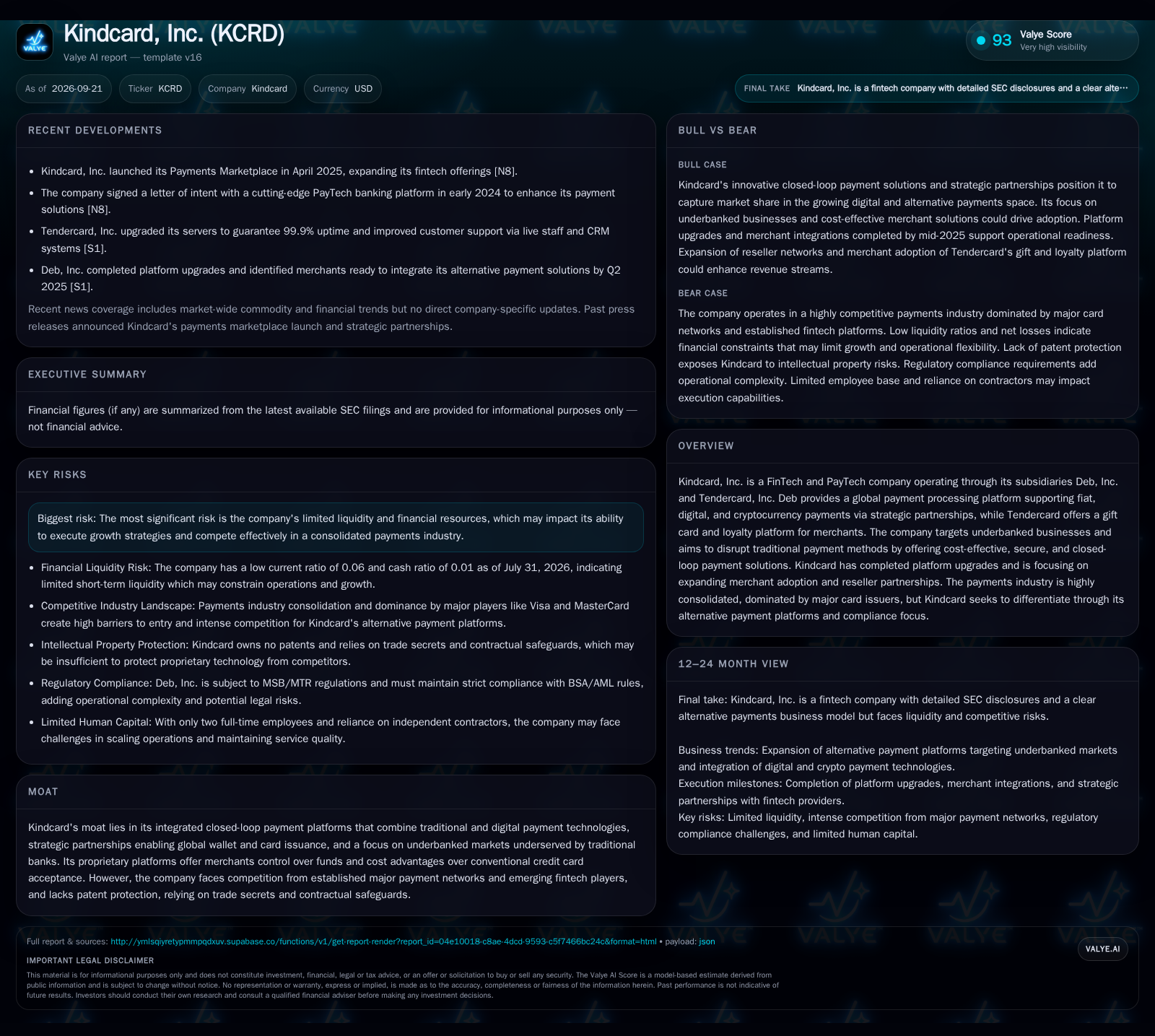
Kindcard, Inc. targets underbanked businesses with alternative payment and gift card platforms, leveraging recent technology upgrades and global partnerships. Despite operational readiness, the company faces intense competition from major card networks and acute short-term liquidity pressures, with a current ratio of just 0.06 as of July 2026. Its ability to scale, attract merchants, and sustain operations hinges on improving potential financial flexibility and demonstrating distinctive value to both merchants and consumers. [S1] [S2]
Kindcard, Inc. is positioning itself as a nimble disruptor in the global payments space, targeting underbanked merchants with its upgraded Deb and Tendercard platforms. By enabling digital, crypto, and alternative closed-loop payments, Kindcard aims to undercut the fees and risks associated with traditional card networks. Its future hinges on converting recent technology investments into rapid merchant adoption and finding sources of capital to sustain its ambitions. [S1] [S2]
Acute Liquidity Risk and Platform Readiness Define Kindcard’s Current State
As of July 31, 2026, Kindcard reported revenue of $72,758 with a net loss of $54,183, cash and equivalents of only $13,028, and current liabilities of $1,118,818. [S2] On the operational side, both Deb, Inc. and Tendercard, Inc. completed significant platform upgrades by Q2 2025, establishing technical readiness and identifying merchants for integration. [S1] These facts set up a tension between operational ambition and financial fragility: while the company’s infrastructure is ready for growth, its ability to fund that growth and survive near-term shocks is severely constrained.
The juxtaposition of platform readiness with acute liquidity constraints highlights a critical inflection point for Kindcard. Operational capability alone does not guarantee market traction; the company must also navigate the timing and sequencing of capital deployment to support merchant acquisition, marketing, and compliance activities. If liquidity remains constrained, the firm risks underutilizing its upgraded platforms, leading to delayed or stalled merchant integrations. Conversely, a strategic infusion of capital could enable accelerated onboarding, creating momentum that leverages the platform investments effectively. This dynamic underscores the importance of aligning financial resources with operational milestones to avoid a mismatch that could impair growth prospects.
How Kindcard’s Model Could Drive Revenue—And Where the Economic Pressure Points Lie
Kindcard’s revenue model is anchored in transaction processing fees, merchant service charges, and potentially value-added services for both its Deb and Tendercard platforms. Deb, Inc. aims to monetize payment flows by enabling fiat, digital, and crypto payments through strategic partnerships with Blox and Viacarte. The company’s value proposition for merchants centers on lower processing costs, enhanced security, and real-time reporting compared to traditional card networks, particularly appealing to underbanked and high-fee-sensitive businesses. Tendercard, Inc. generates revenue by providing merchants with proprietary gift card and loyalty point systems, charging for platform access, settlement, and potential customization.
However, the economics are highly sensitive to volume: fixed costs for compliance, technology, and support must be covered by scaling transaction throughput. With only two full-time employees and a reliance on contractors, Kindcard keeps fixed payroll low but may face bottlenecks in business development and support. The acute liquidity shortfall means any delay in merchant onboarding or volume ramp-up could quickly become existential. Positive operating leverage is possible if merchant adoption accelerates, but negative leverage is equally plausible if scale is not achieved rapidly.
The sensitivity of Kindcard's economics to transaction volume implies a narrow margin for error in scaling efforts. Fixed costs related to regulatory compliance and technology infrastructure create a high operating leverage environment, where incremental revenue gains can disproportionately improve profitability once a critical mass is reached. However, this also means that initial periods of low volume could exacerbate losses and strain cash flow. In this context, the company's ability to rapidly build a diversified merchant base with consistent transaction activity is paramount. Additionally, the reliance on contractors, while cost-effective, may limit scalability in customer support and business development, potentially slowing merchant onboarding and retention efforts.
Competing Against Giants: Kindcard’s Strategic Position in a Consolidated Payments Landscape
Kindcard operates in a payments industry dominated by entrenched players like Visa, MasterCard, Discover, and American Express, all of whom benefit from global network effects, brand trust, and deep integration with consumer and merchant systems. The sector has seen further consolidation, reducing options for merchants and raising the competitive bar for new entrants. Kindcard’s approach—offering closed-loop, digital, and crypto-enabled alternatives—targets a niche underserved by these giants: underbanked merchants and those seeking to avoid high interchange fees and fraud risk.
The company’s competitive positioning relies on its nationwide closed-loop platform, partnerships for global wallet and Visa card issuance, and a focus on compliance and security. However, it lacks patent protection, relying instead on trade secrets and contracts, which may be insufficient in a space where technical differentiation can be quickly replicated. Competing fintechs and neobanks with stronger balance sheets, better-known brands, or established merchant ecosystems could limit Kindcard’s addressable market or compress margins.
Merchant Adoption and Ecosystem Effects Could Unlock Nonlinear Growth
A favorable outcome for Kindcard would see rapid adoption of the Deb and Tendercard platforms among targeted underbanked and fee-sensitive merchants, supported by the completed platform upgrades and integrations with Blox and Viacarte. If Kindcard’s solutions demonstrably reduce merchant costs, improve security, and offer seamless digital/crypto acceptance, word-of-mouth and reseller channels could accelerate network effects, increasing transaction volume and platform stickiness. The 2026 holiday season represents a plausible inflection point for Tendercard’s merchant adoption push.
Confirmation of this scenario would include a significant uptick in merchant onboarding, rising transaction volumes, and recurring platform revenue. Strategic reseller or partnership announcements, as well as evidence of positive operating leverage (costs growing slower than revenue), would further validate the upside case. Falsification would occur if merchant adoption stalls, volume remains low, or if Kindcard fails to secure additional capital to support growth.
Operational Progress Outpaced by Funding Constraints: The Most Likely Trajectory
Given the company’s current liquidity metrics and the competitive intensity of the payments sector, the most plausible path is one where technical and operational readiness is achieved, but financial limitations slow the pace of merchant onboarding and revenue growth. Kindcard may secure some niche wins among underbanked merchants, but scaling the model to a level that covers fixed costs and enables reinvestment will likely require external funding or strategic partnerships.
Evidence supporting this scenario would include limited but steady merchant growth, continued net losses, and potential efforts to raise capital or restructure obligations. Falsification would occur if the company either rapidly accelerates adoption (moving toward the upside case) or exhausts liquidity before reaching sustainable scale (tipping into the downside case).
Liquidity Crunch or Competitive Displacement Could Force Retrenchment
In a hyper-competitive market, larger payment incumbents or better-funded fintechs could also copy or outcompete Kindcard’s offerings before it achieves defensible scale.
This scenario would be confirmed by further erosion of liquidity, rising payables, missed integration milestones, or loss of key merchant relationships. Falsification would require a decisive improvement in the company’s funding position or a meaningful, sustained increase in revenue and merchant engagement.
Milestones and Metrics That Will Define Kindcard’s Ability to Scale and Survive
Quarterly merchant onboarding rates for both Deb and Tendercard platforms—if disclosed—would indicate traction and market acceptance.
Transaction volume growth and revenue per merchant, as these would reveal if platform usage is scaling beyond initial adoption.
Updates on additional capital raises, debt restructuring, or strategic investments that could shore up liquidity.
Retention and churn rates among merchants, which would provide insight into platform stickiness and competitive differentiation.
Evidence of new or expanded partnerships, especially with resellers or ecosystem players, to broaden distribution and reduce customer acquisition cost.
Compliance milestones or regulatory updates for Deb, Inc., as lapses could trigger legal or reputational setbacks.
Any disclosure of adverse legal, regulatory, or operational events that could further constrain potential financial flexibility.
Expansion of the employee or contractor base, as a sign that Kindcard is investing in scaling operations and support infrastructure.
Disclaimer: This is research-only, informational analysis and not investment advice. It may include AI-generated interpretation and general industry context. Always verify important details using primary sources.

Comments