
Marwynn Holdings: Early-Stage Diversification Meets Sector Complexity and Margin Pressure
Marwynn Holdings is building a diversified platform spanning e-waste recycling, nascent AI infrastructure, and food supply chain management. Its recent operational moves—expansion in battery recycling, a new AI subsidiary, and a sourcing realignment in food—signal ambition but also expose the company to high competition, capital intensity, and persistent cost challenges.
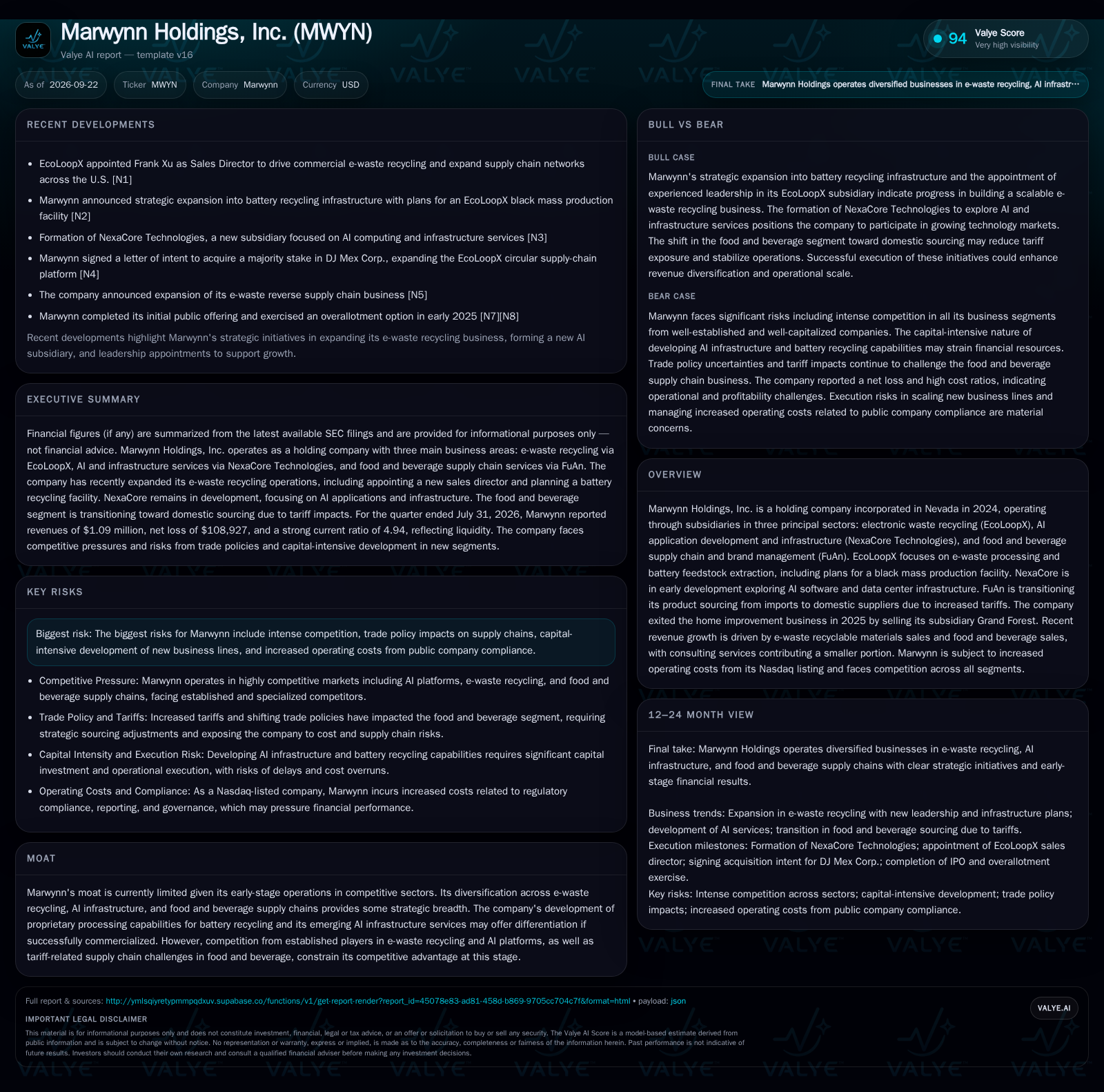
Marwynn Holdings’ recent quarter saw over $1 million in revenue driven by e-waste material and food segment sales, but profitability remains elusive due to high cost ratios and operating losses. The company’s strategic initiatives—expanding e-waste capabilities, launching an AI infrastructure subsidiary, and shifting food sourcing—could diversify and scale revenue if executed effectively. However, Marwynn faces intense competition, capital demands for new ventures, and ongoing cost pressure, particularly as it absorbs the expenses of public company status. Execution on commercial milestones in battery recycling and AI will be critical to validate the long-term thesis. [S2] [N1] [N2] [N3] [N4]
Marwynn Holdings, Inc. is positioning itself as a diversified holding company spanning three challenging but potentially synergistic sectors: electronic waste recycling, AI infrastructure and software, and food supply chain management. With over half of its current revenues now coming from e-waste materials and a strategic push into battery recycling, Marwynn is attempting to build scale in markets where operational efficiency and capital investment are critical. The company’s move to create an AI-focused subsidiary and its pivot in the food segment to domestic sourcing signal a willingness to adapt and expand, but persistent operating losses and high direct costs reveal the difficulty of executing this multi-pronged strategy in the face of established competition and sector-specific risks. [S2] [N1] [N2] [N3]
Recent Moves: Expansion in E-Waste and New Ventures Shape the Operating Landscape
For the quarter ended July 31, 2026, Marwynn Holdings reported $1,090,445 in total revenues, with 52% from recyclable e-waste sales and 41% from food and beverage, but incurred a net loss of $108,927 due to high direct cost ratios, especially in e-waste (95%) and food (67%). [S2]
EcoLoopX, Marwynn's e-waste subsidiary, is expanding its platform with a planned black mass production facility for battery recycling and has appointed a dedicated sales director to diversify sourcing and develop B2B disposal partnerships. [N1] [N2]
The company launched NexaCore Technologies to develop AI applications and infrastructure but remains in the early, pre-commercial stage. [N3]
FuAn Enterprise continues to transition its food and beverage business to domestic sourcing in response to tariffs and trade policy shifts. [S2]
Economics of Diversification: Fixed Costs, Margin Squeeze, and Capital Demands
Marwynn’s revenue base is split primarily between e-waste recycling and food supply chain management, with negligible contribution from consulting and no reported commercial revenue from its AI/infrastructure arm. The e-waste segment’s cost of revenue at 95% suggests razor-thin or negative gross margins, likely reflecting competitive commodity pricing, high logistics or processing costs, and a lack of operational scale. Similarly, food and beverage margins are pressured by input costs and the recent need to shift sourcing strategies.
AI infrastructure development (NexaCore) is capital- and talent-intensive, typically requiring significant upfront investment in data centers, cloud platforms, and engineering—costs that may not yield revenue for several quarters or years. If Marwynn pursues IaaS or AI SaaS offerings, recurring revenue could eventually provide margin leverage, but customer acquisition costs and ongoing infrastructure investment will weigh on near-term profitability.
Overall, Marwynn faces a mix of high variable costs in its current segments and looming fixed cost investments in AI and battery recycling. The company reported cash and liquidity metrics for the period; these figures do not by themselves establish operating runway, investment capacity, financial flexibility, or financing capacity. [S2]
The path to sustainable positive cash flow likely depends on achieving scale, improving operational efficiency in recycling, and successfully commercializing higher-margin technology services.
Facing Entrenched Rivals and Low Switching Costs Across Segments
Each of Marwynn’s segments faces intense competition from established, well-capitalized incumbents. In e-waste, legacy waste firms and specialized recyclers often have established supplier relationships, proprietary processing technologies, and regulatory experience—raising barriers to entry and compressing margins for new entrants.
AI infrastructure and application markets are dominated by hyperscale cloud providers and enterprise AI leaders, making it difficult for a new, unproven entrant to win contracts or achieve differentiation unless it targets a defensible niche or develops proprietary solutions.
The food and beverage supply chain is highly fragmented, with low switching costs for buyers and exposure to commodity price fluctuations and regulatory shifts. Marwynn’s pivot to domestic sourcing may mitigate tariff risk, but it does not fundamentally change the competitive structure or margin pressure in this segment.
Absent a clear proprietary advantage—such as unique recycling IP, exclusive supply agreements, or specialized AI capabilities—Marwynn’s ability to capture and defend margin in any segment remains uncertain.
How Commercialization of Battery Recycling and AI Could Transform Scale and Margins
If EcoLoopX successfully executes its expansion into battery recycling, particularly with the launch of black mass production, Marwynn could unlock higher-margin revenue streams from critical battery metals (lithium, cobalt, nickel). The appointment of a dedicated sales director and the DJ Mex Corp. acquisition intent could accelerate B2B sourcing and aggregation, driving volume and improving negotiating leverage with downstream buyers. [N1] [N2] [N4]
Should NexaCore Technologies manage to develop and commercialize AI infrastructure or software offerings that win enterprise contracts, it could create a recurring, higher-margin revenue base and diversify Marwynn’s income streams beyond commodity recycling and food distribution.
Confirming evidence would include: signed multi-year supply agreements for recycled battery materials, first commercial shipments of black mass, material customer wins or contracts in AI infrastructure, and a shift in segment gross margins toward positive territory.
Falsification would be indicated by continued losses, lack of commercial contracts in new segments, and persistent cost ratios near current levels.
Scaling E-Waste and Food Sourcing Amid Persistent Cost and Execution Hurdles
The most plausible scenario is that Marwynn continues to scale e-waste and food operations gradually, with incremental improvements in sourcing efficiency and operational processes. E-waste revenue could grow as the company expands its supplier network and begins limited battery recycling, but gross margins may remain thin unless process automation or higher-value recycling is achieved.
In food and beverage, the domestic sourcing transition may stabilize supply and reduce tariff exposure, but competitive pricing and fragmented distribution will likely keep margins modest.
NexaCore’s contribution will likely remain minimal in the near term, with expenses outpacing any pilot or consulting revenue. Overall profitability will hinge on Marwynn’s ability to contain overhead, avoid major capital overruns, and demonstrate at least modest improvement in segment gross margins.
Evidence for this scenario would include steady but unspectacular revenue growth, continued operating losses, and cost ratios that improve slightly but remain above sector averages. Material margin expansion or commercial AI traction would be absent.
Capital Constraints and Competitive Pressure Undermine New Initiatives
In a negative scenario, Marwynn’s expansion efforts in battery recycling and AI infrastructure could result in large upfront costs without corresponding revenue or commercial traction. Persistent high cost of goods in e-waste and food, combined with increased overhead from Nasdaq listing and compliance, could exacerbate operating losses.
If competitor pricing or technological advances further compress margins in recycling or food, or if regulatory hurdles slow the ramp-up of new recycling facilities, liquidity could become a concern despite current asset strength.
Failure to secure meaningful contracts or supply agreements—especially in battery recycling or AI—would reinforce the company’s inability to scale beyond commodity trading and low-margin distribution.
Confirmation would come from rising losses, declining cash balances, missed commercial milestones in battery recycling or AI, and the need for dilutive capital raises or asset sales.
Milestones That Will Determine Whether Marwynn’s Diversification Delivers Value
Progress toward commercial operation and shipment of black mass or other recycled battery materials from EcoLoopX facilities would help test the viability of higher-margin recycling. [N2]
Disclosure of multi-year supply or offtake agreements for e-waste or battery materials would signal improved revenue visibility and negotiating leverage.
Customer wins, contracts, or pilot deployments for NexaCore Technologies’ AI or infrastructure offerings—if disclosed—would be critical for validating the technology thesis.
Trends in segment gross margins (especially e-waste and food) would reveal whether operational improvements or scale are being achieved.
Net cash flow from operations and changes in working capital requirements would clarify whether current liquidity can support ongoing investment.
Execution of the DJ Mex Corp. acquisition and subsequent integration results would indicate the company’s ability to scale its e-waste supply chain. [N4]
Board or management commentary on capital allocation priorities and funding plans for infrastructure projects would help gauge the risk of future dilution or financial strain.
If disclosed, customer retention rates or repeat business metrics in food supply chain and e-waste segments would provide insight into switching friction and relationship stability.
Disclaimer: This is research-only, informational analysis and not investment advice. It may include AI-generated interpretation and general industry context. Always verify important details using primary sources.

Comments