
Adobe’s Subscription Engine: AI Innovation, Recurring Revenue, and the Stakes of Liquidity Tension
Adobe reported $6.76 billion in revenue and $1.827 billion in net income for Q3 2026, highlighting the strength of its subscription-based software model and ongoing AI innovation.
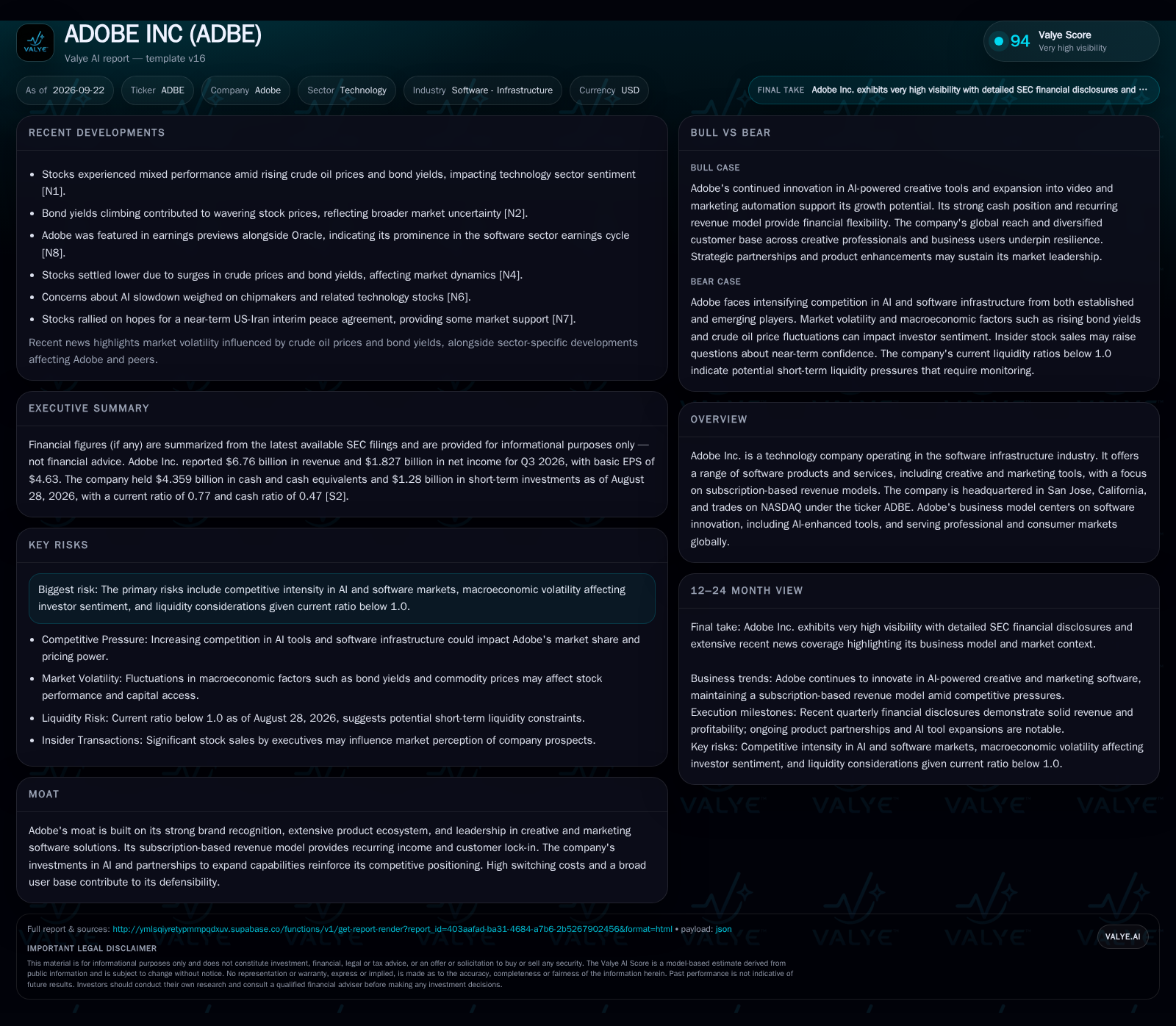
Adobe reported $6.76 billion in revenue and $1.827 billion in net income for Q3 2026, highlighting the strength of its subscription-based software model and ongoing AI innovation. The interplay between recurring revenue, product differentiation, and balance-sheet agility will define Adobe’s trajectory in the next 12-24 months. [S2]
Adobe Inc.’s Q3 2026 results reaffirm its status as a global powerhouse in creative and marketing software, supported by a robust subscription engine and relentless AI-driven product innovation. The next phase for Adobe will hinge on its ability to sustain product differentiation, defend margins, and manage short-term financial agility in a fast-evolving landscape.
Recent Financial Performance and Liquidity Profile Shape Adobe’s Near-Term Agenda
Adobe reported $6.76 billion in revenue and $1.827 billion in net income for the quarter ended August 28, 2026, with basic and diluted EPS of $4.63 and $4.62, respectively [S2]. These results demonstrate the continued strength of Adobe’s core subscription model and its ability to monetize innovation in creative and marketing software.
On the balance sheet, Adobe held $4.359 billion in cash and cash equivalents and $1.28 billion in short-term investments at quarter end, but its current ratio was 0.77 and cash ratio was 0.47 [S2]. This signals that current liabilities exceed current assets, elevating the importance of cash flow timing and possibly constraining flexibility for opportunistic investment or rapid response to external shocks.
Adobe’s inclusion in sector-wide earnings previews alongside Oracle underscores its prominence in the software infrastructure landscape [N8]. However, the company’s liquidity position and competitive context remain central to the near-term narrative.
Subscription Revenue Mechanics and the Leverage of Scale
Adobe’s business model is fundamentally built around recurring subscription revenue, primarily from its Creative Cloud, Document Cloud, and Experience Cloud offerings. This model provides high revenue visibility and reduces cyclicality, with users—ranging from individual creatives to large enterprises—paying monthly or annual fees for access to a suite of integrated tools.
The economics of this model favor high gross margins due to minimal marginal cost for additional users once software is developed and cloud infrastructure is in place. Fixed costs related to R&D and infrastructure are significant but scale efficiently as the customer base grows, creating operating leverage as incremental revenue drops to the bottom line.
AI-driven enhancements and new feature rollouts can justify price increases, reduce churn, and drive upsell opportunities. The company reported profitability for the period. Working capital management becomes critical, as subscription receivables and deferred revenue must be matched against short-term obligations.
The subscription model’s resilience also hinges on customer lifetime value (CLTV) optimization, which becomes increasingly critical as market saturation grows. Adobe must continuously enhance user engagement and reduce churn through personalized AI-driven experiences and seamless integration across its product suite. Economies of scale in cloud infrastructure not only lower incremental costs but also enable rapid deployment of AI features, accelerating innovation cycles. However, sustaining this leverage requires balancing investment in R&D against the risk of diminishing returns, especially as competitive pressures demand faster iteration and more frequent feature updates.
Defending the Creative Ecosystem Amid AI Disruption
Adobe’s competitive advantage historically rests on its brand, product breadth, and the deep integration of its creative and marketing tools. High switching costs—stemming from user familiarity, workflow lock-in, and ecosystem effects—have insulated Adobe from many challengers in the past.
However, the rapid proliferation of AI-powered creative tools from both established technology companies and nimble startups threatens to erode this moat. New entrants can leverage generative AI to offer point solutions that are lower-cost or more user-friendly, potentially appealing to price-sensitive or non-professional users.
Adobe’s ability to maintain its premium pricing and user base will depend on the pace and quality of its own AI innovation, the effectiveness of integrations across its platform, and its capacity to acquire or partner with emerging disruptors. Competitive pressure may also constrain future margin expansion if Adobe is forced to increase investment in product development or adjust pricing to defend share.
Another dimension of Adobe’s competitive challenge lies in the fragmentation of user needs driven by AI democratization. While professional users demand sophisticated, customizable tools, emerging segments may prioritize simplicity and affordability. Adobe’s ability to segment its offerings effectively—potentially through tiered pricing or modular product bundles—will influence its capacity to defend market share across diverse customer profiles. Moreover, the company’s ecosystem strategy, including developer APIs and third-party integrations, will be pivotal in maintaining platform stickiness and creating network effects that could raise switching costs beyond the core product features.
AI-Led Product Differentiation Drives Premium Pricing and Upsell
If Adobe succeeds in embedding cutting-edge AI capabilities across its product suite—delivering tangible productivity gains and creative empowerment for users—it could deepen customer lock-in and justify further price increases. This would reinforce the recurring revenue model, accelerate upsell/cross-sell into adjacent clouds, and expand wallet share among existing customers.
Evidence for this scenario would include sustained or accelerating subscription growth, positive net revenue retention, successful launches of new AI features with high adoption rates, and the ability to raise prices without materially increasing churn. Announcements of major enterprise renewals or expansions, as well as developer ecosystem growth, would further validate this thesis.
Resilient Growth with Margin Pressures and Active Capital Management
The most plausible trajectory is that Adobe continues to deliver steady top-line growth, leveraging its installed base and ongoing product enhancements to maintain relevance in core creative and marketing segments. The subscription model provides stability, but competitive intensity and customer demand for AI-driven features may compress margins or extend sales cycles.
Management could prioritize higher-return product initiatives and maintain discipline on cost structure to preserve profitability.
Confirmation of this scenario would include consistent, if not accelerating, revenue and operating margin trends, stable or improving liquidity ratios, and regular rollouts of competitive product enhancements. Evidence to the contrary would be a sharp rise in churn, declining net revenue retention, or a need for dilutive capital raises.
Competitive Disruption and Liquidity Constraints Force Strategic Retrenchment
In a downside scenario, Adobe’s AI investments fail to keep pace with disruptive new entrants, leading to loss of market share among core professional and business segments. Price competition could intensify, eroding both revenue growth and margins.
This may force Adobe to reduce R&D spend, scale back product launches, or seek external financing on less favorable terms.
This scenario would be confirmed by declining subscription metrics, margin compression, negative working capital trends, or announcements of cost-cutting initiatives and asset sales. A sudden deterioration in liquidity or a credit rating downgrade would further validate the risk.
Milestones That Will Clarify Adobe’s Defensibility and Financial Agility
Disclosure of net revenue retention and customer churn, if provided, to gauge subscription durability.
Pace of new AI-powered feature launches and their adoption rates among existing users.
Evidence of successful cross-sell or upsell into Document Cloud and Experience Cloud from core Creative Cloud customers.
Any announced partnerships, acquisitions, or ecosystem expansions targeting AI or creative tool adjacencies.
Changes in operating margin or R&D spend as a percentage of revenue, signaling investment discipline and innovation commitment.
Large enterprise contract renewals or expansions, which would reinforce customer lock-in.
Financing activities, credit facility usage, or asset sales that may signal liquidity management actions.
Disclaimer: This is research-only, informational analysis and not investment advice. It may include AI-generated interpretation and general industry context. Always verify important details using primary sources.

Comments