
New Oriental: Regulatory Complexity Meets Scale Advantage in China’s Evolving Education Market
New Oriental’s strong financials, entrenched brand, and diversified offerings position it to capitalize on resilient demand for education in China—but persistent regulatory uncertainty and the fragility of its VIE structure create fundamental questions about the durability of its business model.
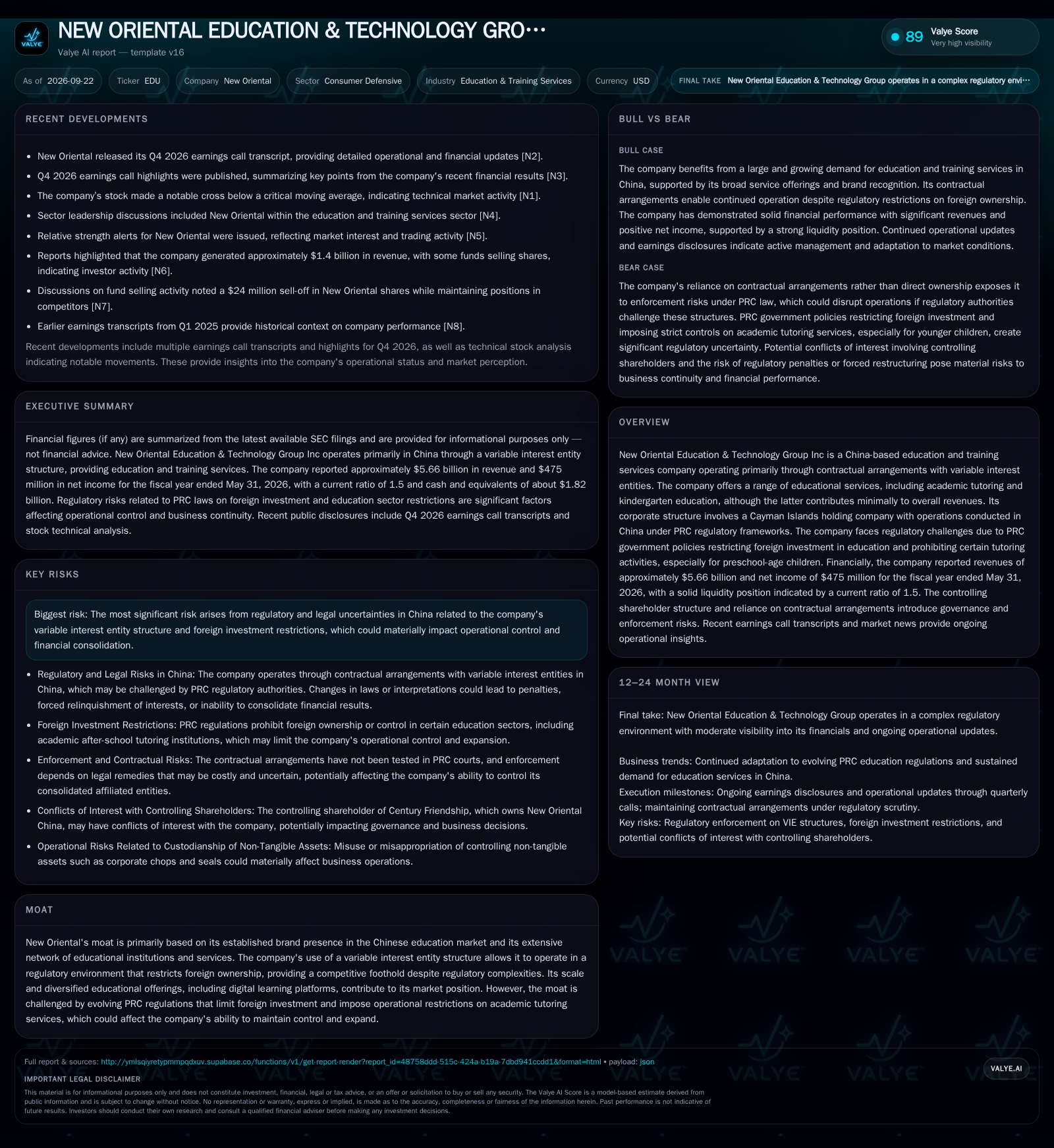
New Oriental ended fiscal 2026 with $5.66B in revenue and $475M in net income, maintaining a current ratio of 1.5 and significant cash reserves. While its scale and brand are competitive strengths, ongoing regulatory risks tied to its variable interest entity (VIE) structure and PRC restrictions on foreign participation in education remain the most salient threats to its business continuity and valuation thesis. The company’s future hinges on its ability to adapt to policy changes and maintain enforceable contractual control over its operating entities in China. [S1]
New Oriental Education & Technology Group stands as one of China’s largest private education providers, leveraging its scale, brand, and diversified offerings to serve a vast and evolving market. The company’s robust revenue and net income for fiscal 2026 point to successful post-crackdown adaptation, but this outward strength belies an underlying fragility: New Oriental’s entire structure depends on variable interest entity (VIE) arrangements, a legal workaround whose validity and enforceability remain untested in Chinese courts. As regulatory scrutiny on foreign participation in education intensifies, the company’s future is ultimately tethered to the shifting tides of PRC policy and its ability to navigate—and survive—continued legal and operational uncertainty.
Financial Performance and Structural Risks Define the Present Moment
For the fiscal year ended May 31, 2026, New Oriental reported revenues of approximately $5.66 billion and net income of about $475 million, reflecting the company’s ability to generate significant cash flow and maintain profitability despite a turbulent regulatory environment. The company reported cash and liquidity metrics for the period; these figures do not by themselves establish operating runway, investment capacity, financial flexibility, or financing capacity. However, these financial strengths are counterbalanced by the persistent risks associated with its VIE structure, which is necessary due to PRC restrictions on foreign ownership in education. The company’s contractual control over its main operating entities remains legally valid but is inherently susceptible to regulatory intervention, and its enforceability has not been tested in Chinese courts. This duality—strong financials amid structural vulnerability—defines New Oriental’s current investment profile. [S1]
How New Oriental Monetizes Education: Revenue Mix, Scale Effects, and Capital Needs
New Oriental’s business model centers on providing academic tutoring and training services across a wide age range, historically earning revenue primarily from K-12 and college prep courses, with minor contributions from kindergarten operations. The company’s scale enables it to leverage centralized curriculum development, standardized teacher training, and national marketing, driving cost efficiencies uncommon among smaller competitors. Fixed costs—such as content development, teacher recruitment, and IT infrastructure—are significant, but scale allows for operating leverage as incremental enrollments carry high contribution margins after classroom utilization thresholds are met.
Pricing power is shaped by the brand’s reputation and perceived quality, although it is constrained by regulatory price caps and restrictions on profit-making in certain segments. Revenue mix is likely dominated by high-frequency, high-volume tutoring, with digital and blended delivery models supplementing in-person instruction. While the company’s capital intensity has historically been moderate—focused on facility leases and digital platform investments—future capital needs could rise if regulatory changes force business model pivots or asset-heavy compliance investments. The economics are inherently sensitive to volume (enrollment) swings, regulatory shifts affecting permitted activities, and potential changes in fee structures imposed by the government.
Brand Recognition and Scale vs. Regulatory and Local Competition
New Oriental’s principal competitive advantage lies in its entrenched brand, extensive curriculum resources, and national reach—factors that attract both students and parents seeking reliable educational outcomes. The company competes with national peers (such as TAL Education and private local providers), as well as with public schools and emerging online platforms. While New Oriental’s VIE structure theoretically gives it a head start in accessing capital and scaling quickly, it also exposes the company to unique regulatory risks that domestic competitors operating without foreign investment do not face.
Substitution risk is present from both state-provided education (especially as the government pushes to reduce the role of private tutoring) and digital-native entrants leveraging lower-cost models. However, New Oriental’s broad service portfolio and ability to pivot between in-person and online formats offer some resilience. Its moat, while meaningful in terms of brand and network, is under constant threat from policy changes that could erode its structural advantages overnight.
If Regulatory Clarity Emerges, Scale and Brand Could Drive Market Share Gains
The most optimistic scenario for New Oriental would be a period of regulatory stabilization or even incremental policy easing—such as clearer guidelines for permissible tutoring activities or a relaxation of restrictions on foreign participation in certain segments. In this environment, New Oriental’s brand, scale, and operational infrastructure could enable it to consolidate market share as weaker, undercapitalized players exit or fail to adapt. Operating leverage would improve as enrollment volumes recover, and the company could selectively expand into adjacent education services or digital offerings with less regulatory risk.
Evidence that would confirm this scenario includes sustained or accelerating revenue growth, margin expansion, and explicit regulatory guidance providing a stable operating framework for VIEs. Additional indicators would be an uptick in digital or adult education segment revenues, and management commentary highlighting successful adaptation to policy changes.
Operating Within Constraints: Incremental Growth Amid Ongoing Uncertainty
The most plausible near-term outcome is a continuation of the current equilibrium: New Oriental maintains solid financial performance and adapts incrementally to regulatory changes, but operates under a cloud of uncertainty regarding the VIE structure and foreign ownership restrictions. Revenue grows modestly as the company finds pockets of permissible activity, diversifies offerings, and prioritizes compliance. Margins remain healthy but do not expand meaningfully, as costs of compliance and risk management offset scale efficiencies.
Confirmation of this scenario would be stable or slightly rising revenues, continued profitability, and regular disclosure of operational adjustments in response to evolving regulations. Falsification would occur if there were a material regulatory intervention targeting VIEs or a sharp contraction in core business lines due to new restrictions.
Regulatory Shock or VIE Enforcement Failure Triggers Structural Disruption
The adverse scenario for New Oriental centers on a major regulatory or legal event: PRC authorities could move to unwind or invalidate VIE arrangements, impose new restrictions that eliminate key revenue streams, or mandate the restructuring of foreign-controlled entities. In this case, New Oriental could lose operational control over its educational subsidiaries, face asset seizures, or be forced to divest core businesses at distressed valuations. The company’s ability to consolidate financial results would be compromised, and its stock could experience a sharp repricing.
Confirmation would include public government actions targeting VIEs, legal proceedings challenging the enforceability of contractual arrangements, or management disclosures of forced operational changes. Early warning signs might be abrupt revenue declines, loss of control over local entities, or regulatory penalties.
Metrics and Developments That Will Determine New Oriental’s Viability
Any regulatory announcements or policy guidance from PRC authorities regarding the legality or future of VIE structures, especially as they pertain to foreign investment in education.
Disclosures of changes in the company’s contractual arrangements with Beijing Xuncheng and its subsidiaries, or any legal proceedings testing the enforceability of these contracts.
Revenue and enrollment trends by segment, particularly in areas affected by recent regulatory changes; a useful metric would be segment-level revenue growth or contraction, if disclosed.
Gross and operating margin trends, which would indicate the company’s ability to offset compliance costs and maintain profitability in a restrictive environment.
Management commentary or filings addressing conflicts of interest with controlling shareholders and any changes to governance mechanisms.
Expansion or contraction in digital education and adult learning offerings, which may indicate the company’s ability to pivot away from heavily regulated segments.
Evidence of asset seizures, forced divestitures, or loss of control over key operating entities, which would signal acute risk to business continuity.
Ongoing liquidity and cash flow metrics, especially in the event of a regulatory shock that could disrupt revenue streams.
Disclaimer: This is research-only, informational analysis and not investment advice. It may include AI-generated interpretation and general industry context. Always verify important details using primary sources.

Comments