
Thor Industries: Navigating Cyclical Headwinds, Innovation Bets, and Supply Chain Complexity
Thor Industries remains a leading player in the recreational vehicle sector, balancing cyclical demand swings, ongoing investment in electric and connected RVs, and persistent supply chain and regulatory challenges. Its ability to convert scale and innovation into sustainable margins will determine its resilience as industry volatility persists.
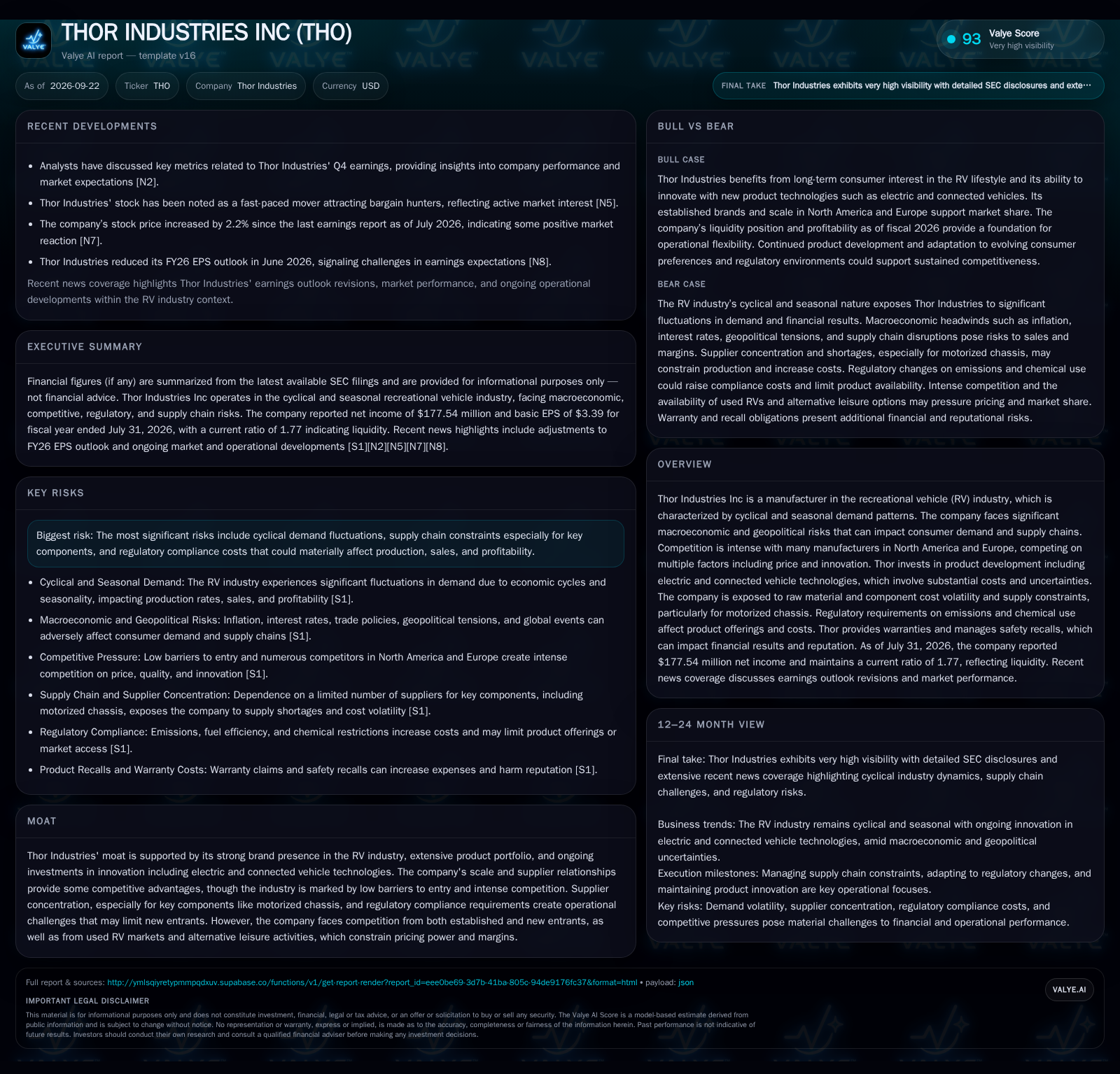
Thor Industries reported $177.54 million in net income and a current ratio of 1.77 as of July 2026, reflecting profitability and liquidity in a turbulent RV market. The company faces cyclical and seasonal demand, intense competition, supplier concentration risks, and regulatory headwinds, while investing heavily in electric and connected vehicle technologies. The next phase depends on Thor’s capacity to manage supply chain disruptions, adapt to evolving regulations, and translate product innovation into market share gains and margin stability. [S1]
Thor Industries stands at the intersection of cyclical demand, innovation-driven transformation, and persistent supply chain and regulatory turbulence in the recreational vehicle market. While the company posted solid profits and maintains liquidity entering fiscal 2027, its outlook is clouded by unpredictable consumer sentiment, supply bottlenecks, and the high cost and uncertain payoff of next-generation RV technologies. Whether Thor can convert its scale, brand equity, and R&D investments into durable competitive advantage will shape its trajectory as the broader RV sector adapts to economic and regulatory shocks.
Recent Financials and Operational Realities: A Snapshot of Thor’s Position
As of July 31, 2026, Thor Industries reported $177.54 million in net income, with basic and diluted EPS of $3.39 and $3.38, respectively. The company’s cash and equivalents stood at $481.99 million, contributing to a current ratio of 1.77 and a cash ratio of 0.31. Operationally, Thor continues to navigate pronounced cyclical and seasonal RV demand, while contending with supply shortages and delivery delays—particularly acute in European operations—which have impaired production efficiency and inventory turns. [S1]
How Thor Converts Demand Cycles and Innovation into Earnings
Thor’s revenue is driven by the sale of new recreational vehicles—towables, motorhomes, and camper vans—primarily through a network of independent dealers. The company’s cost structure is heavily influenced by raw material and component prices, especially motorized chassis, which are often sourced from a concentrated group of suppliers. Margins are sensitive to both input cost fluctuations and the mix of premium versus entry-level products. When demand surges, fixed manufacturing costs are leveraged over higher volumes, boosting operating margins; in downturns, under-absorption of fixed costs can rapidly erode profitability.
Product innovation, notably in electric, hybrid, and connected RVs, requires substantial R&D and capital expenditure, with uncertain timing and scale of returns. The economics of these new models depend on consumer adoption rates, regulatory incentives, and the company’s ability to manage costs as new technologies scale. Aftermarket services, warranties, and recalls add further variability to the cost base, with warranty and recall events potentially causing sudden spikes in expenses. Thor’s business economics thus hinge on its ability to align production and inventory with volatile demand, control input costs, and capture value from innovation faster than rivals.
Brand Scale, Innovation, and the Battle for Share in a Crowded RV Market
Thor’s competitive edge rests on its broad product portfolio, established brands, and scale in North America and Europe. These factors support dealer relationships and some negotiating leverage with suppliers. However, the RV industry’s low barriers to entry foster intense competition, with rivals ranging from large integrated manufacturers to niche upstarts. Price, design, perceived quality, and innovation are frequent battlegrounds, and the used RV market and alternative leisure options create additional pressure on new unit sales.
Supplier concentration—especially for critical components like motorized chassis—diminishes Thor’s bargaining power and exposes it to supply shocks. Regulatory compliance, particularly regarding emissions and chemical content, raises costs and could reduce product availability if standards tighten further. While Thor’s investments in electric and connected RVs may yield a future advantage, the competitive landscape is dynamic, and the pace of consumer adoption will determine whether these bets pay off. In short, Thor’s scale and innovation pipeline provide tools for defense and growth, but do not guarantee pricing power or margin resilience in the face of aggressive competition and external shocks. [S1]
When Innovation and Market Recovery Align: The Bullish Chain Reaction
Thor could outperform if consumer demand for RVs rebounds—driven by favorable economic conditions, demographic tailwinds, or renewed interest in domestic travel—and if the company’s investments in electric and connected RVs translate into premium pricing and market share gains. A scenario where supply chain bottlenecks ease, input costs stabilize, and regulatory changes are managed proactively would allow Thor to leverage its scale and increase profitability as volumes recover. Confirmation of this scenario would include sustained double-digit revenue growth, margin expansion attributable to higher-margin new models, and evidence that new product launches are being met with strong dealer and consumer uptake.
Further, if Thor can demonstrate successful cost control in the ramp-up of electric and hybrid lines, and if regulatory compliance costs are offset by market access or incentives, the company may solidify its leadership in the next generation of RVs. A visible reduction in warranty and recall expenses would also support the bullish thesis.
Cyclical Recovery and Innovation Offsets: A Realistic Near-Term Trajectory
The most plausible scenario is one of moderate revenue and earnings volatility, with Thor navigating through the RV industry’s cyclical trough while incrementally rolling out new electric and connected models. Supply chain constraints and regulatory pressures are likely to persist but may ease gradually, allowing for some improvement in production efficiency. Under this path, Thor’s financial performance is characterized by modest top-line growth, stable but pressured margins, and ongoing R&D outlays that weigh on near-term profitability but are necessary for long-term relevance.
Evidence supporting this scenario would include sequential improvement in inventory turnover, steady or slightly improving gross margins, and incremental revenue contribution from new product segments. Conversely, if supply disruptions or regulatory shocks worsen, or if consumer adoption of new technologies lags, Thor’s earnings could remain subdued for an extended period.
How Prolonged Downturns and Supply Shocks Could Erode Thor’s Resilience
Thor’s downside risk consists of a combination of prolonged demand weakness—triggered by macroeconomic stagnation, higher interest rates, or consumer uncertainty—and persistent supply chain disruptions, especially for key components. If input costs escalate or critical parts remain scarce, Thor could face production bottlenecks, rising inventories, and shrinking margins. Regulatory tightening, particularly around emissions or chemical restrictions, could force costly redesigns or limit product availability, further squeezing profitability.
This scenario would be confirmed by declining sales volumes, deteriorating gross and operating margins, and rising warranty and recall costs. Balance sheet strain could manifest if inventory builds up or if cash reserves are drawn down to cover fixed costs during extended slowdowns. A spike in dealer incentives or discounting would further signal deteriorating market conditions and competitive overcapacity.
What Will Determine Thor’s Next Chapter in the RV Industry?
Quarterly and annual revenue growth rates segmented by product type (e.g., electric, hybrid, traditional RVs) would help assess the traction of new models and underlying demand shifts, if disclosed.
Gross and operating margin trends, particularly in relation to raw material and component cost movements, provide early signals of Thor’s ability to manage input price volatility.
Inventory turnover and days sales of inventory are critical for evaluating the company’s production efficiency and demand-supply alignment, especially amid ongoing supply chain constraints.
Warranty and recall expenses as a percentage of sales reveal the impact of product quality issues and regulatory compliance on profitability.
Capital expenditures and R&D spending levels, and their allocation toward electric and connected vehicle initiatives, would illuminate Thor’s commitment to innovation and future growth drivers.
Dealer inventory levels and order backlogs, if disclosed, serve as forward-looking indicators of channel health and potential revenue visibility.
Geographic revenue breakdowns, particularly between North America and Europe, may highlight regions of relative strength or exposure to supply and regulatory risks.
Any management commentary or disclosure regarding supplier diversification efforts and contingency plans for chassis and key components would help gauge progress on reducing supply chain vulnerability.
Disclaimer: This is research-only, informational analysis and not investment advice. It may include AI-generated interpretation and general industry context. Always verify important details using primary sources.

Comments