
Nuburu’s Blue Laser Ambition: Defense Focus Meets Intense Liquidity and Execution Hurdles
Nuburu, Inc. pursues growth in the defense sector with its blue laser technology and acquisition strategy, but faces acute near-term liquidity pressure and the demanding economics of early-stage hardware innovation.
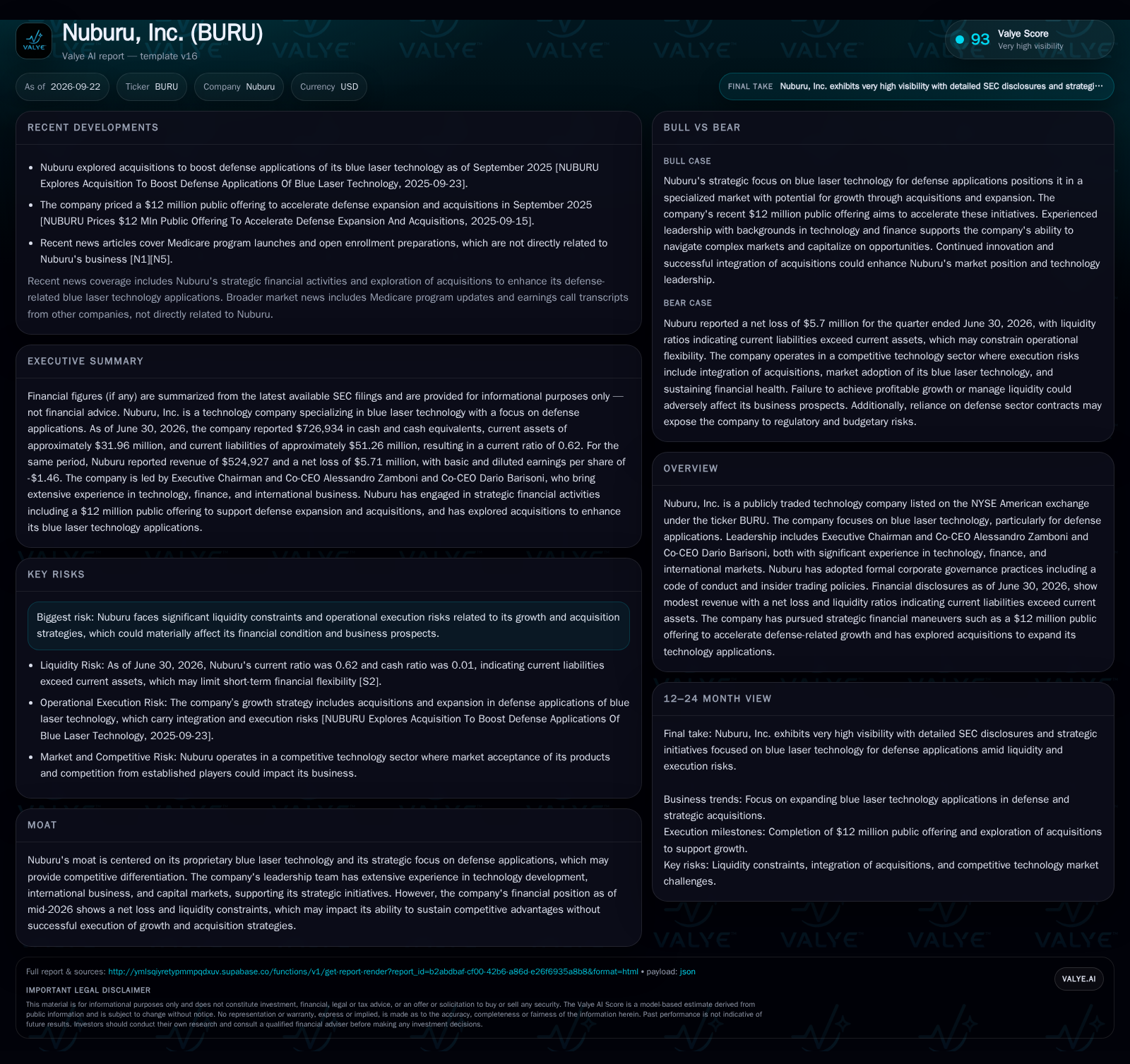
Nuburu is betting on blue laser technology for defense applications, supported by recent capital raises and acquisition initiatives. Despite leadership with deep sector experience, the company’s financial disclosures reveal significant net losses and a current ratio well below 1. [S2]
Strategic moves—including a $12 million public offering and acquisition exploration—highlight an urgent bid to scale and diversify, but the fundamental question is whether Nuburu’s technology and leadership can deliver on its ambitious roadmap before financial pressures become existential.
Liquidity Crunch and Strategic Expansion: The Present State of Play
The company reported cash and liquidity metrics for the period; these figures do not by themselves establish operating runway, investment capacity, financial flexibility, or financing capacity. The company’s operating performance remains deeply negative, with $524,927 in quarterly revenue set against a net loss of $5.71 million and EPS of -$1.46. To address these challenges and accelerate its push into defense applications for blue laser technology, Nuburu completed a $12 million public offering and has explored acquisitions. Leadership continuity and governance structures are in place, but the balance sheet highlights the urgency of converting technical promise into commercial traction. [S2]
Commercializing Blue Laser Technology: Economic Realities and Leverage Points
Nuburu’s core business model appears to hinge on developing and selling blue laser systems, with a strategic emphasis on defense customers. In the defense sector, winning contracts often requires multi-year technology development, rigorous qualification, and extensive field testing—resulting in long sales cycles and significant upfront R&D investment. Hardware-centric models like Nuburu’s typically entail high fixed costs (engineering, manufacturing setup, compliance) and lumpy, contract-driven revenue. Margins can be attractive if the company achieves scale or secures recurring service/upgrade contracts, but without a base of recurring revenue or established customer renewals, operating leverage can cut both ways.
The company’s current revenue base is modest relative to its cost structure, suggesting that fixed costs are not being covered by existing sales. Capital needs remain acute, as indicated by the recent $12 million raise, likely earmarked for both organic development and acquisition-led growth. If Nuburu can leverage its blue laser IP into defense programs of record—or secure long-term supply or integration agreements—the economics could shift dramatically. However, absent such wins, the company risks ongoing dilution or operational retrenchment.
A critical lever in Nuburu’s economic model lies in the potential for aftermarket services and consumables tied to its blue laser systems. If the company can establish recurring revenue through maintenance contracts, upgrades, or proprietary consumables, it may mitigate the lumpy nature of hardware sales. However, this requires robust customer support infrastructure and sustained product reliability, which are challenging for early-stage hardware ventures. Additionally, the capital intensity of scaling manufacturing capabilities—such as securing supply chains for specialized components and achieving quality control at volume—introduces execution risk that could delay margin improvement or increase working capital demands.
Specialization Versus Scale: Nuburu’s Place in the Defense Technology Landscape
Nuburu’s competitive positioning rests on its proprietary blue laser technology, which theoretically offers advantages in applications requiring high power, precision, or wavelength-specific benefits—attributes valued in certain defense and advanced manufacturing settings. The defense market’s barriers to entry are high, encompassing procurement complexity, regulatory scrutiny, and entrenched incumbents with deep customer relationships. Nuburu’s bet is that its technical differentiation and leadership’s sector experience can carve out a defensible niche.
However, the company faces counterforces: established defense primes, diversified photonics players, and adjacent laser technology vendors all vie for similar opportunities. Technology substitution is a real risk, as competing approaches (e.g., infrared lasers, non-laser directed energy, or conventional systems) may offer better cost, reliability, or integration profiles for some applications. Nuburu’s ability to build switching costs, such as through proprietary modules, embedded software, or integration into customer platforms, is not yet proven and remains a critical open question.
Nuburu’s defensibility also depends on its ability to navigate the complex regulatory environment governing defense technologies. Compliance with export controls, cybersecurity requirements, and government contracting standards can impose significant costs and operational constraints. While these barriers may deter some competitors, they also necessitate substantial internal expertise and process maturity, which can strain resources. Furthermore, the pace of technological innovation in photonics means Nuburu must continuously invest in R&D to maintain differentiation, balancing this against the immediate need for commercial traction and cost discipline.
Strategic partnerships or alliances with established defense contractors could serve as a critical mechanism for Nuburu to overcome scale and access challenges. Such collaborations might provide validation, accelerate qualification cycles, and embed the technology within broader systems. However, these relationships often come with demanding contractual terms and require alignment of long-term objectives. Failure to secure or effectively manage partnerships could limit Nuburu’s market penetration and increase vulnerability to competitive displacement by larger incumbents with integrated offerings.
From Niche to Program of Record: What a Breakout Would Look Like
The favorable scenario for Nuburu involves leveraging recent capital to secure one or more defense contracts, either directly or via acquisition, that validate its blue laser technology in mission-critical applications. This could trigger both near-term revenue recognition and long-term adoption if the technology is embedded in platforms with multi-year production or upgrade cycles. Successful acquisition integration would accelerate market access, potentially expanding the customer base and diversifying revenue streams.
Confirmation would come from disclosed contract awards, backlog growth, or announcements of major integrator relationships. Additional evidence would be sequential revenue acceleration, improved gross margins, or customer testimonials citing blue laser performance advantages. Falsification would be the absence of material contract wins or continued stagnant revenue despite expanded business development efforts.
Incremental Progress Under Acute Financial Pressure
The most plausible near-term outlook is a period of continued financial strain as Nuburu pursues defense sector validation and acquisition integration. Revenue may grow incrementally if pilot programs or small contracts are won, but operating losses are likely to persist unless the company can meaningfully scale sales or reduce costs. Further capital raises—potentially at dilutive terms—may be required to bridge to commercialization milestones.
The base case would be confirmed by modest but steady revenue growth, controlled operating expenses, and at least one acquisition that expands addressable markets without overwhelming integration risk. Conversely, evidence of rising losses, inability to close acquisition deals, or deterioration in balance sheet quality would pressure this scenario.
Liquidity Exhaustion and Commercial Setbacks: The Path to Distress
If Nuburu fails to secure material defense contracts or to integrate acquisitions quickly enough to generate cash flow, its acute liquidity position could become existential. In this scenario, lack of commercial traction forces further dilutive equity raises, asset sales, or operational retrenchment. Suppliers or customers may lose confidence if payables stretch or if financial distress becomes public.
Confirmation of this downside would be sequential declines in cash, deteriorating current ratios, or regulatory warnings. Additional warning signs would include missed payroll, delayed filings, or sudden management turnover. The absence of contract wins or customer renewals over multiple quarters would further erode confidence in the business model.
Milestones That Will Define Nuburu’s Blue Laser Trajectory
Quarterly revenue growth or decline, especially evidence of step-changes following contract wins or acquisitions, would help test the commercialization thesis.
Gross margin trends, if disclosed, would clarify whether Nuburu is achieving scale benefits or facing cost overruns.
Disclosure of backlog or multi-year contract awards in defense or adjacent markets would be a concrete indicator of traction.
Cash burn rate and capital raise timing will reveal how close Nuburu is to a liquidity inflection point.
Progress or outcomes from announced or completed acquisitions—such as integration milestones, cross-selling, or retention of key staff—would validate the inorganic growth strategy.
Evidence of customer concentration or diversification, if disclosed, would indicate resilience or vulnerability to contract losses.
Management’s ability to articulate and execute a path to breakeven—through filings, calls, or public presentations—remains a critical qualitative marker.
Disclaimer: This is research-only, informational analysis and not investment advice. It may include AI-generated interpretation and general industry context. Always verify important details using primary sources.

Comments