
AYTU BioPharma’s Bet on EXXUA: Commercial Ambition in CNS Therapeutics Meets Profitability Hurdles
AYTU BioPharma launched EXXUA, a novel antidepressant for major depressive disorder, in 2026 and now targets the large U.S.
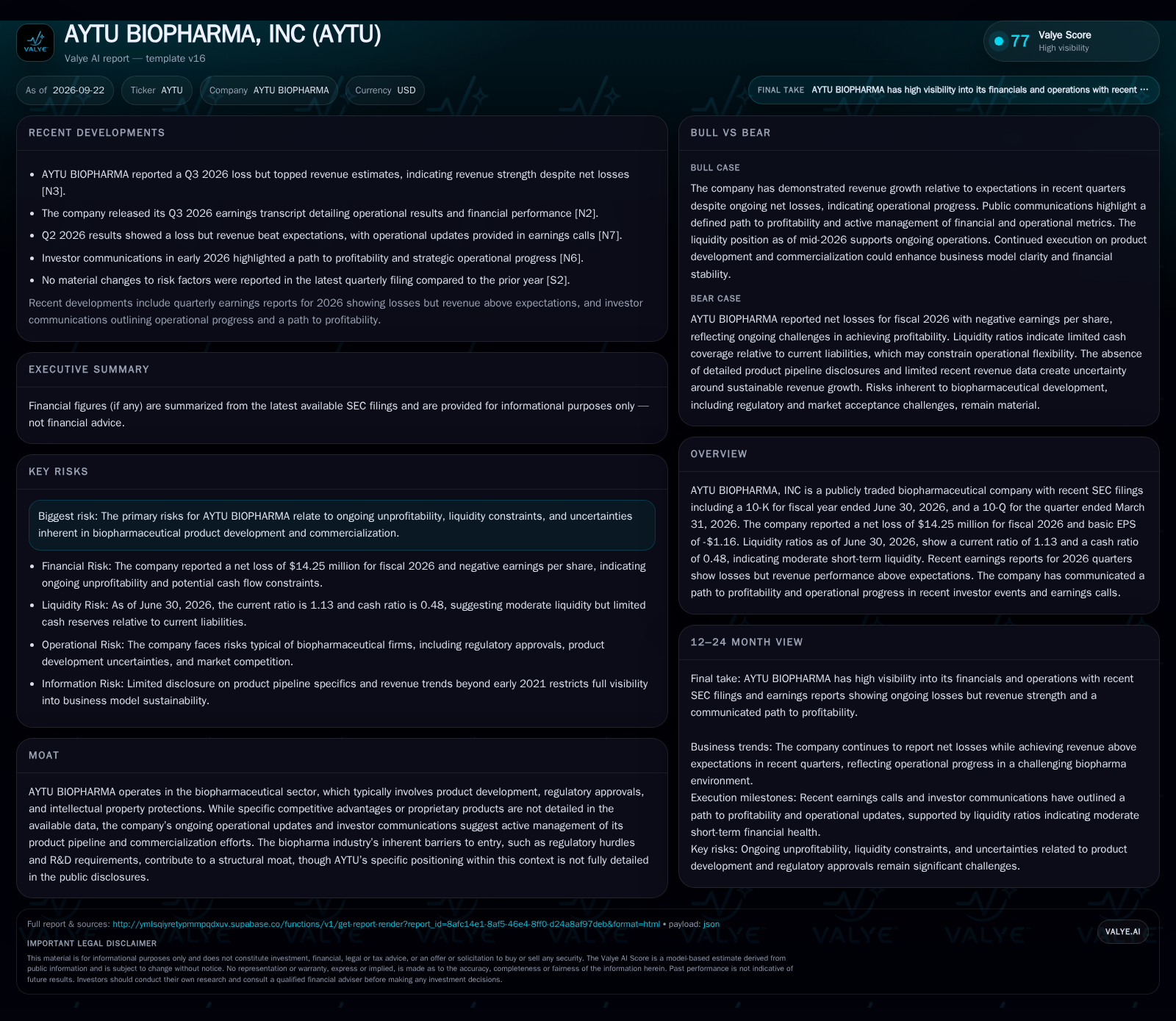
AYTU BioPharma launched EXXUA, a novel antidepressant for major depressive disorder, in 2026 and now targets the large U.S. CNS therapeutics market. Despite topping revenue expectations in recent quarters, the company remains unprofitable, with a net loss of $14.25 million for fiscal 2026 and reported cash balance. [S1] [S2] [N3] [N6]
AYTU BioPharma’s 2026 pivot centers on the U.S. launch of EXXUA, its newly commercialized antidepressant, staking the company’s future on capturing a meaningful share of the vast major depressive disorder (MDD) market. While recent earnings show revenue outpacing expectations, persistent net losses and only reported liquidity position highlight the company’s dependence on rapid commercial traction for EXXUA. AYTU’s ability to break through entrenched competition, manage operating expenses, and sustain its balance sheet will determine whether the EXXUA launch translates into long-term viability or exposes the company to financial strain if adoption lags.
EXXUA Launch and Financial Realities Shape AYTU’s 2026 Outlook
AYTU BioPharma’s commercial launch of EXXUA in early 2026 marks a strategic pivot toward the lucrative U.S. market for major depressive disorder (MDD) treatments. EXXUA’s FDA approval and its positioning as a first-in-class selective serotonin 5HT1a receptor agonist distinguish it from the crowded field of SSRIs and SNRIs, particularly with its lack of a sexual dysfunction warning on the label—a point of differentiation aimed at a significant unmet need among antidepressant users. The company reported a net loss of $14.25 million for the fiscal year ended June 30, 2026, with a current ratio of 1.13 and a cash ratio of 0.48, reflecting reported liquidity position but reported cash balance relative to liabilities. Despite these losses, AYTU topped revenue expectations in Q1, Q2, and Q3 of 2026, suggesting some operational momentum, though the sustainability and scale of this revenue are not fully detailed. The company has suspended further clinical development programs to focus resources on commercializing EXXUA and other CNS products, signaling a shift toward near-term revenue generation and cash flow improvement. [S1] [S2] [N3] [N6]
Revenue Potential, Cost Structure, and the Path to Operating Leverage
AYTU’s revenue model now hinges on prescription growth and market penetration for EXXUA, targeting the over $22 billion U.S. antidepressant market. The economics of branded pharmaceutical commercialization are characterized by high gross margins per prescription but also substantial fixed costs—particularly in sales, marketing, and regulatory compliance. The initial phase of a drug launch typically involves significant upfront investment in commercial infrastructure and physician education, with operating leverage materializing only if prescription volumes scale meaningfully.
The company reported cash and liquidity metrics for the period; these figures do not by themselves establish operating runway, investment capacity, financial flexibility, or financing capacity. If EXXUA’s differentiated profile—namely the absence of sexual dysfunction warnings and a novel mechanism—can drive adoption among prescribers and patients dissatisfied with current options, average revenue per patient could be compelling. However, the timeline for achieving breakeven is highly sensitive to payer coverage, formulary access, and the pace of physician adoption, which are not disclosed.
With clinical development suspended, R&D expenses may decline, but cost savings must be balanced against the need for continued investment in post-market studies, pharmacovigilance, and commercial support.
Differentiation in a Crowded Antidepressant Market: Opportunities and Counterforces
AYTU’s competitive thesis relies on EXXUA’s unique mechanism—selective 5HT1a receptor agonism—and its clean safety label, particularly the absence of sexual dysfunction risk. This could position EXXUA as an attractive alternative for patients who have failed or discontinued SSRIs/SNRIs due to intolerable side effects. However, the market for antidepressants is crowded with generics, well-entrenched brands, and new entrants, making market access and prescriber education critical challenges.
Large pharmaceutical companies dominate the MDD category, with established sales forces, payer relationships, and patient support programs. The absence of reuptake inhibition activity and favorable side effect profile may not be enough to quickly displace or supplement incumbent therapies without robust head-to-head data, real-world evidence, and strong advocacy from key opinion leaders.
Additionally, the company’s smaller scale may limit its negotiating power with payers, potentially leading to slower or more costly market access. If EXXUA can demonstrate meaningful real-world differentiation—such as improved adherence, quality of life, or rapid onset of action—AYTU could carve out a defensible niche, but the company must overcome significant commercial and promotional barriers to achieve material share.
EXXUA Gains Traction: Prescription Growth Drives Rapid Margin Expansion
In a favorable scenario, EXXUA’s differentiated safety and efficacy profile resonates with clinicians and patients, particularly those dissatisfied with current SSRIs/SNRIs. Rapid payer coverage and formulary inclusion drive early adoption, and prescription volumes ramp faster than expected. AYTU leverages its commercial infrastructure efficiently, achieving operating leverage as revenue growth outpaces fixed cost expansion.
Evidence confirming this scenario would include accelerating prescription trends for EXXUA, broad payer coverage announcements, positive physician and patient feedback, and improving gross-to-net revenue realization. Post-marketing data showing real-world effectiveness and a favorable side effect profile would further solidify EXXUA’s market position. AYTU’s earnings would begin to show narrowing net losses, positive operating cash flow, and a clear path to profitability.
Falsification would come from stagnant prescription growth, limited payer access, or the emergence of new safety or efficacy concerns that dampen enthusiasm among prescribers and patients.
Gradual Uptake and Tight Cost Controls: A Slow March Toward Breakeven
The most plausible trajectory is a measured commercial ramp for EXXUA, with adoption occurring as prescribers become familiar with the drug and as payer coverage expands incrementally. AYTU maintains strict cost controls, having suspended further clinical development to preserve cash while investing selectively in commercial support for EXXUA and its other CNS products.
In this scenario, revenue continues to exceed expectations modestly, but net losses persist through at least the next fiscal year. Liquidity remains a constraint, requiring careful working capital management and potentially opportunistic financing to bridge to cash flow breakeven. Evidence supporting this scenario would include steady, if unspectacular, prescription growth, stable or improving gross margin, and disciplined expense management in quarterly filings.
The base case would be undermined if either commercial uptake stalls or if operating expenses creep higher than anticipated, eroding the company’s already reported liquidity position.
EXXUA Struggles to Penetrate Market: Liquidity Pressures Mount
In a negative scenario, EXXUA fails to achieve meaningful market share due to entrenched competition, slow payer adoption, or lack of compelling real-world differentiation. Prescription growth remains muted, and AYTU is unable to offset fixed costs, leading to persistent and potentially widening net losses.
The company’s reported liquidity position becomes increasingly precarious as cash burn accelerates. AYTU may be forced to seek dilutive financing, restructure operations, or pursue asset sales to maintain solvency. Evidence confirming this scenario would include flat or declining prescription numbers, unfavorable payer coverage decisions, widening losses in quarterly reports, and shrinking cash balances.
This outcome could be exacerbated by unforeseen regulatory or safety setbacks, competitive launches of superior therapies, or broader shifts in the CNS treatment landscape.
Milestones That Will Determine AYTU’s EXXUA-Driven Turnaround
Prescription volume and market share trends for EXXUA, if disclosed, are essential to gauge commercial traction and validate differentiation claims.
Gross-to-net revenue realization for EXXUA (i.e., net sales after discounts and rebates) would help test the sustainability of top-line growth.
Updates on payer coverage decisions and formulary placements for EXXUA will signal the drug's ability to penetrate the reimbursement landscape.
Expense discipline, specifically in sales and marketing, relative to revenue growth, will reveal whether cost controls are effective.
Any external financing events, such as dilutive equity raises or debt issuance, would suggest ongoing or worsening liquidity stress.
Disclosures of real-world efficacy or safety data for EXXUA could materially affect prescriber sentiment and the drug’s competitive positioning.
Management commentary or guidance on timelines to profitability and commercial milestones will provide insight into execution progress and risk tolerance.
Disclaimer: This is research-only, informational analysis and not investment advice. It may include AI-generated interpretation and general industry context. Always verify important details using primary sources.

Comments