
Readvantage Corp.: Digital Accessibility Ambition Confronts Scale, Differentiation, and Resource Constraints
Readvantage Corp. delivers bionic reading technology through a digital library and developer API, targeting both individual readers and enterprise integrations.
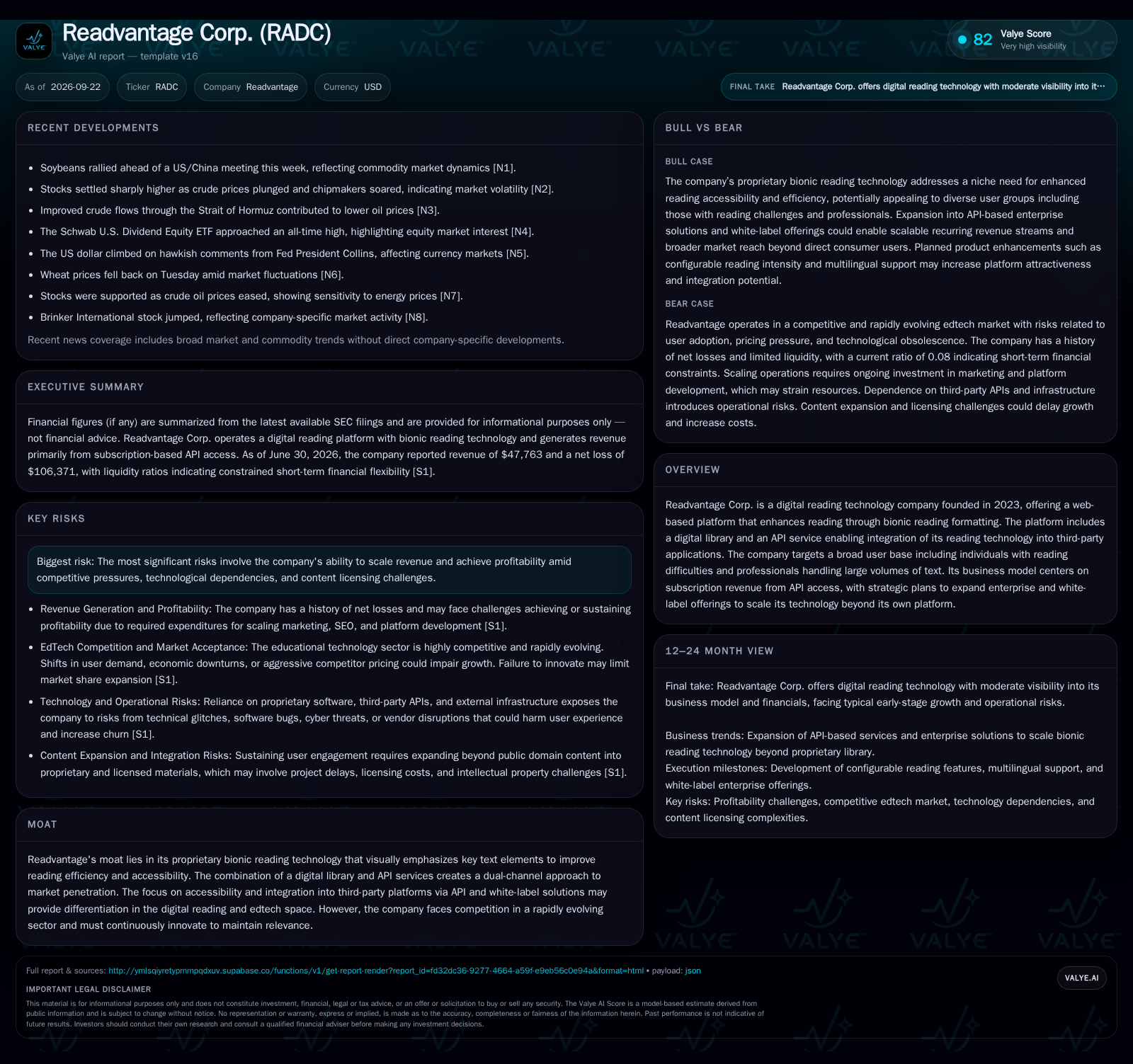
Readvantage Corp. provides a digital reading platform and API focused on accessibility and reading efficiency, reporting $47,763 in FY26 revenue and a net loss of $106,371. Success depends on deepening product integration and proving commercial traction beyond its initial library offering. [S1]
Readvantage Corp. stands at the intersection of digital accessibility and educational technology, offering a bionic reading platform designed to enhance reading efficiency for diverse user groups, including those with accessibility needs. The company’s API-centric approach aims to embed its technology into third-party applications and enterprise workflows, potentially expanding its reach beyond direct-to-consumer channels. [S1]
Acute Liquidity Constraints and Early-Stage Revenue Shape Immediate Priorities
Readvantage Corp. reported FY26 revenue of $47,763, driven primarily by subscription-based API access, with a net loss of $106,371 and basic EPS of -$0.02. The company’s current assets totaled $19,460 against current liabilities of $229,878, resulting in a current ratio of 0.08 and a cash ratio of 0 as of June 30, 2026. The company’s four-employee footprint and three-member board further reflect its early-stage, resource-constrained status. [S1]
Strategically, Readvantage is focused on expanding its API and enterprise offerings, aiming to scale beyond its proprietary digital library. However, the current financial posture means execution risk is elevated—growth initiatives must deliver early traction or risk being stymied by capital limitations.
Given the acute liquidity constraints, Readvantage’s prioritization of initiatives must be highly strategic, focusing on activities that maximize near-term revenue impact while minimizing cash burn. This likely entails prioritizing high-potential API integrations with partners who have existing user bases aligned with accessibility needs, rather than broad-based consumer marketing efforts. Moreover, operational efficiency gains—such as automating onboarding processes or leveraging open-source components where feasible—could help stretch limited resources. The company’s small team size may foster agility but also elevates execution risk, as key person dependencies and capacity limits could delay critical development or sales milestones.
Subscription-Driven API Model Faces Fixed-Cost Pressures and Scale Imperatives
Readvantage’s core economics currently hinge on a subscription model for API access, with additional potential from direct platform subscriptions and future white-label or enterprise contracts. In theory, API-driven SaaS models can deliver attractive operating leverage once a critical mass of customers is achieved, as incremental users require minimal additional cost beyond initial development and infrastructure. However, in the company’s present phase, fixed costs—including software development, content licensing, and minimal personnel—outpace modest top-line growth.
The bionic reading technology and platform differentiation could command premium pricing in niches where accessibility and reading efficiency are valued—such as educational institutions, research, or accessibility-focused enterprises. Yet, actual pricing power is unproven at this scale, and the market may be price-sensitive given the proliferation of free or low-cost digital reading tools. The company’s plan to add configurable features, analytics, and SDKs could enhance value perception, but commercialization is contingent on demonstrating clear ROI for enterprise customers.
Capital needs remain acute.
The subscription-driven API model’s scalability depends heavily on achieving a critical mass of users that amortizes fixed development and content costs over a large revenue base. Until that threshold is reached, the company faces a challenging cost structure where incremental revenue growth yields limited margin improvement. Furthermore, the ability to upsell existing customers to higher-tier plans or additional features will be crucial to enhancing customer lifetime value and improving unit economics. Without demonstrable usage patterns and quantifiable benefits to enterprise clients, pricing flexibility may remain constrained. The planned addition of analytics and SDKs could facilitate more sophisticated customer segmentation and monetization strategies, but only if supported by robust data collection and interpretation capabilities.
Differentiation Through Accessibility Technology, but Facing Broad Edtech and Content Platform Competition
Readvantage’s moat is premised on its proprietary bionic reading formatting, which visually emphasizes key text elements to support comprehension and accessibility. This focus targets a segment underserved by generic e-reading platforms—namely, users with ADHD, dyslexia, or visual impairments, as well as researchers and information professionals handling dense material.
However, the company operates in an intensely competitive landscape. Large digital content platforms, specialized accessibility software vendors, and open-source reading tools all vie for user attention. While few direct competitors may offer bionic reading in exactly the same form, functional substitution is high: alternative text-to-speech tools, adaptive e-readers, and browser extensions can address overlapping pain points. Moreover, established enterprise edtech vendors and library platforms possess distribution advantages, brand recognition, and content partnerships that can be difficult for a new entrant to match.
The API and white-label strategy could carve out a defensible niche if Readvantage becomes the potentially leading accessibility layer for third-party content providers, but sustained differentiation will require ongoing innovation and evidence of superior outcomes for target users.
Sustaining differentiation in the face of broad competition will require Readvantage to continuously validate and enhance the efficacy of its bionic reading technology through empirical user outcomes and accessibility compliance benchmarks. This evidence base could be leveraged to build trust with enterprise clients who often require demonstrable impact before committing to platform integration. Additionally, establishing a developer ecosystem around the API with comprehensive documentation, support, and community engagement could increase switching costs and network effects that strengthen the company’s competitive position. However, this approach demands ongoing investment in developer relations and platform stability, which may be challenging under capital constraints.
If Integration Partnerships and Enterprise Adoption Accelerate, Operating Leverage Could Materialize Rapidly
A favorable outcome would see Readvantage’s API embedded in major educational platforms, digital libraries, and accessibility-focused applications, driving a rapid increase in recurring subscription revenue. Early success with enterprise or institutional customers—particularly those with compliance or accessibility mandates—could validate the value proposition and establish network effects, as more content and users flow through Readvantage’s platform.
Key confirming evidence would include: announcements of integration deals with edtech or content management platforms; rapid growth in API usage metrics (if disclosed); expansion of the developer/partner ecosystem; and a visible uptick in revenue per customer as enterprise contracts scale. Product enhancements such as configurable reading intensity, multilingual support, and robust analytics would reinforce stickiness and pricing power.
Falsification would occur if integration traction remains limited, customer acquisition costs escalate without corresponding revenue growth, or if retention and engagement metrics stall despite product improvements.
Modest Revenue Growth as Platform Expands, But Capital Constraints Limit Speed and Breadth
The most plausible near-term path is gradual expansion of the API customer base, with incremental improvements to the platform’s features and usability. Revenue grows modestly as additional developers and small enterprise clients adopt the technology, but the pace is constrained by limited resources for marketing, content acquisition, and direct sales.
Confirming evidence would be steady, if unspectacular, increases in reported revenue and user engagement, expansion of the API plan tiers, and visible progress on product roadmap items (such as SDKs or enterprise admin tools). However, the company may continue to operate at a net loss, with periodic capital raises required unless a breakthrough partnership or licensing deal accelerates scale.
Falsification would be signaled by stagnant revenue, delays in product enhancements, or evidence that free or lower-cost alternatives are eroding Readvantage’s addressable market.
Liquidity Pressures and Competitive Substitution Threaten Platform Viability
In a more adverse scenario, Readvantage’s acute liquidity constraints force cutbacks in development and marketing just as user acquisition becomes critical. Competitors—either large content platforms adding similar accessibility features or nimble startups leveraging open-source solutions—capture the attention of accessibility-focused users and enterprise buyers.
The company may struggle to fund necessary content licensing or to attract developers to its API, resulting in stagnant or declining usage. If partnerships fail to materialize and the value of bionic reading is not widely recognized or demanded, churn could rise and customer lifetime value fall, making the economics unsustainable.
Negative confirming evidence would include shrinking revenue, layoffs or delayed product launches, and disclosures of going-concern risks or urgent capital needs.
Milestones and Metrics That Will Shape Readvantage’s Accessibility Platform Thesis
Quarterly or annual revenue growth rates, especially from API and enterprise channels, to gauge adoption and product-market fit.
Gross margin trends and breakdown of fixed versus variable costs, to assess scalability and operating leverage potential.
Announcements of integration partnerships with major edtech, library, or content management platforms.
API usage statistics (number of calls, active developers, enterprise API customers), which would illuminate traction beyond the consumer platform.
Customer retention and engagement metrics, such as churn rate or average revenue per user, to test recurring revenue durability.
Progress on planned product enhancements, including configurable reading intensity, multilingual support, and enterprise administration tools.
Disclosure or evidence of additional funding, capital raises, or strategic investments to address liquidity constraints.
Expansion of the proprietary or licensed content library, which could unlock new user segments and reduce substitution risk.
Disclaimer: This is research-only, informational analysis and not investment advice. It may include AI-generated interpretation and general industry context. Always verify important details using primary sources.

Comments