
Espey Mfg. & Electronics: Backlog Strength and Engineering Focus in a Complex Defense Market
Espey Mfg. & Electronics leverages a substantial funded backlog and vertically integrated capabilities to navigate defense and industrial demand, but faces persistent customer concentration, supply chain, and pricing pressures that could shape future performance and margin resilience.
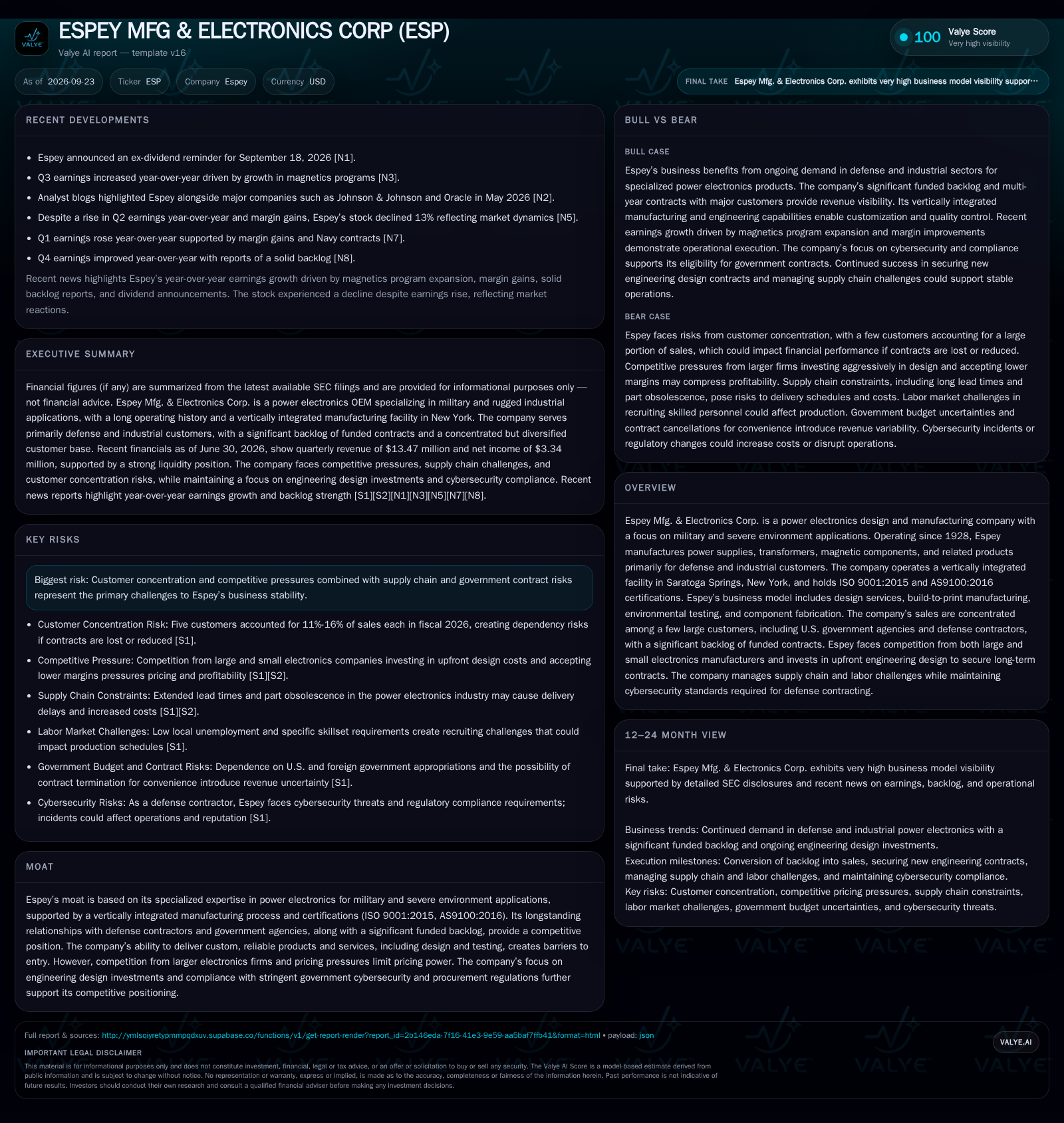
Espey Mfg. & Electronics Corp. enters fiscal 2027 with $134.9 million in sales backlog, ongoing earnings growth driven by magnetics programs, and robust vertical integration, but must manage heavy customer concentration, aggressive industry competition, and supply chain headwinds as it converts backlog to revenue and pursues new contracts. [S1] [N3] [N8]
Espey Mfg. & Electronics stands at a pivotal intersection of defense-driven demand and operational complexity. A substantial funded backlog and disciplined margin execution have propelled recent earnings growth, particularly in magnetics programs. Yet, the company’s heavy reliance on a handful of major customers, aggressive industry competition, and the persistent challenges of long supply chains and technical labor shortages create a nuanced risk-reward profile. The coming year will test Espey's ability to convert backlog into revenue, secure new design wins, and maintain its position in a fiercely competitive, compliance-intensive market.
Operating Realities: Backlog, Margins, and Concentration Challenges
Espey Mfg. & Electronics enters fiscal 2027 with a sales backlog of approximately $134.9 million, of which $123.7 million is already funded and $11.2 million unfunded but likely to be awarded. Notably, around $48 million of the backlog is anticipated to convert to shipments within the fiscal year, providing substantial near-term revenue visibility [S1]. Recent quarters have seen earnings growth, particularly driven by magnetics program expansion and margin gains, even as the company’s stock experienced a 13% decline following Q2 earnings—highlighting the disconnect between operational performance and market sentiment [N3] [N5]. Customer concentration remains acute: five customers each contributed 11%-16% of sales in fiscal 2026, which exposes Espey to the risk of contract loss or reduction [S1].
Espey’s Approach to Monetizing Power Electronics Through Custom Solutions
Espey’s business model is anchored in the design, manufacture, and testing of power electronics for military and severe industrial environments. Revenue is typically generated through a mix of custom engineering design contracts and build-to-print manufacturing, with a significant proportion of sales tied to long-cycle government and defense programs. The company’s vertically integrated Saratoga Springs facility enables in-house fabrication, testing, and environmental qualification, which can both compress lead times and support quality assurance.
Fixed costs are substantial in the form of plant, equipment, and experienced technical staff, but variable costs—materials, components, and skilled labor—are also meaningful, especially given long lead times and part obsolescence risks. Operating leverage can be achieved as higher backlog conversion and program wins absorb fixed overhead, but margin compression is a persistent risk due to aggressive pricing by larger competitors and the need to invest in upfront engineering design. Espey’s minimal R&D spend (about $70,000 annually) reflects a customer-driven, contract-funded innovation model rather than speculative technology bets [S1]. Capital intensity is moderate to high, given the need for specialized equipment, compliance systems, and ongoing cybersecurity investments.
Leveraging Specialization and Vertical Integration to Secure Defense Contracts
Espey’s competitive position is grounded in its long-standing expertise in power electronics for defense and harsh environments, with ISO 9001:2015 and AS9100:2016 certifications providing credibility for mission-critical applications. Its vertically integrated operations allow for end-to-end control, customization, and rapid prototyping—advantages in a procurement environment that values reliability and compliance. However, the company faces intense competition from both large defense OEMs and nimble smaller firms, many of whom are willing to invest heavily in upfront engineering and accept lower margins to secure recurring programs [S1] [S2].
Switching costs in defense and industrial electronics are elevated due to qualification cycles, documentation, and the need for proven reliability, but price and performance remain decisive. Espey’s customer relationships with government agencies and Tier-1 contractors are valuable, but the lack of proprietary technology or platform lock-in limits pricing power. Aggressive competitor investment in design and cost reduction could erode Espey’s share if it cannot maintain engineering differentiation or operational efficiency.
Backlog Conversion, New Wins, and Margin Defense as Growth Catalysts
The most favorable outcome for Espey would involve efficient conversion of its $134.9 million backlog into revenue at stable or rising margins, coupled with the successful capture of new engineering design contracts—particularly in defense modernization or emerging industrial applications. Sustained demand for custom power electronics, combined with the company’s ability to manage supply chain risks and labor requirements, could lead to above-peer growth and earnings expansion.
Confirmation of this scenario would come from quarterly reports showing high backlog burn-through rates, new contract announcements (especially with new or diversified customers), and stable-to-rising gross margins. Additional evidence would include the company maintaining or increasing its funded backlog and demonstrating resilience to supply chain disruptions. Conversely, material delays in conversion, a shrinking backlog, or deteriorating margins would challenge the upside thesis.
Maintaining Performance Despite Industry Headwinds and Execution Challenges
A more plausible middle path sees Espey steadily converting its backlog into revenue, with margins fluctuating in response to competitive pricing, inflationary pressures, and periodic supply chain disruptions. The company retains its core defense and industrial customers, though customer concentration remains a persistent risk. New contract wins offset program roll-offs, but growth is modest and tied to the cadence of government appropriations and industrial project cycles.
Evidence supporting this scenario would include a relatively stable backlog (with funded and unfunded components replenished over time), ongoing but moderate earnings growth, and no significant customer losses. Labor and supply chain challenges are managed but not eliminated, resulting in occasional delivery or cost issues. Falsification would come from an unexpected contraction in the backlog, major contract losses, or a step-change in margin erosion.
Risks from Customer Concentration and Supply Chain Disruptions
The adverse scenario for Espey centers on the risks posed by its concentrated customer base and persistent supply chain and labor headwinds. Loss or reduction of one or more top customers—whether due to contract non-renewal, budget cuts, or competitive displacement—would create a sharp revenue and margin contraction. Simultaneously, further elongation of supply chains or acute skilled labor shortages could delay backlog conversion, inflate costs, and damage Espey’s reputation with government and prime contractor customers.
Confirmation of this scenario would be visible in a rapid decline in reported backlog, significant drops in quarterly revenue, or public disclosure of major lost contracts. Margin compression, increased delivery delays, or a spike in working capital requirements would further support the downside case. Evidence against this scenario would include continued backlog replenishment, customer diversification, or successful mitigation of supply chain/labor disruptions.
Factors That Could Confirm or Undermine Espey’s Defense Growth Prospects
Quarterly backlog trends—especially the proportion of funded versus unfunded backlog, and the rate at which backlog is converted to shipments and revenue.
Announcement of new engineering design contract wins, particularly with new or less concentrated customers.
Gross margin and operating margin developments, as a test of pricing discipline and supply chain/labor cost management.
Customer concentration metrics—if disclosed, changes in the percentage of sales coming from the top five customers would clarify dependency risk.
Workforce headcount and labor cost trends, including the ability to recruit and retain skilled technical staff in a tight labor market.
Supply chain lead times and any reported issues with part obsolescence or sourcing delays.
Cybersecurity incident disclosures or compliance updates, given the strategic importance of defense contracting eligibility.
Disclaimer: This is research-only, informational analysis and not investment advice. It may include AI-generated interpretation and general industry context. Always verify important details using primary sources.

Comments