
Breeze Acquisition Corp. II: SPAC Structure, Incentives, and the Stakes of the Business Combination Clock
Breeze Acquisition Corp. II has completed its IPO, raising $125 million, and now faces the typical SPAC race against time to secure a value-creating business combination. With no operating business or sector focus disclosed, the company’s prospects hinge entirely on deal execution, sponsor incentives, and alignment with evolving SPAC market dynamics.
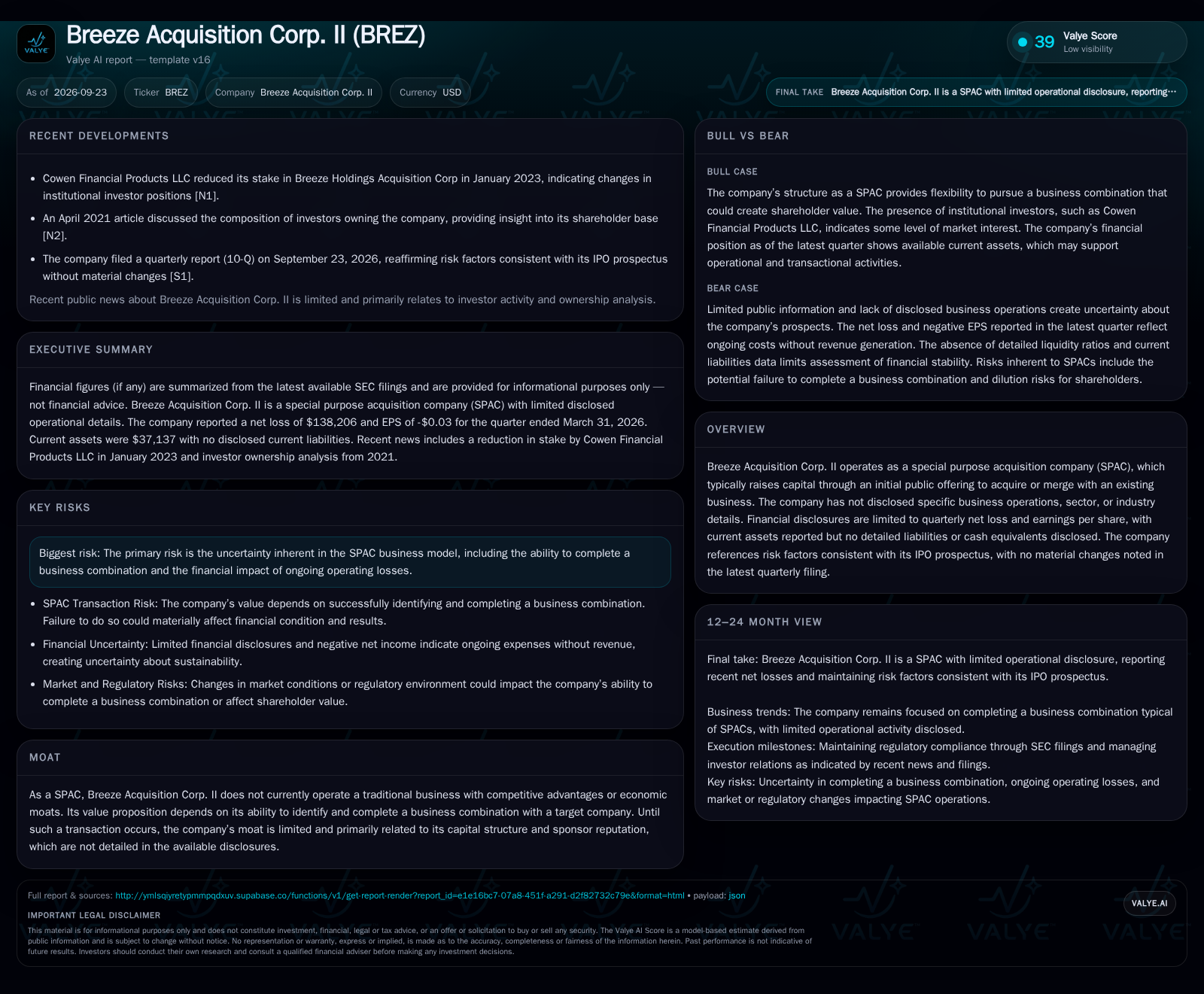
Breeze Acquisition Corp. II is a newly listed SPAC with $125 million raised and no current operations. Its future depends on identifying and closing a business combination within the standard completion window, with all value creation and downside risk tied to deal selection, sponsor incentives, and the broader SPAC environment. Ongoing net losses and minimal current assets outside the trust account emphasize the urgency of executing a transaction before the redemption clock runs out. [S1]
Breeze Acquisition Corp. II exemplifies the modern special purpose acquisition company (SPAC) model: it has raised $125 million in an IPO, holds additional sponsor capital, and has yet to announce any business combination or target sector. With net losses and nearly all cash likely held in trust, Breeze’s future is entirely contingent on its ability to identify, negotiate, and close a deal before the redemption window closes. The interplay of sponsor incentives, market cycles, and the unknowns of target selection define both the upside and the risk for investors at this stage. [S1]
Recent IPO and the SPAC Mandate: Setting the Stage
Breeze Acquisition Corp. II completed its IPO on May 14, 2026, issuing 12.5 million units at $10 per unit for total gross proceeds of $125 million. Simultaneously, the sponsor purchased 447,500 private placement units for $4.475 million. As of March 31, 2026, the company reported a net loss of $138,206 and disclosed minimal current assets outside the trust account, with no operating revenue and no current liabilities reported. The company's filings confirm it had not commenced operations and is focused solely on finding a business combination, with risk factors unchanged since its IPO. This context puts Breeze squarely in the early, pre-combination phase, with the clock now ticking to execute a deal or face redemption requirements. [S1]
How Value Accrues (or Erodes) in the SPAC Model
SPACs like Breeze generate no operating revenue before a business combination. All IPO proceeds—less expenses—are typically held in a trust account, earning modest interest, and are redeemable by public shareholders if no deal is completed within the specified window, usually 18–24 months. The economics for public investors hinge on the quality, timing, and terms of the eventual business combination. If a deal is completed, the value proposition depends on the acquired company's growth prospects and post-merger execution. If no deal occurs, public shareholders can redeem their shares at the pro rata trust value, but warrants and rights may expire worthless.
Sponsor economics are structured for high leverage: founders and insiders receive a substantial equity stake, often 20% of post-IPO equity, for a nominal investment, but only if a deal is consummated. This creates strong incentives to complete any transaction, potentially at odds with public shareholder interests. Operating costs and deal search expenses are funded from proceeds outside the trust, which are usually limited. If the company fails to close a deal, these sunk costs and the sponsor’s initial investment are lost. The capital structure and redemption mechanics mean the company has little flexibility for significant expenditures or investments pre-combination, and negative earnings reflect ongoing G&A and professional fees. [S1]
SPACs Compete for Targets, Not Customers: Sourcing and Incentive Dynamics
Unlike operating companies, Breeze’s competitive set consists of other SPACs and private equity funds seeking attractive merger targets. The SPAC market has grown crowded, with numerous vehicles chasing a finite pool of high-quality companies willing to go public via merger. Sponsor reputation, network, and deal-making experience can be differentiators, but these attributes are not detailed in Breeze’s public disclosures. The absence of a stated sector or geography focus means Breeze can pursue any target, widening its opportunity set but also diluting any claim to specialized sourcing advantages.
Counterforces include target companies’ increasing bargaining power, heightened regulatory scrutiny of SPAC transactions, and investor skepticism following a cycle of underwhelming post-merger performances across the sector. SPACs also compete on deal terms, including valuation, earn-outs, and sponsor concessions. The dilution from warrants, rights, and founder shares remains a structural disadvantage for public investors if the acquired business underperforms.
Catalyst: Securing a High-Quality Merger Target in a Favorable Market
The most favorable outcome for Breeze investors would be the identification and successful merger with a high-growth, scalable private company that leverages the SPAC’s capital and public-listing advantages. In this scenario, the target would bring a compelling story, strong management, and a clear path to value creation, leading to positive investor reception, upside in share price, and warrant/rights value realization.
Evidence that would confirm this pathway includes the announcement of a definitive merger agreement with a well-regarded target, robust PIPE (private investment in public equity) participation signaling institutional confidence, and favorable proxy materials outlining pro forma growth and profitability. Early indications such as sector rumors, insider share purchases (if disclosed), or sponsor participation in additional financing rounds would also support the upside scenario.
Typical SPAC Cycle: Deal Execution Under Time Pressure
The most plausible path is that Breeze, like many SPACs, will announce a business combination within the standard 18–24 month window, likely in a sector with receptive market conditions. The target may be a mid-sized, growth-oriented private company seeking public capital or liquidity. Public shareholders will have the option to redeem their shares at the pro rata trust value if dissatisfied with the deal terms. The share price may track close to trust value until deal closure, with limited warrant or rights value unless the market perceives substantial upside in the target.
Confirmation of this scenario would come from regulatory filings announcing a letter of intent or merger agreement, proxy filings, and the launch of the shareholder vote process. Falsification would be the absence of any deal progress as the redemption deadline approaches, or announcement of a deal that prompts high redemption rates and little PIPE support.
Deal Failure or Poor Target Selection: Risks to Capital and Value
The main downside scenarios are either failure to secure a business combination before the redemption deadline or the completion of a merger with a poor-quality target. In the first case, public shareholders would receive their pro rata share of the trust, but warrants and rights would expire worthless, and sponsors would lose their investment. In the second case, public shareholders who do not redeem could face significant value erosion if the post-merger company underperforms or is subject to high redemptions, leaving it undercapitalized.
Indicators confirming the downside would include repeated deadline extensions, lack of deal announcements, or the selection of a highly speculative or controversial target. High redemption rates, negative market reactions to deal terms, and low PIPE participation would also signal risk to remaining shareholders.
Milestones That Will Define Breeze’s SPAC Trajectory
Announcement of a letter of intent or definitive agreement with a merger target would be the single most material development.
PIPE (private investment in public equity) commitments, if disclosed, would provide insight into institutional investor confidence and deal quality.
Shareholder redemption rates at deal closing would reveal market approval (or skepticism) of the chosen combination.
Any extensions to the business combination deadline, or proxy filings seeking to amend the trust terms, would indicate deal execution risk.
Sponsor or insider participation in additional financing, if disclosed, could signal alignment and confidence.
Public filings or media leaks about target sector, geography, or management team would help clarify deal direction and market fit.
Ongoing G&A burn outside the trust account, if disclosed, would indicate runway for deal sourcing and negotiation.
Disclaimer: This is research-only, informational analysis and not investment advice. It may include AI-generated interpretation and general industry context. Always verify important details using primary sources.

Comments