
SuRo Capital (Neostellar Capital): Externalization, Incentive Structures, and the Search for Scalable Advantage
SuRo Capital’s transition to external management, ongoing regulatory uncertainty, and a performance-independent advisory fee model reshape its risk-reward profile. The company's future will hinge on regulatory outcomes, portfolio performance, and its ability to align incentives in a competitive BDC landscape.
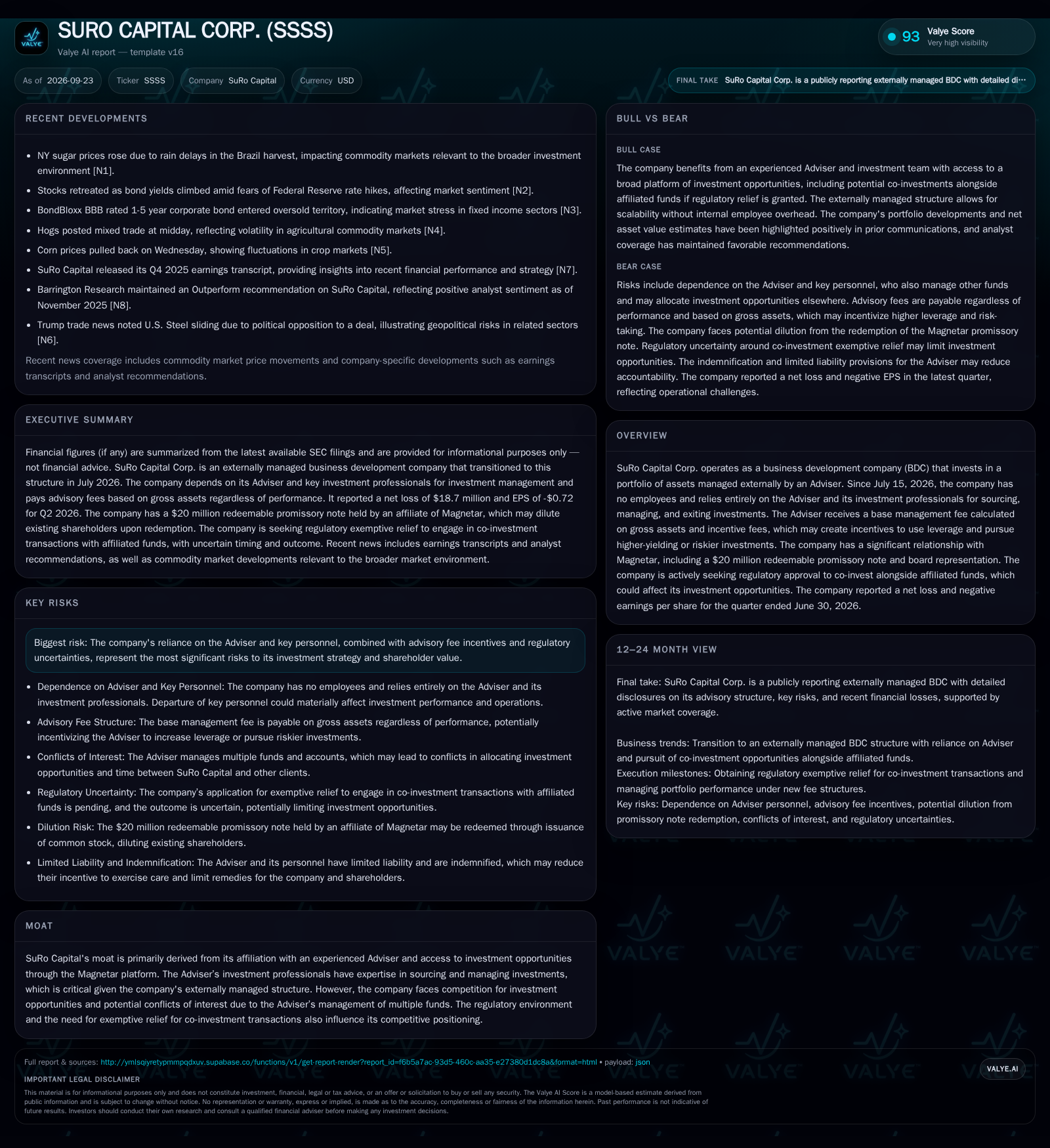
SuRo Capital, now operating as Neostellar Capital, is an externally managed BDC with no employees, relying entirely on its Adviser for investment decisions. The Adviser is compensated on gross assets regardless of performance, creating potential incentive misalignments. The company reported a net loss of $18.7 million for Q2 2026, faces potential shareholder dilution from a $20 million Magnetar note, and is awaiting SEC approval for co-investment relief—factors that could materially shape its value proposition and risk profile in coming quarters. [S1] [S2]
The externalization of SuRo Capital (now Neostellar Capital) marks a pivotal shift in its business model, transferring operational responsibility and investment discretion entirely to an external Adviser. With advisory fees tied to gross assets rather than investment performance, the company’s incentive structure diverges from traditional internally managed BDCs, potentially influencing risk appetite and capital allocation. The company’s recent net loss, pending regulatory approval for co-investments, and possible shareholder dilution from a Magnetar note highlight the critical variables that could determine its trajectory in an increasingly competitive BDC environment. [S1] [S2]
Recent Structural Changes and Financial Results Define the Starting Point
SuRo Capital completed its transformation into an externally managed BDC as of July 15, 2026, eliminating direct employees and placing all investment and administrative responsibilities with its Adviser. This change fundamentally alters the company’s cost structure and operational leverage, tying its fate to the Adviser’s investment acumen and resource allocation. [S1]
The company reported a net loss of $18.7 million for the quarter ended June 30, 2026, with basic and diluted EPS of -$0.72 per share, underscoring recent portfolio or operational headwinds. [S2]
A $20 million redeemable promissory note held by a Magnetar affiliate, bearing 6.5% interest and maturing in 2029, may be mandatorily redeemed through the issuance of common stock, introducing potential dilution for current shareholders. [S1]
SuRo Capital is seeking SEC exemptive relief to co-invest alongside affiliated funds, with timing and outcome uncertain. This pending decision could materially impact future deal flow and portfolio construction. [S1]
Economics Shaped by Fee Structure, Leverage Potential, and Adviser Incentives
As an externally managed BDC, SuRo Capital’s principal cost driver is its advisory agreement: the Adviser receives a base management fee of 1.75% of gross assets, plus a two-part incentive fee. Crucially, these fees are payable regardless of investment performance, meaning that asset growth—rather than net returns to shareholders—becomes a key driver of Adviser compensation. This structure may incentivize the Adviser to pursue leverage or higher-risk assets to maximize managed assets.
Because the company itself has no employees, fixed operating costs are likely low outside advisory and administrative fees. Variable costs are embedded in the Adviser’s platform. However, the lack of internal resources may limit SuRo Capital’s ability to directly monitor investments or respond to portfolio events, increasing dependency on Adviser oversight.
Capital needs are dictated by both the pipeline of investment opportunities and the company’s ability to raise or recycle capital through exits. The presence of a sizable redeemable note (Magnetar) introduces potential for dilution if repaid in stock, which could affect per-share economics and shareholder returns.
Operating leverage is largely a function of scaling assets under management: as assets grow, some administrative expenses may remain fixed, but advisory fees scale in direct proportion, which may limit margin expansion unless portfolio returns are strong enough to outpace fee drag.
Access, Conflicts, and the Challenge of Differentiation in BDC Investing
SuRo Capital’s competitive positioning is closely tied to its Adviser’s platform, reputation, and sourcing network. The potential for co-investment alongside affiliated funds, if SEC relief is granted, could expand access to larger or more attractive deals, potentially improving portfolio quality and diversification.
However, external management introduces inherent conflicts of interest: the Adviser manages multiple funds and may allocate the best opportunities elsewhere, especially if compensation structures differ across vehicles. This creates the risk that SuRo Capital becomes a secondary allocation for less attractive or more speculative assets.
The BDC sector is intensely competitive, with both internally and externally managed players vying for yield, proprietary deal flow, and scale advantages. Larger BDCs or those with greater access to low-cost capital may outcompete SuRo Capital on pricing or terms. Furthermore, the company’s advisory fee model is not unique within the sector, reducing the likelihood of a structural cost advantage.
Potential substitutes include direct lending funds, private credit vehicles, and other specialty finance companies, all of which compete for similar assets and investor capital. Regulatory uncertainty around co-investment only heightens the risk of being edged out from the most desirable deals.
If Regulatory Relief and Adviser Alignment Converge, Value Creation Could Accelerate
A favorable trajectory for SuRo Capital hinges on two main developments: successful SEC exemptive relief for co-investment and demonstrable Adviser alignment with shareholder interests. If the company secures the ability to co-invest alongside affiliated funds, it could participate in a wider array of high-quality deals, diversify its portfolio, and potentially boost returns.
Upside would be further supported if the Adviser’s investment team, led by CEO Mark D. Klein and CFO Allison Green, is able to source and manage investments that outperform peers, leveraging their experience and network.
Evidence confirming this scenario would include regulatory approval for co-investment, an uptick in portfolio IRR or realized gains, narrowing of the NAV discount, and positive analyst revisions to NAV or earnings outlooks. A decline in the net loss trend—or a pivot to profitability—would further confirm operational momentum. Increased analyst coverage or new large-scale investments would also be supportive. [N7] [N8]
External Management Drives Mixed Outcomes Amid Portfolio and Regulatory Uncertainties
The most plausible scenario is one in which SuRo Capital continues to operate as a smaller, externally managed BDC, with performance closely tracking the Adviser’s ability to source attractive investments and manage risk. The company may experience moderate asset growth, but fee drag and competition for deals could limit net returns to shareholders.
If regulatory relief for co-investment is delayed or denied, the company’s opportunity set may remain constrained, and it could be relegated to secondary or less competitive deals. The potential dilution from the Magnetar note conversion may further weigh on per-share results.
Confirmation of this scenario would be a continuation of modest portfolio turnover, persistent but narrowing net losses, stable or slowly accretive NAV per share, and steady but unremarkable analyst coverage. Regulatory limbo, limited deal flow, or flat portfolio marks would reinforce this middle path. [S1] [S2]
Misaligned Incentives and Regulatory Setbacks Could Deepen Value Erosion
The most adverse scenario involves a combination of persistent net losses, failure to secure SEC co-investment relief, and misalignment between Adviser incentives and shareholder value. If the Adviser prioritizes asset growth over prudent risk management—or allocates the best deals to other managed vehicles—portfolio performance could deteriorate further.
Additional risks include forced redemption of the Magnetar note into common stock during periods of weak share price, exacerbating dilution and potentially triggering a negative feedback loop for NAV and market value. Further, if key Adviser personnel depart or conflicts of interest become pronounced, SuRo Capital could struggle to attract or retain quality investments.
Downside signals would include widening net losses, NAV erosion, negative analyst revisions, regulatory rejection or protracted delays, and increased headline risk around conflicts or governance. A meaningful drop in market value relative to NAV or a spike in share count due to note conversion would further confirm a deteriorating scenario.
Milestones and Data Points That Will Clarify SuRo Capital’s Alignment and Opportunity Set
Outcome and timing of SEC exemptive relief for co-investment transactions with affiliated funds—approval would signal greater opportunity set, while denial would constrain deal flow.
Magnitude and composition of net investment income and net realized/unrealized gains or losses—a sustained move toward profitability would validate portfolio strategy.
Management fee and incentive fee trends as a percentage of assets—a useful metric would be the ratio of fees to total returns, testing whether fee structure is impairing shareholder value.
Changes in net asset value (NAV) per share and market value relative to NAV—persistent discounts may indicate market skepticism about Adviser alignment or portfolio quality.
Magnitude and timing of Magnetar note redemption—if converted to common stock, tracking resultant dilution and share count changes is critical.
Portfolio turnover and new investment announcements—high-quality deal flow and realizations would suggest Adviser effectiveness.
Disclosures on Adviser conflicts of interest and allocation policies—greater transparency would help assess risk of adverse selection.
If disclosed, Adviser personnel stability and retention, particularly for key investment decision-makers.
Disclaimer: This is research-only, informational analysis and not investment advice. It may include AI-generated interpretation and general industry context. Always verify important details using primary sources.

Comments