
Crona Corp.: Early-Stage Casket Import Ambition Meets Severe Financial and Execution Hurdles
Crona Corp. targets the U.S. funeral products market with imported, competitively priced caskets, but acute financial distress, zero revenue to date, and minimal operating capacity leave its business model unproven and highly vulnerable. The company’s future hinges on securing new funding and demonstrating commercial traction in a mature, cost-competitive industry.
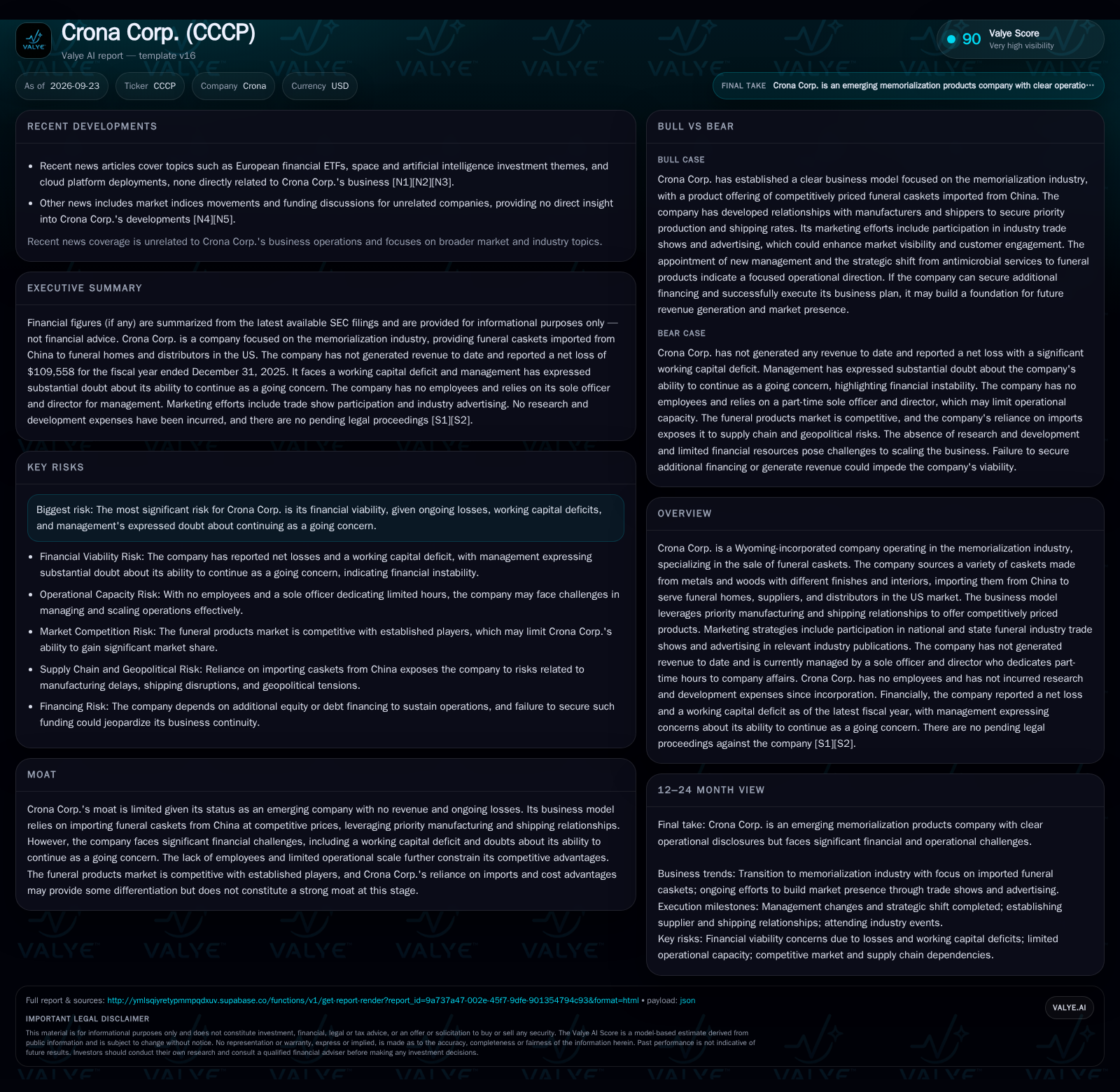
Crona Corp. has pivoted to the memorialization industry, aiming to sell imported funeral caskets to U.S. funeral homes and distributors by leveraging priority manufacturing relationships in China. However, the company has not generated any revenue, reports ongoing losses, and faces a substantial working capital deficit, with management expressing serious doubts about its ability to continue as a going concern. Its commercial model, execution capacity, and ability to withstand competitive or supply chain shocks remain highly uncertain. [S1] [S2]
Crona Corp. presents a stark case of early-stage ambition confronting the realities of a capital-intensive, low-margin industry. Having pivoted from antimicrobial services to importing funeral caskets for the U.S. market, the company touts priority supply chain relationships and a focus on cost competitiveness. Yet, not a single dollar of revenue has been realized, and management’s own disclosures highlight severe financial distress and doubts about ongoing viability. With no employees and only a part-time executive, the company’s ability to execute, build relationships, and withstand shocks is in question. Crona’s future will depend on its capacity to raise capital, deliver commercial proof points, and survive in a market that rewards scale and reliability. [S1] [S2]
Acute Financial Strain and Unproven Commercial Model Define Crona’s Status
Crona Corp. has not generated any revenue since its inception and reported a net loss of $109,558 for the year ended December 31, 2025. As of September 30, 2025, the company faced a working capital deficit of $298,501 and management has explicitly stated substantial doubt about its ability to continue as a going concern. The company’s sole officer and director works only part-time, and there are no employees. Crona relies entirely on additional equity or debt financing to maintain operations, with no evidence of commercial uptake or customer traction as of the latest filings. [S1] [S2]
These facts matter because they signal that Crona remains in a pre-revenue, pre-commercialization phase, with acute financial stress and virtually no organizational or operational infrastructure. The company’s survival depends on external funding and a rapid transition from concept to execution in a highly competitive, low-margin sector.
Import-Driven, Price-Focused Model Faces High Fixed Costs and Thin Margins
Crona’s business model is predicated on importing funeral caskets from Chinese factories and selling them to U.S. funeral homes, suppliers, and distributors at competitive prices. Theoretically, the ability to secure priority manufacturing and shipping could enable Crona to undercut traditional domestic suppliers or offer better availability. However, the company’s lack of revenue to date means the unit economics are unproven.
In the funeral casket industry, margins are typically modest, with cost of goods, shipping, warehousing, and distribution representing a significant portion of the sale price. Fixed costs—such as warehousing, compliance, and marketing—can be leveraged over scale, but Crona’s current zero-revenue status means fixed expenses (professional fees, general administrative costs) have not been offset by any sales. With no employees, execution is dependent on a single part-time officer, likely constraining deal flow, customer acquisition, and supply chain management.
The business requires up-front capital for inventory, logistics, and trade show marketing, but Crona’s working capital deficit and lack of financing raise questions about whether it can even assemble an initial inventory or meet customer delivery expectations. If financing is secured and sales begin, Crona could see some operating leverage—yet, in a mature market, price competition and customer switching inertia may cap gross margin expansion.
Entering a Mature, Relationship-Driven Market with Minimal Differentiation
The U.S. funeral products market is mature and highly competitive, dominated by entrenched manufacturers and distributors with long-standing relationships with funeral homes and purchasing cooperatives. Price is a factor, but reliability, product quality, logistics, and service responsiveness are often more important in customer retention.
Crona’s only stated edge is priority manufacturing and shipping relationships in China, which may allow slightly lower pricing or improved availability. However, competing on price alone is rarely sustainable in this industry, as established players can match price cuts and offer better terms or service. Furthermore, Crona’s lack of brand, reputation, and operational scale makes it difficult to win over risk-averse funeral home customers.
The company’s reliance on Chinese imports also exposes it to geopolitical risk, shipping disruptions, and potential tariffs, which could erase any cost advantage. Without a demonstrated ability to deliver consistently and support customers, Crona’s market entry will likely be met with skepticism or indifference unless it can rapidly prove reliability and value.
What It Would Take for Crona to Achieve Commercial Traction
The most favorable scenario for Crona would involve securing sufficient bridge financing to fund initial inventory, sales efforts, and marketing—allowing the company to fulfill its first orders and demonstrate reliable delivery. If Crona’s cost structure is truly superior due to priority manufacturing relationships, and if it can pass those savings to customers while maintaining acceptable margins, it could attract price-conscious funeral homes or distributors, particularly those underserved by current suppliers.
A credible upside chain would involve: (1) financing secured; (2) first commercial orders fulfilled without quality or delivery issues; (3) repeat orders or multi-unit contracts from initial customers; and (4) visible growth in trade show leads or inbound inquiries. Evidence confirming this scenario would include announced customer contracts, recognized revenue, and positive gross margins in future filings.
Falsification would come from continued absence of revenue, inability to fulfill orders, or failure to secure funding—indicating the business model remains purely aspirational.
Stalled at the Starting Line: Most Plausible Near-Term Outlook
Given the acute working capital deficit, lack of employees, and zero revenue, the most likely outcome is continued operational stasis unless Crona can rapidly secure external financing. Even with new funding, execution risk remains high: building inventory, establishing logistics, and winning customer trust are challenging for a minimally staffed, unknown entrant.
Should Crona secure limited capital, it may be able to fund a small inventory run and attend more trade shows, but customer conversion rates in this category tend to be slow without a compelling differentiator. The company could remain in a pre-revenue or minimal-revenue phase for several quarters, burning cash on overhead and marketing with little commercial impact.
This scenario would be confirmed by continued low or zero revenue, persistent net losses, and further going-concern language in future filings. Evidence of progress would include new financing, first revenue recognition, or hire(s) to expand operating capacity.
Acute Liquidity Crunch Could Force Cessation or Restructuring
In the adverse scenario, Crona fails to secure necessary funding and is unable to cover basic operating expenses, leading to a forced halt in operations. The company’s sole officer and director working part-time means there is little capacity to pursue alternative strategies, renegotiate supplier terms, or sell assets. In this scenario, Crona could default on payables, lose supplier relationships, and be forced to wind down or seek protection from creditors.
Confirmation would come from further deteriorating balance sheet metrics, explicit default or legal proceedings, or formal announcements of business cessation. Falsification would require new sources of capital, cost restructuring, or an unexpected commercial breakthrough that stabilizes the business.
Milestones That Will Test Crona’s Ability to Transition from Concept to Commercial Reality
Evidence of secured bridge or growth financing—equity or debt—would be the first sign Crona can fund basic operations and inventory build.
First recognized revenue from casket sales, even at small scale, would indicate initial commercial traction and test the company’s ability to fulfill orders.
Gross margin on early sales (if disclosed) would help determine whether Crona’s import-driven model delivers sustainable economics or simply passes through cost savings at minimal profit.
Hiring of operational staff or expansion of management bandwidth would suggest greater commitment to execution and scaling.
Supplier or logistics disruptions—such as delays, cost increases, or loss of priority status—would test the resilience of Crona’s supply chain advantage.
Repeat business or multi-unit orders from initial customers would validate Crona’s value proposition and hint at the possibility of scaling.
Any changes in industry regulatory or tariff environment affecting Chinese imports could materially impact Crona’s cost structure and viability.
Inclusion in trade show exhibitor lists or industry publications (if disclosed) would provide evidence that Crona is actively marketing and building visibility.
Disclaimer: This is research-only, informational analysis and not investment advice. It may include AI-generated interpretation and general industry context. Always verify important details using primary sources.

Comments