
General Mills: Portfolio Reshaping and Liquidity Friction in a Shifting Consumer Staples Landscape
As the company pivots through divestitures and operational transformation, the ability to translate pricing power and product mix into sustainable profit growth emerges as the central challenge.
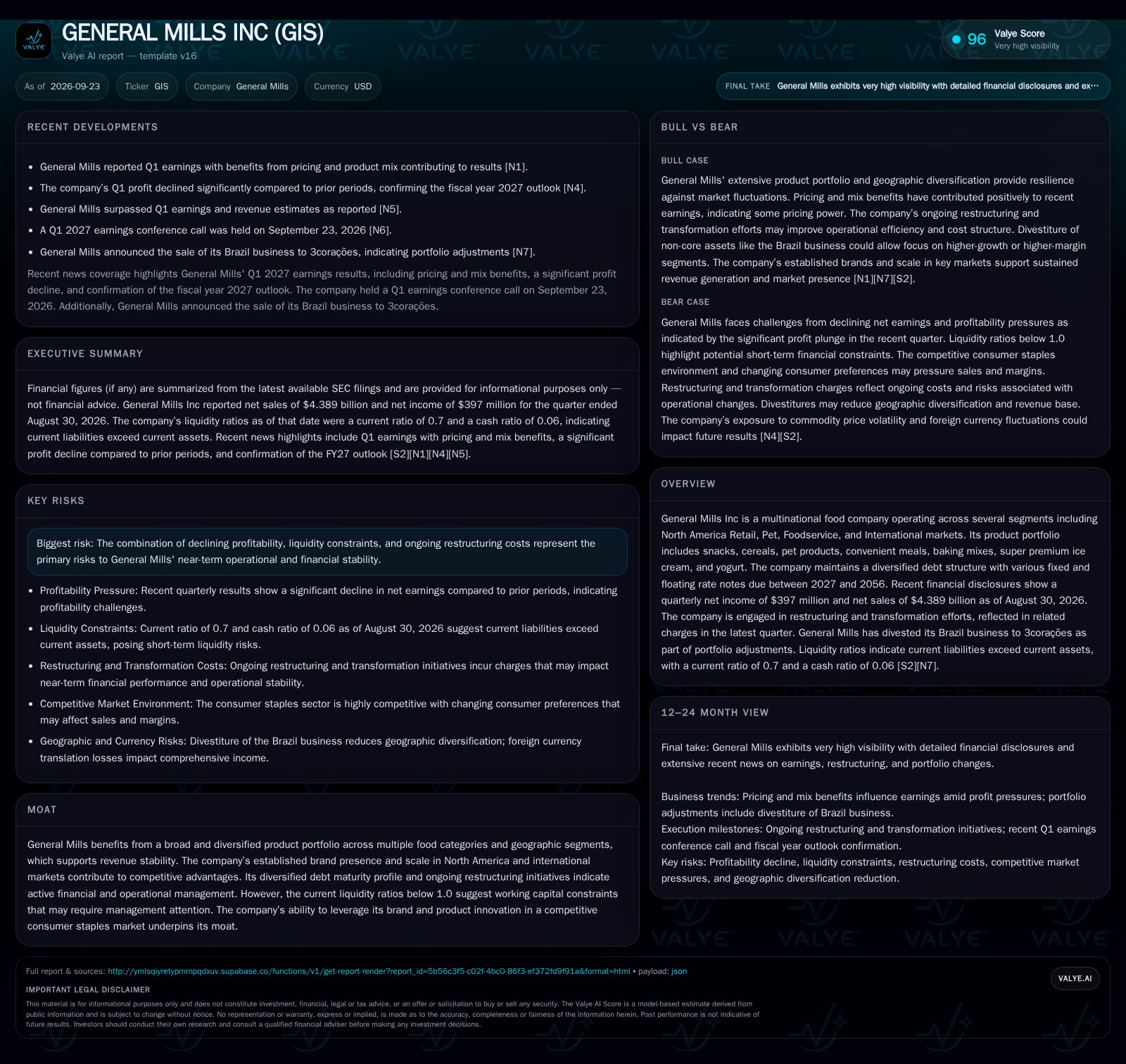
General Mills reported Q1 net sales of $4.389 billion and net income of $397 million, but profitability fell sharply year-over-year. Ongoing restructuring, a divestiture in Brazil, and a current ratio of 0.7 highlight both portfolio focus and short-term liquidity tension. The company's ability to offset cost pressures and maintain brand strength in a competitive market will be critical over the coming quarters. [S2] [N1] [N4] [N7]
General Mills enters fiscal 2027 at a strategic crossroads: while its global portfolio of branded foods delivered $4.389 billion in Q1 sales, net earnings have dropped sharply and liquidity ratios have slipped below comfort levels. Ongoing restructuring and the Brazil divestiture reflect a company in active transition, seeking to sharpen operational focus and defend margins in a consumer staples market facing cost inflation and evolving shopper preferences. The next phase will test whether General Mills’ scale and brand equity can offset financial and competitive headwinds.
Restructuring Costs, Declining Profits, and Portfolio Focus Shape the Current Quarter
General Mills reported net sales of $4.389 billion and net income of $397 million for the quarter ended August 30, 2026—a steep decline from $1.204 billion in net earnings during the same quarter last year. Operating profit was $633.6 million, with cost of sales at $2.902 billion. The company incurred $21.4 million in restructuring, transformation, impairment, and other exit costs during the quarter, signaling ongoing operational changes. General Mills also completed the divestiture of its Brazil business, sharpening its portfolio focus but reducing geographic diversification. These facts frame a period of significant transition, with profitability and liquidity under pressure as the company seeks to reposition for future growth. [S2] [N1] [N4] [N7]
How General Mills Converts Brand Scale into Cash Flow—And Why Margin Leverage Matters
General Mills’ business model relies on converting the scale and reach of its branded food portfolio—spanning cereals, snacks, pet products, and more—into steady revenue through retail, foodservice, and international channels. Historically, the company has achieved relatively stable gross margins by leveraging its brand equity to could support premium pricing and a broad distribution network, while managing costs through supply chain optimization and product mix.
Pricing and mix contributed positively to Q1 results, suggesting some ability to pass costs to consumers. However, with cost of sales at $2.902 billion against $4.389 billion in sales, margin pressure remains acute—a dynamic exacerbated by commodity inflation and changing consumer habits. The company's restructuring charges further reduce near-term profit conversion, while the low current and cash ratios highlight exposure to working capital pinch points and potential refinancing needs.
Fixed costs related to manufacturing, marketing, and R&D create operating leverage: incremental sales can drive profits higher if volumes and pricing hold, but cost shocks or volume declines can quickly erode margins.
Brand Power and Category Breadth vs. Retailer Bargaining and Private Label Threats
General Mills’ moat is rooted in its portfolio of established brands and broad product reach across categories like cereal, snacks, and pet foods. This enables shelf presence, consumer recognition, and negotiating leverage with retailers. However, the consumer staples sector remains intensely competitive: private label offerings, aggressive promotions from peers, and evolving consumer trends (such as demand for healthier or more convenient options) all pose persistent threats.
Retail customers (supermarkets, mass merchants, e-commerce platforms) continue to consolidate buying power, pressuring branded suppliers on price and terms. At the same time, the shift toward digital retail and direct-to-consumer channels introduces both opportunity and risk—potentially lower distribution costs, but also fiercer competition and the need for digital marketing investment.
Internationally, General Mills’ divestiture of the Brazil business reduces geographic reach, increasing reliance on North American and select international markets. This could sharpen focus but also heighten exposure to regional competitive dynamics and macroeconomic swings.
If Restructuring Unlocks Margin Expansion and Brand Innovation Spurs Growth
The favorable scenario sees General Mills’ restructuring and portfolio moves (such as the Brazil divestiture) yielding a leaner, more focused organization with improved cost discipline. If management successfully streamlines operations, reduces overhead, and reallocates capital toward higher-margin or faster-growing categories (e.g., pet products, premium snacks), operating margins could expand even in the face of moderate top-line growth.
Further, if the company leverages its brand equity to introduce successful new products or premium line extensions, it could capture additional pricing power and consumer loyalty—offsetting competitive and input cost pressures. Confirmation of this scenario would come from sustained gross and operating margin improvement, reduced restructuring charges, and signs of market share gains in core categories.
A reversal of the current liquidity strain—evidenced by improved current and cash ratios through working capital management or asset sales—would also support this upside. Robust free cash flow generation and debt reduction could further enhance potential financial flexibility and shareholder returns.
Operational Adjustments Partially Buffer Margin Pressure Amid Competitive Headwinds
The most plausible outcome is that General Mills manages to stabilize its profitability through a combination of modest pricing actions, incremental product innovation, and ongoing cost control, but does not achieve a full margin or earnings rebound in the near term. Market share in core categories is maintained, but growth is incremental and closely tied to broader consumer staples demand trends.
Restructuring and transformation costs remain a drag on reported earnings for several more quarters, but operational improvements gradually materialize, allowing the company to maintain its dividend and service debt. Liquidity ratios improve only modestly, as working capital remains tight and cash balances are managed cautiously.
Evidence supporting this scenario would include stable or slightly improving gross margins, consistent (if unspectacular) sales performance in key segments, and a gradual reduction in restructuring charges and impairment costs. Conversely, further significant declines in profitability or persistent liquidity stress would falsify this base case.
Margin Compression, Liquidity Stress, and Competitive Losses Undermine Stability
The adverse scenario unfolds if cost inflation, competitive pricing, or consumer downtrading overwhelm General Mills’ ability to sustain margins. If restructuring fails to deliver cost savings or disrupts core operations, operating profit could deteriorate further. Persistent liquidity stress—evidenced by a prolonged current ratio below 1.0 and a cash ratio near zero—could force asset sales, dividend cuts, or costly refinancing.
In this scenario, the loss of geographic diversification (post-Brazil divestiture) amplifies exposure to North American market pressures, and the company may cede shelf space or market share to private labels or more agile competitors. Confirmation would come from continued profit declines, negative free cash flow, mounting short-term debt, or evidence of forced portfolio actions under duress.
Quantitative and Strategic Markers That Will Clarify General Mills’ Resilience
Quarterly gross and operating margin trends—evidence of margin recovery or further compression would test the impact of restructuring and pricing actions.
Progress on restructuring and transformation charges—declining costs would suggest operational improvements are taking hold.
Sales and market share performance in core categories (especially cereals, snacks, and pet products)—stable or growing share would support brand strength.
Evidence of successful new product launches or premium line extensions—a useful metric would be revenue contribution from new products, if disclosed.
Debt maturity management and refinancing activity—favorable terms or debt reduction would improve potential financial flexibility.
International segment performance post-Brazil divestiture—growth or margin improvement in remaining geographies would test geographic focus.
Disclaimer: This is research-only, informational analysis and not investment advice. It may include AI-generated interpretation and general industry context. Always verify important details using primary sources.

Comments