
The company reported cash and liquidity metrics for the period; these figures do not by themselves establish operating runway, investment capacity, financial flexibility, or financing capacity.
Securetech Innovations, Inc. faces a challenging operational environment in 2026, marked by restated financials, a material weakness in internal controls, and a net loss despite multi-million dollar revenues.
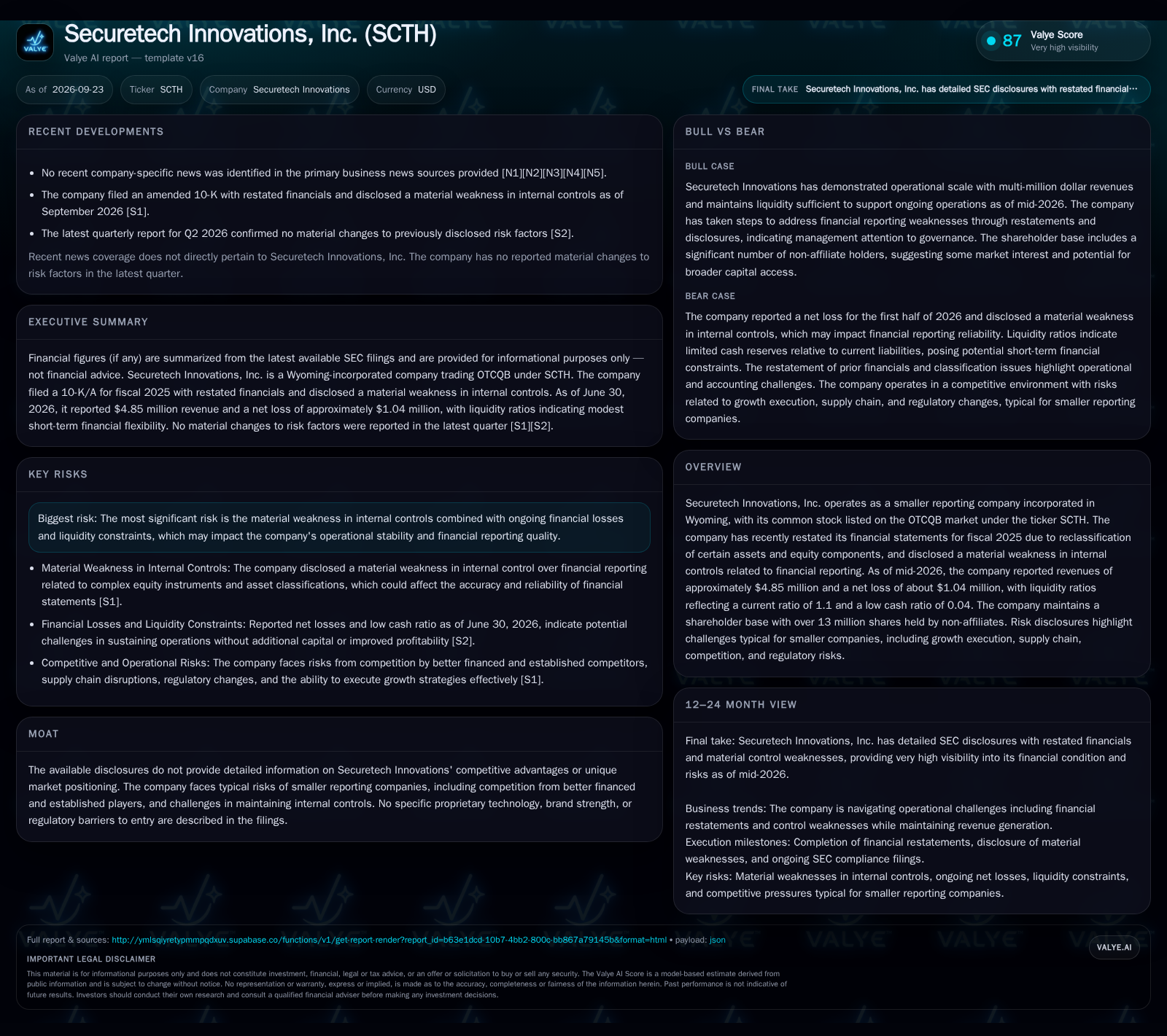
Securetech Innovations, Inc. reported $4.85 million in revenue and a $1.04 million net loss for the first half of 2026, restated its financials, and disclosed a material weakness in internal controls. [S1] [S2]
Securetech Innovations, Inc., a Wyoming-based OTCQB-listed company, finds itself at a critical juncture in 2026. The company’s recent restatement of financials and a material weakness in internal controls have amplified scrutiny of its operational discipline, while six-month revenues of $4.85 million and a net loss of $1.04 million underscore the ongoing challenge of achieving profitability. [S1] [S2]
Restatements, Losses, and Liquidity: The Immediate State of Securetech
In the first half of 2026, Securetech Innovations reported $4,852,716 in revenue and a net loss of $1,039,954, translating to a basic and diluted loss per share of $0.06. The company amended its 2025 annual report to restate certain accounts receivable and equity classifications, and disclosed a material weakness in internal control over financial reporting—specifically tied to complex equity instruments and asset classifications. As of June 30, 2026, Securetech held $311,711 in cash and cash equivalents, with current assets of $9,458,668 and current liabilities of $8,625,056. No material changes to risk factors have been reported since the last quarter, leaving the company’s operational and financial vulnerabilities in sharp focus. [S1] [S2]
Beyond the immediate financial figures, the interplay between liquidity and working capital management is critical to understanding Securetech’s near-term operational viability. The relatively narrow gap between current assets and liabilities suggests limited buffer against unforeseen expenses or revenue shortfalls. If accounts receivable collections slow or inventory turnover declines, cash flow pressures could intensify rapidly. Moreover, the disclosed material weakness in internal controls may not only affect financial statement reliability but also hinder timely cash management and forecasting, compounding liquidity risks. A detailed examination of the company’s cash conversion cycle and the quality of current assets would help assess whether reported liquidity is truly accessible and sustainable.
Revenue Scale, Cost Structure, and the Pressure of Thin Margins
Securetech’s ability to generate nearly $5 million in half-year revenues demonstrates some operational scale; however, persistent net losses suggest that either gross margins are thin, operating expenses are high relative to revenue, or one-off costs (such as those associated with financial restatements and controls remediation) are weighing on results. As a smaller reporting company, Securetech likely faces limited pricing power and may be compelled to compete on price or flexibility, compressing gross margins. Fixed costs (administrative, compliance, and possibly R&D if the company is developing new products or technologies) may not be fully leveraged at current revenue levels, making profitability highly sensitive to revenue growth or cost containment. If the company’s revenue is project-based or transactional rather than recurring, income volatility could further constrain its ability to plan and invest.
The cost structure’s fixed versus variable composition is a pivotal determinant of Securetech’s scalability and margin resilience. If a significant portion of operating expenses is fixed, the company faces high operating leverage, meaning small revenue declines could disproportionately impact profitability. Conversely, a more variable cost base would allow for greater flexibility in adjusting to market fluctuations but might also limit the ability to invest in growth initiatives. Additionally, the presence of one-time charges related to remediation efforts inflates operating expenses temporarily but may yield long-term benefits if controls are strengthened. Evaluating the trajectory of these costs and their proportion to gross profit over multiple periods would clarify whether Securetech’s financial challenges stem from structural inefficiencies or transitional investments.
Market Dynamics: Competition, Differentiation, and Barriers to Entry
Securetech operates in a segment characterized by intense competition from larger, better-capitalized firms as well as numerous smaller players. The absence of disclosed proprietary technology, unique regulatory advantages, or strong brand positioning suggests that the company’s competitive moat is weak. In such environments, customer switching costs are usually low and price sensitivity is high, especially if products or services are commoditized. Without clear evidence of recurring revenue, a differentiated platform, or a sticky ecosystem, Securetech’s customer relationships may be transactional and vulnerable to churn. Regulatory compliance and supply chain reliability are likely additional challenges, as established competitors may be better equipped to absorb shocks or invest in process improvements. For Securetech to strengthen its position, it would need either a technological edge, exclusive partnerships, or a niche market segment less exposed to pure price competition.
In markets characterized by commoditization and low switching costs, differentiation often hinges on service quality, integration capabilities, or customer experience rather than solely on product features. Securetech’s competitive position could be enhanced if it leverages operational agility or niche expertise to tailor solutions that larger competitors cannot efficiently replicate. Strategic partnerships or alliances, even if not exclusive, might create incremental barriers to entry or foster customer stickiness through bundled offerings. However, without demonstrable recurring revenue models or intellectual property protections, the company remains vulnerable to aggressive pricing tactics and innovation cycles driven by better-capitalized rivals. Monitoring customer retention rates and contract renewal patterns would provide insight into the durability of Securetech’s market foothold.
What Would a Turnaround Look Like? Triggers for Sustainable Profitability
A favorable outcome for Securetech hinges on two major developments: remediation of its internal control weaknesses and a shift to sustained profitability. If the company successfully addresses its financial reporting controls—demonstrated by clean future audit opinions and no further restatements—investor confidence could improve, potentially unlocking new sources of capital or partnership opportunities. On the operating side, margin improvement could come from a combination of higher-value contracts, increased pricing power, or a more efficient cost structure. Evidence that would confirm this scenario includes consecutive quarters of positive net income, rising gross margins, and stable or growing cash balances. Additional proof points would be new long-term customer agreements, recurring revenue streams, or disclosures of differentiated technology or exclusive market access. Conversely, ongoing losses, further restatements, or additional control weaknesses would falsify the turnaround thesis.
Maintaining Operations Amid Constraint: The Most Plausible Trajectory
The most likely path for Securetech is continued operation with marginal improvements but persistent financial and operational constraints. The company may stabilize revenue near current levels, with periodic losses offset by cost management or incremental efficiency gains. Liquidity will likely remain tight, requiring careful working capital management and possibly opportunistic capital raises. Any progress on internal controls could reduce audit and compliance costs over time, but the absence of a clear competitive differentiator means that revenue growth will be hard-won and margins will remain under pressure. Confirmation of this scenario would include stable or slightly improving financial metrics, absence of further major restatements, and continued but unspectacular revenue performance. If the company is unable to control expenses or if liquidity worsens, the risk of operational disruption or dilutive financing will increase.
What Could Go Wrong? The Risks of Control Failures and Capital Strain
The adverse scenario centers on the persistence or worsening of financial reporting weaknesses and liquidity erosion. If Securetech fails to remediate its material weakness in internal controls, the company could face further restatements, regulatory scrutiny, and loss of stakeholder trust. In a worst-case scenario, supply chain shocks, competitive losses, or regulatory setbacks could compound these pressures, accelerating losses and jeopardizing the company’s ability to continue as a going concern. Confirming evidence would include additional restatements, declining current and cash ratios, missed payments, or going concern warnings in future filings.
What Will Determine Securetech’s Next Chapter?
Progress in remediating the disclosed material weakness in internal controls, as evidenced by future audit opinions or management disclosures.
Quarterly gross margin and operating expense trends, which would reveal whether the company is moving toward profitability or further losses.
Changes in the cash and cash equivalents balance, especially relative to current liabilities and accounts payable.
Any new disclosures regarding long-term customer contracts, recurring revenue streams, or differentiated technology offerings.
Evidence of capital raising activity—such as new equity or debt issuance—that could impact dilution or long-term viability.
The status of supply chain reliability and any disruptions reported in filings or management commentary (if disclosed).
Updates to risk factor disclosures, particularly around competitive threats, regulatory changes, or additional operational vulnerabilities.
Shareholder composition and trading liquidity, which would affect both market perception and the company’s ability to raise capital on favorable terms.
Disclaimer: This is research-only, informational analysis and not investment advice. It may include AI-generated interpretation and general industry context. Always verify important details using primary sources.

Comments