
Amesite’s AI Healthcare Vision: Advancing NurseMagic™ from Early Success to Broad Impact
Amesite Inc. is leveraging proprietary AI and a tiered SaaS model to target documentation and workflow pain points in post-acute healthcare. Substantial recent product adoption and enterprise launches point to early momentum, but modest revenue, persistent losses, and competitive headwinds underscore the challenge of converting innovation into durable scale.
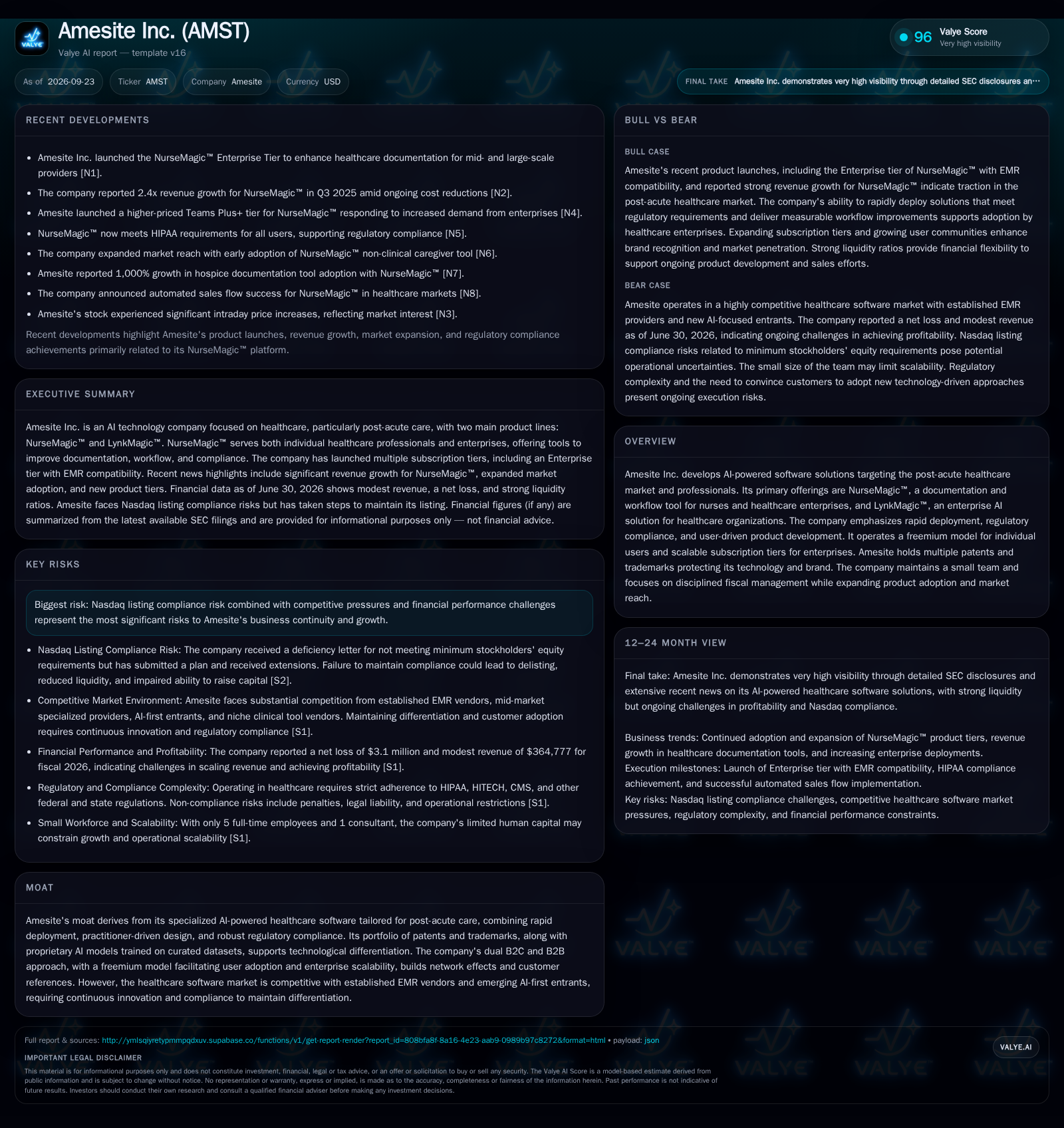
Amesite has launched and expanded its AI-powered NurseMagic™ platform, reporting strong adoption growth and new enterprise deployments in the post-acute care market. While the company’s freemium-to-enterprise SaaS strategy and patent portfolio offer potential for differentiation, its modest revenue base, ongoing net losses, and exposure to intense competition and Nasdaq compliance risks highlight the need for continued execution and scale to justify its ambitions. [S1] [N1] [N2] [N4] [N7]
Amesite Inc. is attempting to carve out a niche in post-acute healthcare by delivering AI-powered documentation and workflow tools for nurses, caregivers, and providers. The company’s NurseMagic™ platform has recorded notable adoption surges and enterprise launches, especially in hospice and non-clinical caregiving segments. Yet, with modest revenue, persistent losses, and a lean team, Amesite’s challenge is to transform early traction into scalable, profitable growth—while navigating compliance, competition, and the inherent inertia of the healthcare sector. The next phase will test whether its technology and go-to-market model can overcome these structural hurdles.
Recent Enterprise Wins and Product Expansion Highlight Amesite’s Immediate Momentum
Several recent developments stand out for Amesite. First, the company launched a census-based Enterprise tier for NurseMagic™ with EMR compatibility and automated interdisciplinary team reporting, targeting mid- and large-scale healthcare providers [N1] [S1]. Second, reported 1,000% growth in hospice documentation tool adoption and early market traction for non-clinical caregiver solutions underscore that demand exists across multiple subsegments [N7] [N6]. Third, Amesite reported 2.4x revenue growth for NurseMagic™ in Q3 2025 and introduced a higher-priced Teams Plus+ tier in response to enterprise demand, suggesting some willingness to pay for advanced features [N2] [N4]. However, for the fiscal year ended June 30, 2026, total revenue remained modest at $364,777 with a net loss of $3.1 million and only 5 full-time employees, highlighting the gap between adoption headlines and financial scale [S1]. These facts set the stage for evaluating whether the company’s product momentum can translate into sustainable economics and market share.
Exploring the Freemium-to-Enterprise SaaS Model: Strengths and Challenges
Amesite’s business model relies on a tiered SaaS structure: a free version for individual nurses and caregivers, subscription-based tiers for teams and enterprises, and a newly launched Enterprise tier with census-based pricing and EMR compatibility. This approach is designed to lower adoption friction at the individual level (B2C) while capturing higher-value contracts at the enterprise level (B2B). If executed well, such a model can create operating leverage, as incremental software deployments typically carry low variable costs relative to fixed development and compliance investments.
However, the company’s modest revenue base and ongoing net losses highlight the early-stage nature of its economics. The key test will be whether enterprise deployments—such as the recent 2,700-patient contract—can scale meaningfully and drive a shift in revenue mix toward larger, longer-term contracts.
A crucial unknown is churn and retention: the freemium approach can accelerate user acquisition but often yields lower per-user economics unless conversion to paid tiers is robust. Without disclosed customer retention or upsell rates, the sustainability of revenue growth remains uncertain.
Maintaining a Distinct Position in the Competitive Healthcare Software Market
Amesite operates in a sector dominated by large, well-capitalized EMR vendors, mid-market workflow tool providers, and a new wave of AI-first software entrants. The company’s patent portfolio, proprietary AI models, and HIPAA/EMR compliance provide necessary—though not sufficient—defenses in a highly regulated, risk-averse environment. Its dual B2C and B2B go-to-market strategy, supported by influencer partnerships and digital marketing, may help build grassroots adoption and enterprise credibility.
Still, established EMR providers possess deep customer relationships, integration footholds, and regulatory expertise. For Amesite, the real challenge is not just technological differentiation but embedding itself in already-crowded clinical workflows—where switching costs, IT inertia, and procurement cycles can be formidable. The company’s ability to demonstrate measurable ROI (e.g., documentation time saved, compliance gains) will be critical for conversion and retention, especially as larger competitors begin to integrate AI-driven tooling into their own offerings.
How Enterprise Adoption Could Transform Early Progress into Sustainable Growth
The favorable scenario sees Amesite’s recent enterprise wins and product launches catalyzing a virtuous cycle: successful deployments lead to strong reference customers, which in turn unlock larger contracts and broader adoption across the fragmented post-acute care landscape. As more providers adopt the EMR-compatible Enterprise tier, integration frictions decrease, and the company is able to upsell additional modules and expand seat counts within existing accounts.
If retention is high and the company can demonstrate clear value—such as quantifiable reductions in documentation time or compliance errors—then pricing power could improve, driving higher average contract values. Confirmation would come from sequential growth in enterprise revenue, positive gross margin trends, and disclosure of multi-year contracts or renewal rates. Falsification would be indicated by stalled enterprise deployments, declining average revenue per customer, or inability to grow beyond initial pilot programs.
Amesite’s Prospects for Incremental Growth Despite Ongoing Operational Challenges
The most plausible scenario is one of incremental progress. Amesite continues to add small- and mid-sized enterprise customers and sees steady adoption of NurseMagic™ among individual caregivers, but overall revenue growth is constrained by long sales cycles, customer procurement hurdles, and the need to continually invest in compliance and integrations. Operating leverage improves only modestly, as the company must expand its support and engineering teams to meet enterprise expectations.
Evidence supporting this scenario would be continued, but moderate, growth in both user counts and revenue, with limited expansion in contract size or duration. Falsification would occur if either rapid scale-up or notable market share gains emerge, or if competitive displacement accelerates customer churn.
Risks of Market Entrenchment and Scaling Difficulties Limiting Expansion
The adverse scenario sees large EMR vendors and established workflow tool providers leveraging their scale, integration, and regulatory muscle to either replicate or marginalize Amesite’s offerings. AI-first competitors with more resources may outpace the company in both product innovation and go-to-market investment. In this context, customer acquisition costs rise, sales cycles lengthen, and the freemium model fails to convert a meaningful proportion of users to paid tiers.
Operationally, the company’s small team may struggle to support enterprise deployments, leading to service gaps or customer dissatisfaction. Inability to achieve Nasdaq compliance or raise additional capital could force strategic pivots or delisting, further constraining growth. Confirmation would come from persistent revenue stagnation, rising churn, or disclosure of customer or partner losses. Falsification would require evidence of breakout adoption, improved profitability, or major new contracts.
Key Milestones That Will Reveal Amesite’s Prospects for Lasting Scale and Profitability
Enterprise contract wins: The number, size, and renewal rates of enterprise contracts—especially multi-year or multi-site agreements—will be decisive for scaling.
Revenue mix evolution: Progress in shifting from B2C freemium to higher-value B2B/enterprise subscription revenue, if disclosed, will indicate success in capturing larger customers.
Customer retention and upsell rates: Churn, expansion within existing accounts, and conversion from free to paid users (if disclosed) would provide critical insight into product stickiness.
Gross margin trends: Improvements here would indicate operating leverage and pricing power as the model scales.
Competitive responses: New product launches, pricing changes, or AI integrations by entrenched EMR vendors could threaten Amesite’s differentiation.
Product roadmap execution: Timely delivery of new features, integrations, and regulatory milestones (such as additional EMR certifications) will be crucial for maintaining momentum.
Nasdaq compliance and capital access: Ongoing listing status, equity raises, or changes in financial runway could materially impact operational flexibility.
Team expansion and operational capacity: Growth in headcount, particularly in sales, support, or engineering, would be necessary to support larger-scale enterprise deployments.
Disclaimer: This is research-only, informational analysis and not investment advice. It may include AI-generated interpretation and general industry context. Always verify important details using primary sources.

Comments