
21Shares Hyperliquid ETF: Early-Stage Crypto ETF Leverages Staking as a Differentiator
21Shares Hyperliquid ETF (THYP) offers investors Nasdaq-listed access to the HYPE token and its staking rewards, but faces the dual challenge of proving market traction and navigating regulatory uncertainty in a volatile digital asset landscape.
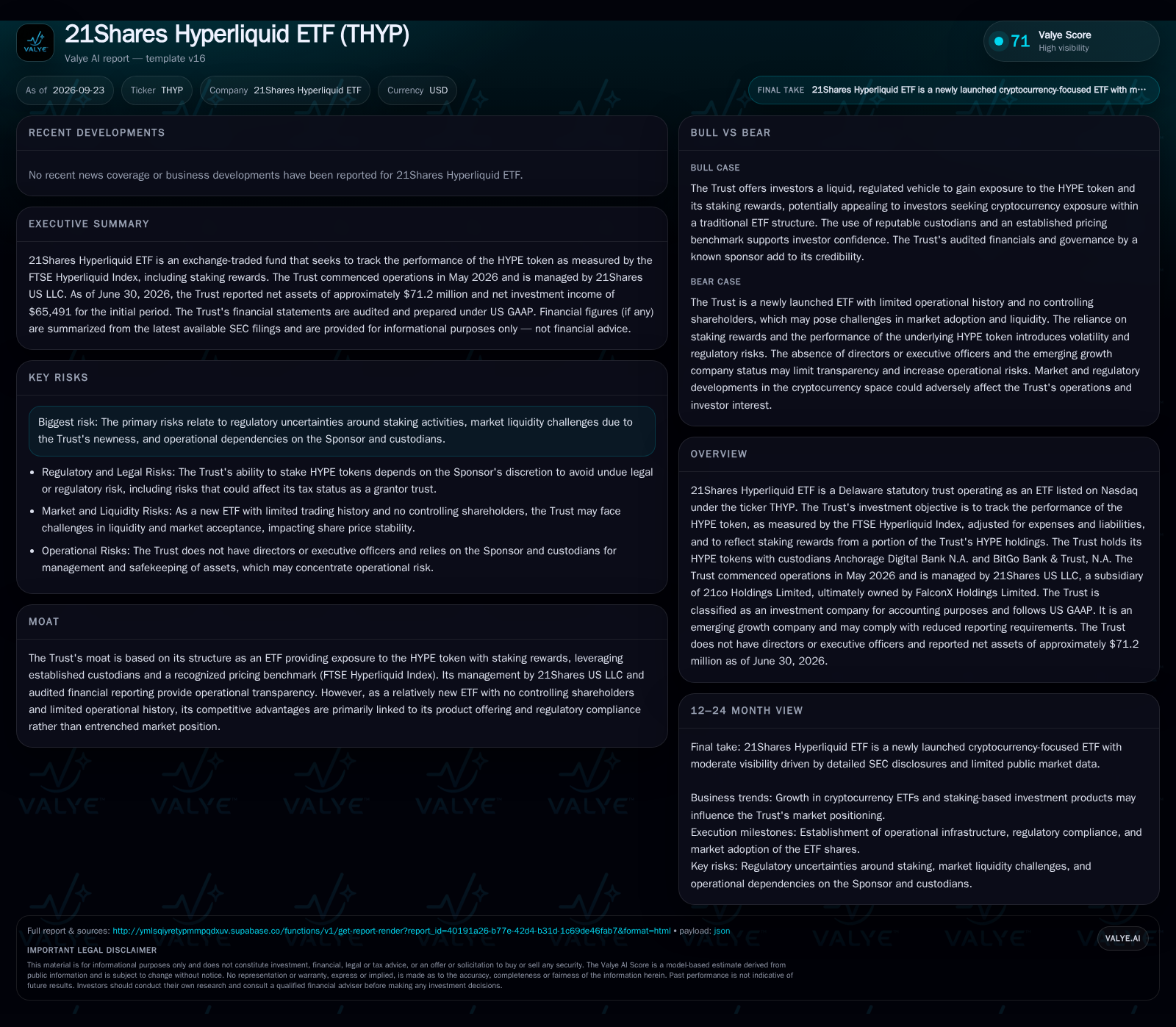
21Shares Hyperliquid ETF is a newly launched, Nasdaq-listed fund tracking the HYPE token and distributing staking rewards. With $71.2 million in net assets and over 94% of tokens staked as of June 2026, it provides regulated exposure to digital assets but remains unproven on market adoption, liquidity, and regulatory durability. The structure’s reliance on staking and a single-token focus heightens both its appeal and its risk profile. [S1]
21Shares Hyperliquid ETF (THYP) is among the first wave of U.S.-listed exchange-traded funds structured to deliver both direct exposure to a single digital asset—HYPE—and its associated staking rewards. The fund’s $71.2 million in net assets and high staking ratio reflect early adoption among crypto-forward investors seeking regulated access and additional yield. However, as a newly launched product with no operating history beyond its initial months, THYP must demonstrate it can achieve scale, maintain liquidity, and withstand the regulatory and technical uncertainties inherent in the rapidly evolving world of digital asset investment vehicles. [S1]
Initial Asset Base and Staking Strategy Define Early Traction
As of June 30, 2026, 21Shares Hyperliquid ETF reported net assets of $71.2 million, with 1,880,000 shares outstanding and a net asset value per share of $37.86. The Trust had staked 94.43% of its HYPE holdings, generating $125,025 in staking rewards income in its initial reporting period. Net investment income stood at $65,491 after $59,534 in expenses. These facts establish THYP as a newly seeded, operational ETF with a strong emphasis on staking as a value proposition. The high staking participation means returns are directly exposed to both the performance of HYPE and the protocol’s staking economics. [S1]
How Staking Rewards and Token Volatility Drive Return Potential
THYP’s model is to provide investors with price exposure to the HYPE token, as measured by the FTSE Hyperliquid Index, while also capturing and passing through staking rewards. The primary sources of return are thus (1) changes in the price of HYPE and (2) the yield from staking activities. Expense drag, including management fees and custodian costs, reduces gross returns. Because nearly all HYPE held is staked, the fund’s ability to generate incremental yield depends on both the protocol’s staking economics (annualized yield, slashing risk, lock-up periods) and the operational effectiveness of the custodian. If staking yields remain attractive and protocol risks are managed, THYP could offer a superior total return profile compared to spot-only crypto ETFs.
However, the fund’s economics are inherently volatile. Token price swings can overwhelm yield effects, and staking rewards are variable, subject to protocol governance changes, and potentially vulnerable to regulatory intervention. The ETF structure introduces fixed costs (audit, listing, custody) that require scale to optimize efficiency. As an emerging growth company, THYP may benefit from reduced compliance costs in the near term, but longer-term operating leverage will depend on asset growth and market acceptance.
ETF Structure and Staking as Differentiators Amid Crypto Product Proliferation
THYP’s main competitive advantage is its ability to offer regulated, exchange-traded access to a single-token crypto exposure with staking rewards. This differentiates it from traditional spot crypto ETFs (which do not typically pass through staking income), closed-end crypto trusts, and direct token ownership. The use of established custodians (Anchorage Digital Bank N.A. and BitGo Bank & Trust) and management by 21Shares US LLC add institutional credibility.
However, the competitive landscape is fluid. Larger asset managers may launch similar products, potentially with lower fees or greater liquidity, eroding THYP’s first-mover benefits. Substitution risk is high: investors seeking diversified crypto exposure may prefer basket products, while those focused on staking yield might pursue direct staking or DeFi protocols for higher returns (albeit with less regulatory protection). The absence of a direct customer retention mechanism—such as multi-asset coverage, active management, or loyalty programs—means THYP’s moat is primarily structural and regulatory, not behavioral.
What Would Enable Asset Growth and Sustainable Differentiation
The most favorable scenario for THYP is one in which the HYPE token appreciates in value, staking yields remain robust, and regulatory clarity supports the inclusion of staking rewards in ETF structures. Growing investor acceptance of single-token crypto ETFs, especially those offering yield, could drive inflows and secondary market liquidity. Demonstrated operational reliability—no custody or staking incidents, consistent NAV tracking, and transparent fee structures—would build institutional and retail trust.
Evidence confirming this scenario would include a steady increase in net assets, rising trading volume, and additional ETF launches using similar staking models. Market data showing THYP trading at or near NAV, as well as disclosures of growing institutional shareholding, would further validate the case. Falsification would come from persistent trading discounts, declining assets, or publicized operational setbacks (e.g., staking losses, custody issues, or regulatory interventions curtailing staking).
Plausible Early-Stage Outcomes: Adoption Hurdles and Operational Maturation
The most likely outcome over the next 12–24 months is modest asset growth as THYP establishes an operational track record and seeks to build investor awareness. Volatility in HYPE’s price and fluctuations in staking yields may result in uneven performance and secondary market discounts or premiums to NAV. The ETF is likely to appeal primarily to crypto-enthusiast investors and asset allocators seeking regulated access to staking yield, but will need time to gain traction with mainstream ETF buyers.
Confirming evidence would be slow but steady increases in net assets, absence of major operational incidents, and consistent NAV tracking. Falsifying evidence would include stagnant or shrinking AUM, persistent illiquidity, or a failure to maintain staking rewards due to protocol or regulatory changes.
How Regulatory Shifts or Protocol Events Could Undermine Returns
A severe downside could be triggered if regulatory authorities restrict or ban the inclusion of staking rewards in registered investment products, or if a major protocol event (such as a HYPE network failure, slashing incident, or drastic governance change) erodes the value or liquidity of the HYPE token. The ETF’s single-asset focus amplifies exposure to idiosyncratic risk: any material issue with HYPE or its underlying protocol could result in rapid asset flight and trading at a persistent discount to NAV.
Concrete evidence of this scenario would include regulatory enforcement actions, suspension of staking activities, abrupt drops in net assets, or publicized custody incidents. Falsification would require regulatory affirmation of staking in ETFs, continued protocol stability, and resilience in secondary trading even during market shocks.
Milestones and Metrics That Will Define THYP’s Traction and Durability
Net asset growth and sustained increases in shares outstanding, indicating investor inflows and market acceptance. [S1]
Consistency and transparency of staking rewards income, as a percentage of net assets and relative to protocol benchmarks. [S1]
Trading volume and bid-ask spreads on Nasdaq, which would reveal secondary market liquidity and investor engagement—if disclosed.
Deviation of market price from NAV (premium/discount), signaling the ETF’s liquidity and arbitrage efficiency—if disclosed.
Incidence (or absence) of custody or staking-related losses, as reported in audited financials or sponsor disclosures.
Regulatory developments specifically targeting staking in ETFs or digital asset investment vehicles.
Changes in the HYPE protocol, such as governance shifts, staking reward adjustments, or technical disruptions, that could impact the ETF’s returns.
Sponsor’s fee disclosures and any changes to expense structure, affecting the net yield passed to shareholders.
Disclaimer: This is research-only, informational analysis and not investment advice. It may include AI-generated interpretation and general industry context. Always verify important details using primary sources.

Comments