
Nexscient’s AI Acquisition Drive: Strategic Expansion Meets Liquidity Tension
Nexscient, Inc. has rapidly transformed itself through the $6.2 million acquisition of Flipside AI and a new strategic alliance with Tekcapital, aiming to carve out a niche in physical AI data services.
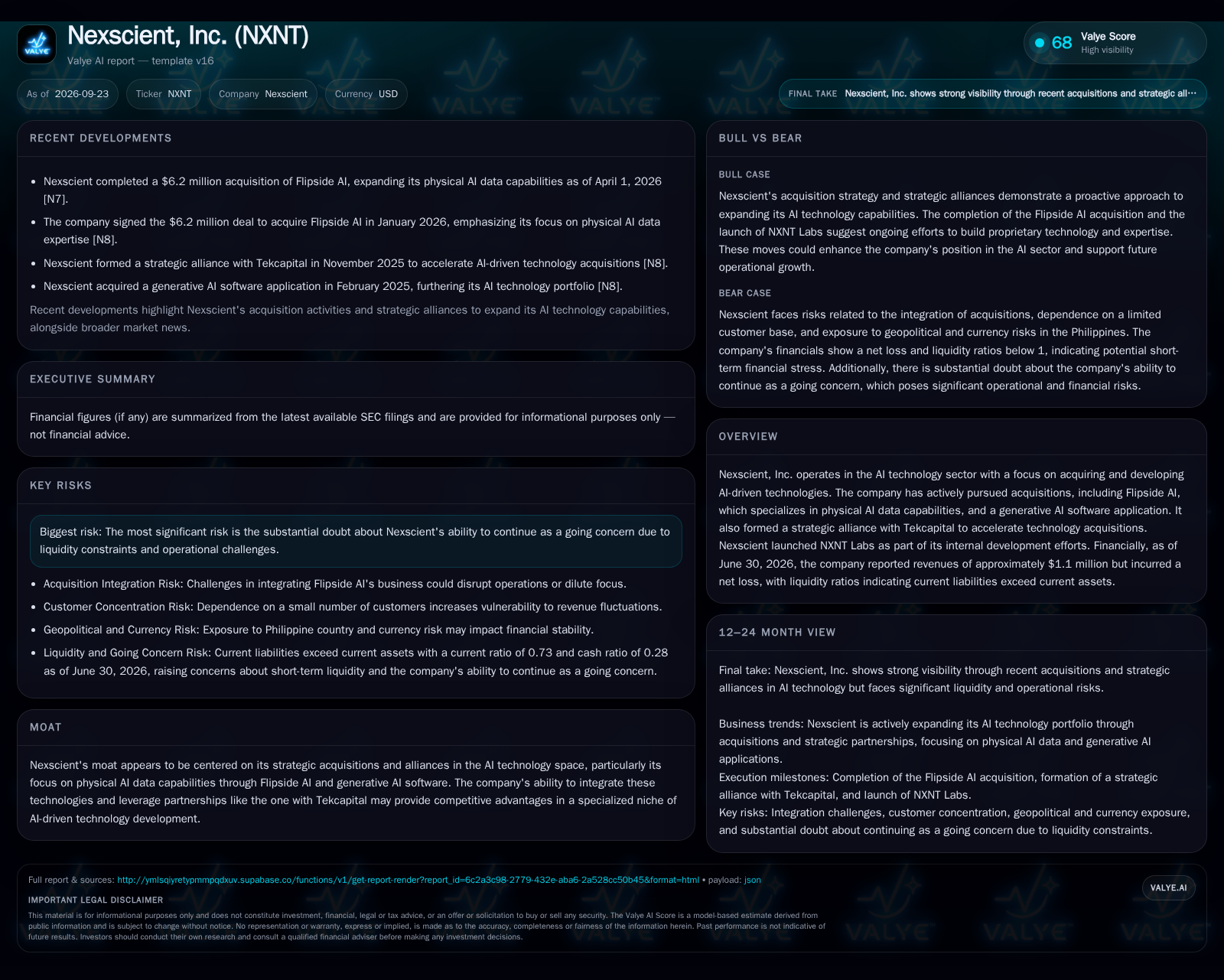
Nexscient, Inc. is pursuing aggressive growth in AI technology by acquiring Flipside AI and forming a strategic partnership with Tekcapital. The company’s ability to realize value from these initiatives hinges on successful integration, customer diversification, and near-term funding solutions. [S1] [N7] [N8]
Nexscient, Inc. has pivoted from a non-revenue shell to an AI technology player through a $6.2 million acquisition of Flipside AI, specializing in data curation and annotation for autonomous driving, robotics, and geospatial applications. This move, combined with a strategic partnership with Tekcapital, marks a rapid shift toward building a specialized AI platform. [S1] [N7] [N8]
Flipside Acquisition and Liquidity Strain Define Nexscient’s Near-Term Reality
The defining recent development for Nexscient is its $6.2 million acquisition of Flipside AI, completed April 1, 2026. This transaction transformed the company from a pre-revenue shell into an operating business focused on physical AI data services, including annotation, curation, and validation for sectors such as autonomous driving, robotics, and geospatial analytics. [S1] [N7] [N8]
Financially, as of June 30, 2026, Nexscient reported quarterly revenues of $1.1 million, a net loss of $557,687, and a cash balance of $489,216. Its current liabilities of $1,775,262 exceed current assets, resulting in a current ratio of 0.73 and a cash ratio of 0.28. The company has explicitly disclosed substantial doubt about its ability to continue as a going concern. [S1]
Beyond the Flipside deal, the company formed a strategic alliance with Tekcapital in November 2025 to accelerate further AI-driven technology acquisitions, signaling an ambition to build a broader AI platform. [N8]
How Nexscient’s Revenue Model Now Relies on Physical AI Data Annotation
Nexscient’s revenue engine is now primarily driven by Flipside AI’s business of providing data curation, annotation, and validation for AI applications. These services—critical to machine learning model development—are typically sold via project-based or ongoing contracts to enterprise clients in sectors requiring high-quality labeled data, such as autonomous vehicles, robotics, and geospatial intelligence. The economics of annotation businesses tend to be labor-intensive, with a blend of offshore operational leverage (in Flipside’s case, in the Philippines) and technology-enabled productivity. Gross margins in this sector can vary widely depending on the degree of automation, customer mix, and contract structure.
Fixed costs may be relatively low, but variable costs are significant, especially if customer projects require bespoke annotation or rapid scaling. Achieving operating leverage typically requires growing a diversified portfolio of recurring annotation contracts, automating workflows, and cross-selling higher-margin AI services. [S1]
The acquisition of Flipside AI has introduced amortizable intangibles and goodwill to Nexscient’s balance sheet, which could result in future impairment charges if anticipated synergies do not materialize. The company’s recent $135,000 impairment on software underscores the risk of capital misallocation or shifting strategic priorities. [S1]
AI Data Services: Nexscient’s Niche and Its Competitive Crosswinds
Nexscient’s core post-acquisition offering—physical AI data annotation—places it in competition with both global data labeling firms and emerging automated annotation platforms. The company’s Philippine operations may offer cost advantages, but this is counterbalanced by customer concentration and country/currency risk. Large, diversified data annotation players and vertically integrated AI developers could exert pricing pressure or internalize data labeling, eroding Nexscient’s margin potential.
The strategic alliance with Tekcapital may provide access to new deal flow or proprietary technology, but the moat is unproven until Nexscient demonstrates the ability to integrate acquisitions, cross-sell services, and retain key customers. The risk of substitutes is high: advances in synthetic data generation, self-supervised learning, or automated annotation could reduce demand for manual data curation services over time.
Customer stickiness in annotation businesses is typically moderate unless tied to multi-year, workflow-integrated contracts; without evidence of such arrangements, customer churn could be an ongoing risk. The company’s dependence on a small number of clients further amplifies revenue volatility and bargaining power concerns. [S1]
If Integration Succeeds and Customer Base Diversifies, Nexscient Could Scale Rapidly
A favorable outcome for Nexscient hinges on the successful integration of Flipside AI—achieving operational synergies, retaining key clients, and leveraging the Tekcapital alliance for proprietary deal flow or technology. If the company can convert its project-based business into a stable roster of recurring, multi-year contracts (particularly with high-growth autonomous vehicle or robotics clients), this would drive revenue visibility and operating leverage.
Upside would be confirmed by a combination of expanding gross margins (from automation or higher-value services), reduction in customer concentration, and evidence of new technology-driven offerings via NXNT Labs. Additional non-dilutive funding or successful renegotiation of short-term liabilities would further bolster the case for scale.
Conversely, failure to diversify revenue sources or secure additional funding would quickly falsify this scenario, especially given the explicit going concern warning and current liquidity shortfall. [S1]
Consolidation Brings Revenue, But Integration and Funding Remain Ongoing Hurdles
The most plausible near-term scenario is that Nexscient operates as a niche data annotation provider, with Flipside AI as its principal revenue driver. Revenues may grow modestly as the company leverages its Philippine operations and Tekcapital partnership for incremental contracts, but customer concentration, integration challenges, and liquidity constraints persist.
In this scenario, Nexscient remains vulnerable to customer churn and sector cyclicality, with little room for operational missteps given reported cash balance and a short maturity profile on subsidiary borrowings. Confirmation would come from steady (but unspectacular) sequential revenue growth, modest gross margin expansion, and incremental reduction in short-term liabilities. Falsification would be signaled by further impairment charges, loss of major clients, or an inability to secure bridge financing within the next two quarters. [S1]
Liquidity Crunch and Integration Failures Could Trigger Rapid Deterioration
A negative trajectory could unfold if Nexscient fails to integrate Flipside AI operationally or loses key customers, leading to revenue contraction and further net losses.
Downside confirmation would come from accelerating net losses, additional impairment charges, loss of core clients, or inability to refinance short-term debt. If automation and synthetic data alternatives gain traction, demand for Nexscient’s core services could erode even faster, compounding financial distress. [S1]
What Will Determine Nexscient’s Fate in the Next Year?
Gross margin trends post-Flipside acquisition, which would indicate whether operational synergies or automation are being realized.
Revenue concentration: a useful metric would be the share of revenue from the top one or two customers, if disclosed, to assess risk of client loss.
Cash burn and runway: sequential cash flow from operations and changes in working capital will clarify how long Nexscient can operate without additional funding.
New contract wins or renewals, especially multi-year or recurring agreements, would test the company’s ability to build a sticky customer base.
Integration milestones: evidence of cost reductions, technology cross-pollination, or new product launches from the NXNT Labs initiative.
Resolution or refinancing of short-term borrowings at the subsidiary level, which could relieve immediate liquidity pressure.
Developments in the Philippines’ regulatory, currency, or labor environment, which could impact Flipside’s operating cost base and risk profile.
Any further impairment charges or write-offs, which would signal difficulties in executing the acquisition and integration strategy.
Disclaimer: This is research-only, informational analysis and not investment advice. It may include AI-generated interpretation and general industry context. Always verify important details using primary sources.

Comments