
Key Tronic’s Restructuring Crossroads: Manufacturing Expansion, Cash Constraints, and the Search for Profitability
Key Tronic’s deepening 2026 losses and reported cash balance underscore the urgency of its operational turnaround. With new manufacturing capacity in the US and Vietnam, the company’s path depends on whether restructuring can deliver sustainable margin improvements amid persistent tariff and macroeconomic headwinds.
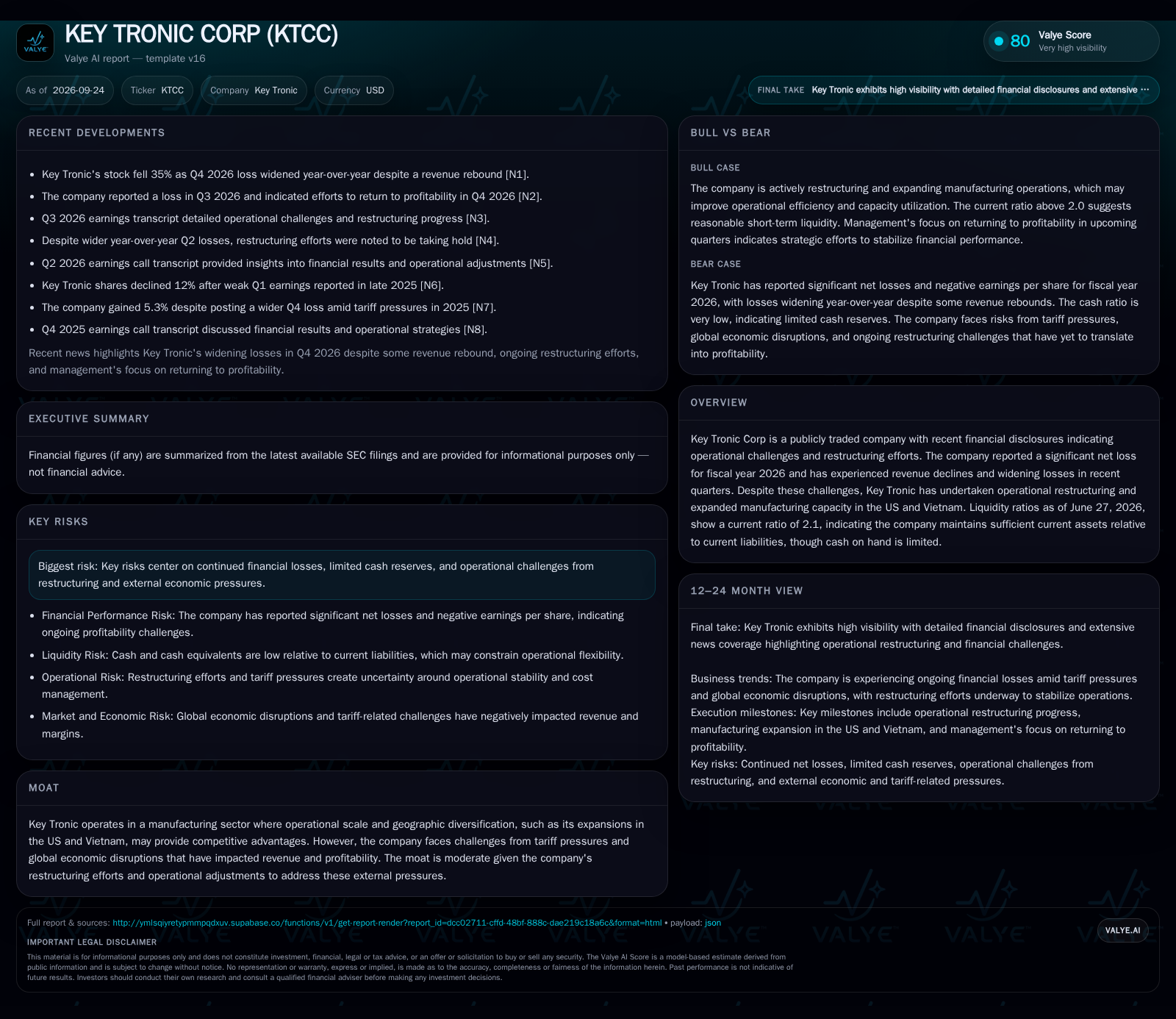
Key Tronic reported a $47.8 million net loss for fiscal 2026 and has a reported cash ratio despite a current ratio of 2.1. Management is aggressively restructuring and expanding manufacturing in the US and Vietnam, aiming to return to profitability. The company’s future hinges on whether operational changes can offset ongoing revenue volatility and external risks such as tariffs and global disruptions. [S1] [N1] [N2] [N8]
Key Tronic’s fiscal 2026 results reveal a company in the throes of a deep operational transformation. Despite some revenue recovery in recent quarters, losses have widened, culminating in a $47.8 million net loss and a severely depleted cash position. Management’s response has been a sweeping restructuring program and expansion of manufacturing capacity in both the US and Vietnam. The company’s ability to translate these changes into sustained profitability—while navigating tariff headwinds and global disruptions—now stands as the central question for investors and stakeholders alike.
2026 Losses Deepen as reported cash balance Narrows
Key Tronic reported a net loss of $47.793 million for the fiscal year ended June 27, 2026, with both basic and diluted earnings per share at -$4.41. These results highlight a significant deterioration in profitability, even as the company saw some revenue rebound in the most recent quarter. [S1] [N1]
However, the company’s current assets of $223.759 million against $106.492 million in current liabilities yield a current ratio of 2.1, indicating adequate short-term asset coverage on paper. [S1]
Management has responded to these pressures with aggressive restructuring initiatives, including the expansion of manufacturing operations in the US and Vietnam. The stated goal is to return to profitability, with a particular focus on Q4 2026 as a potential inflection point. [N2] [N4] [N8]
How Restructuring, Scale, and Cost Pressures Shape Margins
Key Tronic operates as an electronics manufacturing services (EMS) provider, typically generating revenue through contract manufacturing of components and finished goods for OEM customers. Revenue is recognized both over time and at point-in-time, depending on contract structure, with the majority in recent periods coming from over-time arrangements. This implies ongoing, project-based relationships but does not guarantee recurring revenue in a subscription sense. [S2]
The company’s cost structure is likely dominated by labor, materials, and facility overheads—highly sensitive to input costs, tariffs, and supply chain disruptions. EMS businesses traditionally operate on thin gross margins, relying on volume and efficient asset utilization for profitability. Fixed costs from plant expansions in the US and Vietnam may increase operating leverage, amplifying both upside and downside when demand shifts.
Recent restructuring aims to streamline operations and improve cost competitiveness, presumably by optimizing labor mix, consolidating facilities, and shifting production to lower-cost geographies or those less exposed to tariffs. The ability to convert restructuring into margin gains—without sacrificing service levels or incurring further write-downs—will be central to any recovery.
The interplay between restructuring initiatives and scale economies is critical in determining Key Tronic’s margin trajectory. While expanding manufacturing capacity can dilute fixed costs over higher volumes, the timing and pace of demand recovery are pivotal. If demand growth lags, increased fixed costs may exacerbate margin pressure due to underutilized capacity. Conversely, successful ramp-up of new plants with efficient production processes could yield operating leverage benefits. Moreover, the company’s ability to negotiate favorable supplier contracts and manage inventory levels amid volatile input costs will influence gross margin stability. The balance between cost control and maintaining service quality is delicate, as aggressive cost-cutting risks impairing customer relationships or product quality, potentially undermining long-term revenue.
Tariffs, Scale, and Geographic Diversification in a Crowded EMS Market
Key Tronic competes in a global EMS sector characterized by intense price pressure, commoditization, and customer churn. Major competitive levers include cost structure, geographic footprint, customer diversification, and the ability to absorb or pass through tariff and supply chain shocks. The company’s expansion in the US and Vietnam could provide a partial hedge against tariffs and geopolitical risk, as well as appeal to customers seeking near-shore or China-plus-one manufacturing strategies.
However, leading EMS peers often benefit from even greater scale, deeper customer relationships, and more robust balance sheets, enabling them to weather downturns and invest in automation or digital integration. Key Tronic’s moderate scale and currently constrained liquidity may limit its ability to compete for large, sticky contracts or to absorb further shocks. The company’s moat is thus moderate at best, reliant on execution of restructuring and the strategic value of its new manufacturing locations.
Substitutes for Key Tronic’s services include both larger EMS providers and, for some customers, in-house manufacturing. The threat of customer insourcing rises if Key Tronic cannot demonstrate cost or service differentiation post-restructuring.
Geographic diversification through manufacturing expansion in the US and Vietnam introduces both strategic advantages and operational complexities. While proximity to key markets can reduce lead times and enhance responsiveness, managing cross-border supply chains requires robust coordination to avoid inefficiencies. The relative wage differentials and regulatory environments in these regions also affect cost structures and compliance risks. Additionally, the capacity to leverage automation and digital manufacturing technologies varies by location and can influence competitive positioning. In a commoditized EMS market, differentiation through operational excellence and flexible manufacturing solutions may be as important as scale. Key Tronic’s success will depend on integrating these factors to create a resilient and adaptable supply chain that can withstand tariff fluctuations and geopolitical uncertainties.
If Restructuring Delivers Margin Upside and Manufacturing Expansion Yields New Contracts
The most favorable outcome for Key Tronic is that restructuring efforts sharply reduce costs and enhance operational efficiency, while expanded US and Vietnam plants attract new or expanded customer programs—especially those seeking tariff mitigation or supply-chain diversification. This could drive higher plant utilization, improved gross margins, and a return to profitability as targeted by management for Q4 2026 and beyond.
Confirmation of this scenario would include: a sustained move back to positive operating income, margin expansion despite persistent external headwinds, and evidence of new long-term customer wins or contract extensions linked to the new manufacturing footprint.
Falsification would occur if, despite restructuring, losses persist, utilization remains low, or new manufacturing capacity fails to attract incremental business, leaving the company exposed to ongoing cash burn and competitive attrition.
Should restructuring efforts lead to meaningful margin improvement, the resulting free cash flow generation could enable reinvestment in technology and process innovation, further strengthening Key Tronic’s competitive edge. Additionally, demonstrating consistent operational improvements could rebuild customer confidence, reducing churn and fostering longer-term contracts with more predictable revenue streams. However, sustaining these gains requires continuous monitoring of cost drivers and market dynamics, as well as agility to adjust production in response to shifting customer demands or supply chain disruptions.
Restructuring Gradually Stabilizes Margins, But Volatility Persists
The most plausible near-term scenario is that restructuring delivers incremental cost savings and modest operational improvements, but external pressures—tariffs, input cost inflation, and revenue volatility—continue to weigh on margins. Revenue may stabilize or modestly recover, but high fixed costs and thin gross margins limit profitability. The company is able to maintain operations and service existing customers but struggles to rebuild cash reserves or materially outgrow peers.
This scenario would be supported by evidence of narrowing losses, improved but still low cash balances, and moderate utilization of new manufacturing capacity. However, continued revenue and earnings volatility, along with a lack of major new customer contracts, would signal that the turnaround is incomplete.
Falsification would come from either a rapid return to sustained profitability (suggesting upside) or further widening losses, cash depletion, or customer attrition (indicating downside risk).
Liquidity Erodes and Restructuring Fails to Offset External Shocks
The adverse pathway is one where restructuring fails to deliver meaningful margin improvements, new manufacturing capacity remains underutilized, and external shocks—such as worsening tariffs, supply chain disruptions, or a major customer loss—drive further revenue declines and persistent negative cash flow.
The company might be forced to seek external capital under distressed terms, further dilute shareholders, or consider asset sales or strategic alternatives.
Evidence for this scenario would include ongoing negative operating cash flow, declining current assets, rising payables, or disclosures of covenant breaches, delayed payments, or adverse changes in customer concentration.
Milestones That Will Reveal the Trajectory of Key Tronic’s Turnaround
Quarterly operating income and gross margin trends—evidence of whether restructuring is translating into improved profitability.
Utilization rates and revenue contribution from new US and Vietnam manufacturing facilities, if disclosed.
Cash flow from operations and changes in cash and equivalents, particularly as a signal of liquidity stabilization or further stress.
Customer concentration and any disclosures regarding major contract wins, renewals, or losses.
Evolution of tariff-related costs and management’s ability to mitigate them via supply chain or geographic diversification.
Progress on working capital management: inventory turns, receivable collection periods, and payables if disclosed.
Debt levels, covenant compliance, and any new financing arrangements or capital raises.
Management commentary on competitive positioning and pipeline for new business related to expanded manufacturing capacity.
Disclaimer: This is research-only, informational analysis and not investment advice. It may include AI-generated interpretation and general industry context. Always verify important details using primary sources.

Comments