
Immuron Ltd: Scaling Oral Immunotherapy with Clinical and Commercial Milestones
Immuron’s proprietary oral polyclonal antibody platform has driven consistent sales growth through Travelan® and ProIBS®, while clinical-stage assets and U.S. expansion offer further upside—tempered by development uncertainty, raw material cost risk, and ongoing financial losses.
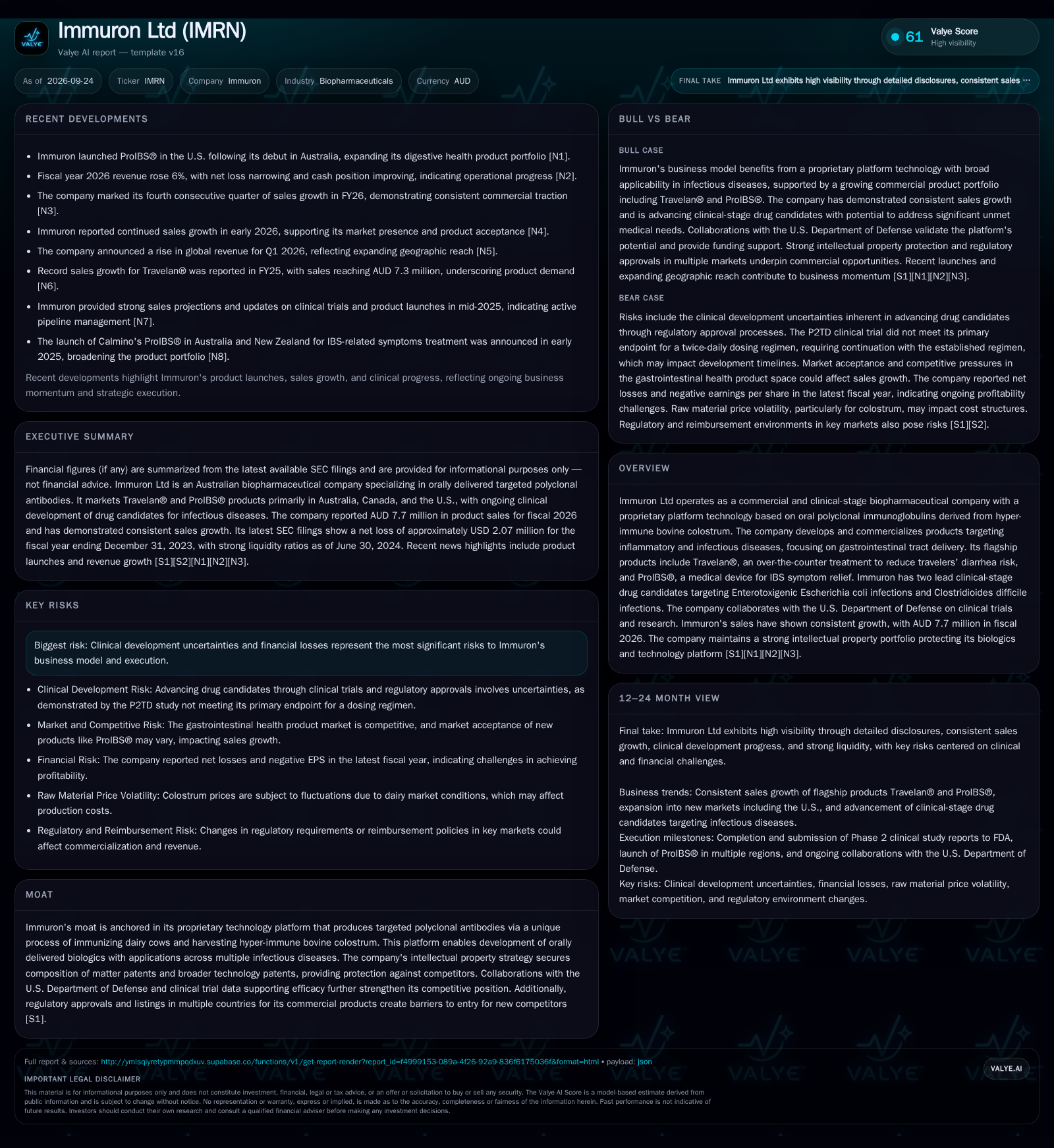
Immuron reported AUD 7.7 million in fiscal 2026 product sales, marking its fourth consecutive quarter of growth, with recent launches of ProIBS® in the U.S. and ongoing clinical-stage programs. While strong IP and Department of Defense collaborations support the pipeline, net losses persist and a recent clinical trial setback highlights the execution risk in advancing new therapeutics. The company’s ability to translate its proprietary platform into both commercial and clinical wins remains the central question as it scales.
Immuron Ltd stands at the intersection of commercial execution and clinical ambition. Its proprietary oral antibody platform has underpinned steady growth through established products like Travelan® and recent launches such as ProIBS® in the U.S., while pipeline programs targeting infectious diseases promise larger upside. Yet, persistent net losses, raw material cost volatility, and the realities of clinical trial setbacks underscore the fragility of the scaling thesis. The company’s next phase will test whether its unique immunotherapy platform can move from a niche gastrointestinal health business to a broader infectious disease player.
Immuron’s 2026 Outlook Shaped by Product Launches, Sales Trends, and Trial Outcomes
Immuron reported AUD 7.7 million in product sales for fiscal 2026, marking its fourth consecutive quarter of sales growth and a 6% year-over-year revenue increase [N2] [N3]. This performance reflects continued demand for Travelan®, its flagship OTC product for travelers’ diarrhea, and the commercial rollout of ProIBS® for IBS symptom relief, which launched in the U.S. following its Australian debut [N1] [N8]. However, the company continues to operate at a net loss, with fiscal 2023 filings showing a net loss of approximately USD 2.07 million and ongoing negative EPS [S2]. On the clinical front, a Phase 2 trial (P2TD) for a lead drug candidate did not meet its primary endpoint for a new dosing regimen, requiring continued development with an established protocol [S2]. These developments highlight the dual nature of Immuron’s current state: commercial momentum and pipeline expansion, but with clear financial and operational risks.
Transforming R&D into Revenue: The Economics Behind Immuron’s Oral Antibody Platform
Immuron’s economics are anchored in its proprietary platform for producing targeted polyclonal antibodies from hyper-immune bovine colostrum. The company’s commercial products, notably Travelan® and ProIBS®, are sold over-the-counter as digestive health solutions, generating relatively predictable revenue compared to typical early-stage biopharma firms [S1] [N2]. This OTC model can provide higher volumes at lower unit margins, with success hinging on brand recognition, distribution reach, and market education. Expansion into the U.S. and Asia-Pacific can drive volume, but each new geography requires regulatory navigation and marketing spend.
Variable costs are dominated by raw materials (colostrum), whose prices are exposed to dairy market fluctuations, and by manufacturing processes that require specialized handling to preserve antibody integrity. Fixed costs include R&D, clinical trial expenses, and regulatory compliance. The company’s clinical-stage assets, if successful, could command premium pricing or licensing revenues, but also require substantial upfront investment and carry high attrition risk. Operating leverage is possible if sales volumes of commercial products rise faster than fixed cost growth, or if a clinical asset achieves regulatory approval and market adoption. However, persistent net losses suggest that current sales are not yet sufficient to cover the fixed cost base, and that further funding for pipeline advancement may be needed if losses persist [S2].
Evaluating Immuron’s Market Position: Competitive Dynamics and Moat Considerations
Immuron’s main competitive advantage lies in its proprietary process for generating orally delivered polyclonal antibodies—a platform protected by composition and technology patents [S1]. This approach differentiates it from single-antibody biologics and conventional small-molecule therapeutics, potentially enabling broader pathogen coverage and favorable safety profiles for gastrointestinal indications. Barriers to entry include the complexity of immunizing dairy cows, maintaining consistent antibody titers in colostrum, and scaling manufacturing while meeting regulatory standards.
However, the OTC gastrointestinal health market is highly competitive, with established brands and a proliferation of probiotics, prebiotics, and alternative therapies. For its clinical-stage assets, Immuron faces competition from both traditional antibiotics and emerging microbiome-targeted therapies, many of which are being developed by larger pharmaceutical companies with greater resources. Collaborations with the U.S. Department of Defense provide some external validation and non-dilutive funding, but the company’s ability to defend share and pricing will depend on demonstrating clinical efficacy, cost-effectiveness, and securing favorable reimbursement if prescription products reach market.
Potential for Breakthroughs from OTC Specialties to Infectious Disease Solutions
The bullish scenario for Immuron is that it successfully leverages its oral immunotherapy platform to expand both its commercial product line and gain regulatory approval for a clinical-stage asset targeting high-need infectious diseases. Continued sales growth from Travelan® and ProIBS®, especially in the U.S., would demonstrate the scalability of its commercial model and validate the demand for targeted polyclonal antibody products. A pivotal clinical trial readout with positive efficacy and safety data—especially in collaboration with the Department of Defense—could unlock licensing deals, government procurement, or fast-track regulatory pathways.
Confirmation of this scenario would include sustained double-digit sales growth, successful completion and regulatory submission of Phase 2 or pivotal trials, and evidence of expanding gross margins as scale is achieved. A major pharmaceutical partnership or non-dilutive government funding for late-stage trials would further support the thesis. Falsification would come from stalled sales in new markets, further clinical trial setbacks, or inability to improve operating leverage despite revenue growth.
Projected Commercial Advances Amid Pipeline and Profitability Challenges
The most plausible path for Immuron is continued modest sales growth from its current OTC portfolio, primarily driven by geographic expansion and increased market penetration of Travelan® and ProIBS®. The clinical pipeline advances slowly, with at least one candidate progressing through additional trials but facing typical development delays and attrition risk. The company manages to narrow losses but does not achieve sustained profitability, requiring periodic capital raises to fund R&D and scale operations.
Evidence supporting this scenario would be continued single-digit to low double-digit annual revenue growth, progress updates on clinical milestones without major breakthroughs, and a gradually improving but still negative bottom line. Falsification would require either a sharp reversal in sales momentum, a transformative clinical or commercial win, or a material increase in cash burn forcing a strategic reset.
Risks of Clinical Setbacks and Margin Compression Impacting Growth
The adverse scenario features a combination of clinical setbacks, raw material cost spikes, and intensified competition in the OTC digestive health segment. Further failed clinical trials or regulatory delays could force Immuron to scale back its pipeline or rely exclusively on modest OTC product revenues. Rising colostrum prices or manufacturing challenges would squeeze gross margins, while larger brands or new entrants erode market share for Travelan® and ProIBS®.
This scenario would be confirmed by flat or declining sales, sustained or widening net losses, and negative updates on clinical trial progress. A dilutive capital raise, asset sale, or strategic review could signal financial distress. The company’s inability to defend its intellectual property or respond to regulatory changes in key markets would further accelerate downside risks.
Critical Milestones Influencing Immuron’s Platform Expansion
Quarterly sales growth rates for Travelan® and ProIBS®, particularly in the U.S. and new geographic markets.
Updates on the progress, completion, and regulatory submission of Phase 2 and pivotal clinical trials for infectious disease candidates.
Gross margin trends and disclosure of cost of goods sold, especially in relation to colostrum price fluctuations (if disclosed).
Cash burn rate and frequency/terms of any new capital raises, which would clarify the company’s runway and funding needs.
Evidence of new commercial partnerships, distribution deals, or government procurement contracts.
Regulatory developments affecting OTC product approvals, prescription conversion, or reimbursement policies in major markets.
Patent litigation, expiries, or new intellectual property grants that could affect the durability of Immuron’s competitive moat.
Market share trends or competitive responses from established OTC and pharmaceutical players in gastrointestinal health.
Disclaimer: This is research-only, informational analysis and not investment advice. It may include AI-generated interpretation and general industry context. Always verify important details using primary sources.

Comments