
Campbell’s at a Crossroads: Margin Compression, Strategic Resets, and the Stakes of Cost Discipline
Campbell’s faces a profitability squeeze as inflation, cost headwinds, and evolving consumer dynamics test its brand power and recent acquisitions. With a sharp dividend cut and margin repair efforts underway, the company’s future hinges on restoring operational leverage and defending volumes in a fiercely competitive food landscape.
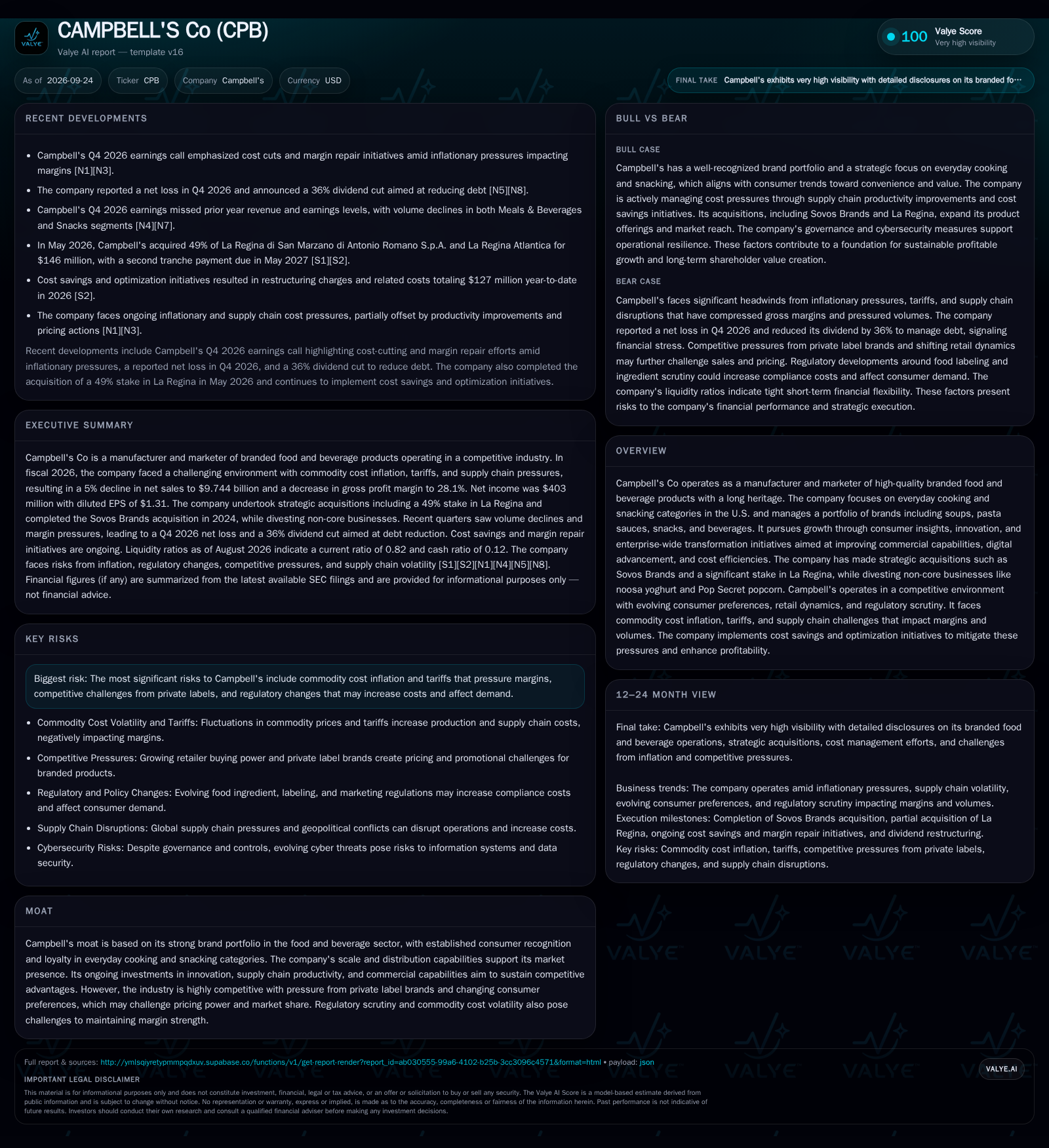
In 2026, Campbell’s reported a 5% sales decline and shrinking gross margins amid cost inflation and supply chain pressures. The company posted a Q4 net loss, cut its dividend by 36% to address debt, and is doubling down on cost savings and margin repair after recent acquisitions and divestitures. The path forward will test Campbell’s ability to restore profitability, manage leverage, and defend its branded positioning against intensifying private label and value-driven competition. [S1] [N4] [N5] [N8]
Campbell’s enters 2027 at a pivotal inflection point. Despite a storied brand portfolio and recent expansion into new sauce and snacking categories, the company is contending with a challenging mix of margin erosion, volume declines, and heightened competitive threats. A 36% dividend cut and a Q4 net loss underscore the urgency of cost-cutting and operational discipline. With ongoing restructuring and a renewed focus on core categories, Campbell’s must prove it can reestablish profitable growth in a food industry where consumer loyalty and pricing power are increasingly under pressure.
Margin Pressures, Dividend Cut, and the Realities of 2026 Performance
Campbell’s reported net sales of $9.744 billion for fiscal 2026, a 5% decrease from the prior year, driven by unfavorable volume/mix and divestitures, only partially offset by higher prices [S1]. The company’s gross profit margin fell to 28.1% from 30.4%, reflecting persistent cost inflation, tariffs, and supply chain pressures. In Q4 2026, Campbell’s posted a net loss and cut its dividend by 36% to reduce debt, highlighting both margin compression and the need to shore up the balance sheet [N4] [N5] [N8]. The company reported cash and liquidity metrics for the period; these figures do not by themselves establish operating runway, investment capacity, financial flexibility, or financing capacity. [S1] Recent acquisitions (Sovos, La Regina) and divestitures (noosa yoghurt, Pop Secret) point to an ongoing portfolio realignment aimed at core U.S. cooking and snacking categories [S1] [S2].
How Margin Structure and Cost Levers Shape Campbell’s Profitability
Campbell’s economics are tightly linked to its ability to extract value from branded products in mature, highly competitive categories. The company’s revenue model is fundamentally driven by volume and mix (unit sales across soups, sauces, snacks, and beverages), pricing (including the ability to pass on input cost increases), and product innovation that can command a premium. However, 2026 results show the limits of pricing power: while net price realization was positive, it was not enough to offset volume declines and cost headwinds [S1].
Fixed costs—including manufacturing overhead, logistics, and marketing—create operating leverage when volumes grow, but the opposite occurs when sales contract. The sharp drop in gross margin suggests that cost inflation and tariffs outpaced any gains from supply chain productivity or cost savings programs. Variable costs (ingredients, packaging, transportation) remain volatile, and Campbell’s exposure to commodity prices adds further unpredictability.
Recent restructuring and cost optimization initiatives resulted in $127 million of charges in 2026, indicating the scale of required cost resets [S2]. Acquisitions (notably Sovos and La Regina) could eventually add scale and synergy benefits, but integration costs and the upfront cash outlays (e.g., $146 million for 49% of La Regina, with another $140 million due in 2027) increase near-term pressure on margins and liquidity [S1] [S2].
Brand Equity vs. Private Label: Where Campbell’s Stands in the Food Wars
Campbell’s core advantage lies in its portfolio of legacy brands with high consumer recognition, especially in soups, sauces, and snacks. These brands historically enabled shelf space dominance and some pricing power. However, the competitive landscape is shifting: private label and value brands are expanding rapidly, leveraging retailer scale and price sensitivity among consumers. The company’s reported volume declines in both Meals & Beverages and Snacks underscore the real threat from these competitors [S2] [N4].
Retailers—now more concentrated and powerful—are pushing harder on pricing and promotional terms, further eroding branded margins. Campbell’s also faces category-specific competition from both legacy peers (large U.S. and global food conglomerates) and nimble upstarts targeting health, clean label, or specialty diets. The company’s innovation pipeline and marketing investments are intended to defend share, but success depends on anticipating consumer shifts more quickly than rivals.
The recent divestitures (noosa yoghurt, Pop Secret) and targeted acquisitions suggest a strategy to double down on categories where Campbell’s can maintain brand relevance and scale. However, this focused approach raises the stakes for execution and may limit diversification if core categories continue to struggle.
If Margin Repair Sticks and Portfolio Moves Pay Off
A favorable scenario for Campbell’s would see cost inflation moderating, supply chain productivity improvements taking hold, and cost savings initiatives translating into sustainable margin recovery. If integration of Sovos and La Regina delivers synergy—such as procurement savings, manufacturing efficiency, or cross-brand marketing—Campbell’s could rebuild operating leverage and restore earnings momentum.
This outcome would likely require consumer volumes stabilizing, aided by innovation (new products, packaging formats, or health-oriented variants) that win back share from private label and value competitors. Success would be evidenced by a return to positive volume growth in core categories, sequential gross margin improvement, and the ability to maintain or modestly grow the (now-lowered) dividend without further asset sales or debt increases.
Confirmation would come from quarterly disclosures showing sustained gross margin expansion, improving EPS, and positive volume/mix in Meals & Beverages and Snacks. Falsification would be persistent volume declines, further margin compression despite cost initiatives, or signs that integration synergies are not materializing.
Profitability Recovery Remains Slow as Cost Pressures and Volume Headwinds Persist
The most plausible near-term path is a gradual, uneven recovery in margins, with sequential stabilization but no rapid return to prior profitability levels. Campbell’s margin repair efforts and cost savings programs offset some—but not all—of continued input cost inflation and competitive pricing pressure. Volume trends remain soft, especially in categories where private label and value alternatives are gaining ground.
Portfolio changes (acquisitions and divestitures) provide some focus but do not deliver immediate top-line or margin lift. The company maintains disciplined capital allocation, prioritizing debt reduction and only cautiously restoring dividend growth. Share gains are limited, and innovation yields mixed results.
This scenario would be confirmed by flattish or modestly improving margins, continued restructuring and optimization charges, and cautious management commentary on the outlook.
If Cost Inflation, Weak Volumes, and Debt Constraints Trigger a Downward Spiral
A negative scenario would see persistent or worsening cost inflation, further volume erosion as consumers trade down, and private label encroachment accelerating. In this environment, Campbell’s pricing actions fail to keep pace with cost increases, and operational savings are insufficient to stem margin declines.
Liquidity constraints are heightened by ongoing restructuring costs, integration outlays, and scheduled payments for the La Regina acquisition.
Falsification would require stabilization of volumes, a reversal in margin trends, or credible progress toward synergy realization and debt reduction.
Milestones That Will Define Campbell’s Margin Recovery and Market Standing
Quarterly gross margin trend: Is there sequential improvement, and does it hold as input costs fluctuate?
Volume/mix breakdown in Meals & Beverages and Snacks: Are declines moderating, or is market share loss accelerating (if disclosed)?
Progress on cost savings and restructuring initiatives: Are actual savings realized in line with expectations, and do restructuring charges decline over time?
Integration updates for Sovos and La Regina: Are synergy targets clearly articulated and met, especially regarding procurement and distribution?
Net debt and leverage ratio: Does the company make tangible progress on deleveraging post-dividend cut and acquisitions?
Evidence of successful innovation: Are new products or reformulations gaining traction and contributing to volume or margin growth (if disclosed)?
Disclaimer: This is research-only, informational analysis and not investment advice. It may include AI-generated interpretation and general industry context. Always verify important details using primary sources.

Comments