
RAVE Restaurant Group: Franchise Expansion, Buffet Momentum, and Scale Constraints
RAVE Restaurant Group leverages a franchise-first model anchored by the legacy Pizza Inn brand, showing recent growth in buffet unit sales and profitability. Yet, the company's reliance on regional concentration, shrinking Pie Five exposure, and the realities of scale in a hyper-competitive sector temper its long-term expansion prospects.
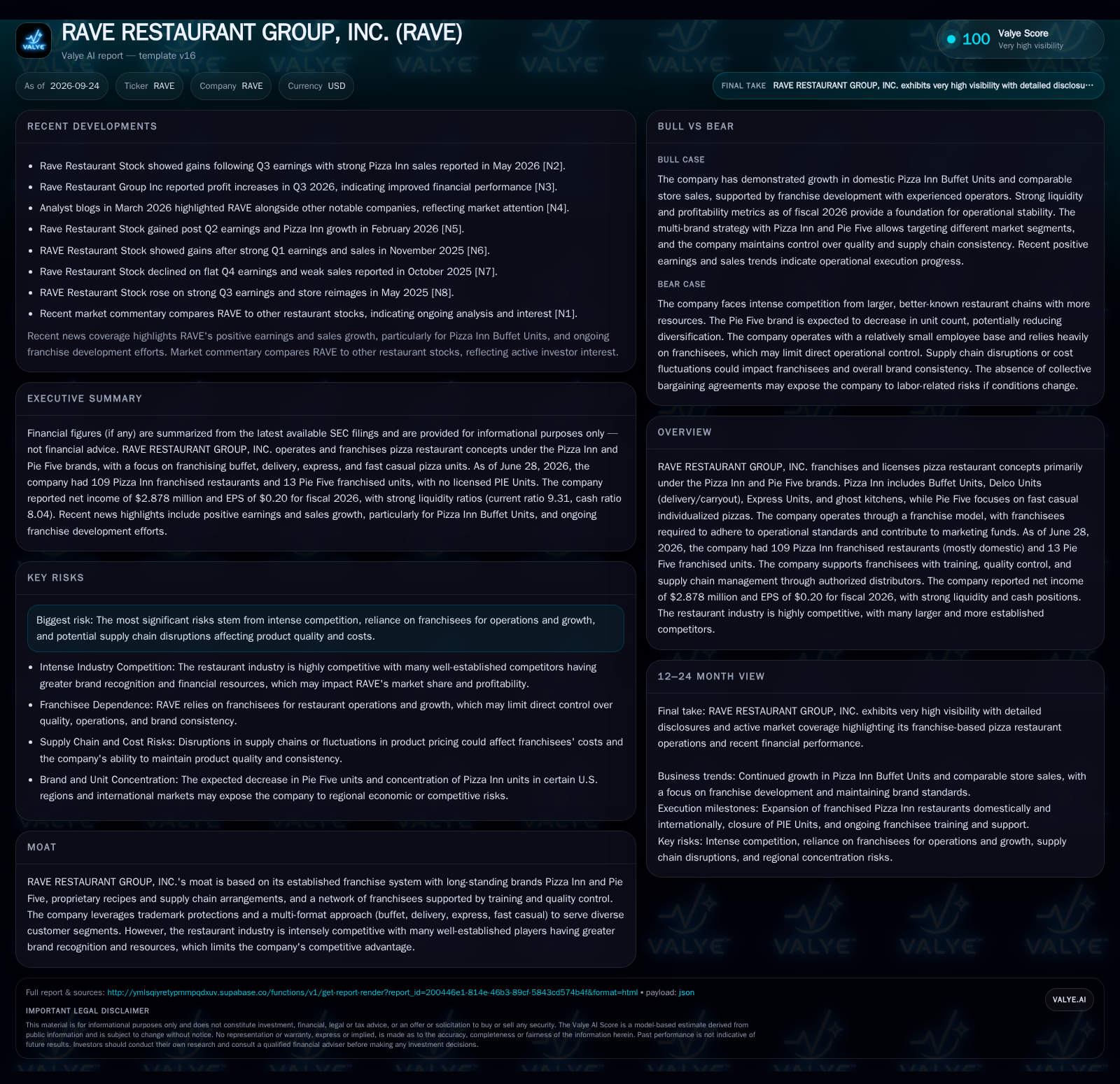
RAVE Restaurant Group reported net income of $2.878 million and EPS of $0.20 for fiscal 2026, buoyed by 7.2% growth in Pizza Inn domestic retail sales in Q1 2026 and improved adjusted EBITDA. The company operates 109 Pizza Inn franchised restaurants and 13 Pie Five units, with a strong cash and investment position but faces shrinking Pie Five exposure and the challenges of competing with larger brands. Franchise-driven expansion, especially in buffet formats, remains the growth engine, but execution risks and regional concentration persist. [S1] [N2] [N3]
RAVE Restaurant Group, the operator and franchisor behind Pizza Inn and Pie Five, is navigating a familiar strategic crossroad in the pizza segment: leveraging a legacy buffet brand for regional growth while contending with the scale, marketing muscle, and menu innovation of national chains. Recent earnings and sales growth at Pizza Inn buffet units underscore the resilience of its value-driven, family-dining model, but the company's narrowing Pie Five footprint and reliance on franchisee execution highlight the challenges of sustaining momentum in a crowded and capital-intensive industry. The question is whether RAVE can continue to expand its buffet-driven franchise system fast enough—and profitably enough—to offset its structural disadvantages in brand recognition, marketing, and innovation. [S1] [N2] [N3]
Recent Trends: Buffet-Driven Sales Growth and Changes in Franchise Presence
RAVE Restaurant Group reported net income of $2.878 million and basic and diluted EPS of $0.20 for the fiscal year ended June 28, 2026. As of the same date, the company operated 109 franchised Pizza Inn restaurants (91 domestic, 18 international) and 13 franchised Pie Five units, with no remaining licensed Pizza Inn Express (PIE) kiosks. Pizza Inn’s domestic retail sales rose 7.2% for the three months ended March 29, 2026, compared to the prior year, driven by an increase in average Buffet Units open and higher comparable store sales. Adjusted EBITDA for the quarter also improved year-over-year, reaching $1.109 million. The company’s cash and short-term investments totaled $13.61 million, with a current ratio of 9.31 and a cash ratio of 8.04, reflecting a highly liquid balance sheet. [S1] [N2] [N3]
Notably, the Pie Five brand continues to contract, with unit count declining and management signaling further reductions ahead. This underscores a strategic pivot toward the core Pizza Inn buffet concept, which remains the primary engine of sales and franchise development.
How the Franchise Model Creates Leverage While Limiting Growth and Control
RAVE’s economics are fundamentally shaped by its franchise-first model: the company earns revenue primarily through franchise fees, royalties (typically a percentage of franchisee sales), and contributions to marketing funds. This structure minimizes capital requirements and direct exposure to restaurant-level operating costs, shifting most of the day-to-day risk (labor, rent, food costs) to franchisees. As a result, RAVE’s cost base is more fixed and less volatile than that of a traditional operator, providing a degree of operating leverage as systemwide sales grow.
However, the franchise approach constrains the company’s ability to directly drive unit-level innovation, enforce operational standards, or rapidly pivot formats. While Pizza Inn buffet units benefit from relatively high average unit volumes (AUVs) compared to express or kiosk formats, RAVE’s royalty income is ultimately capped by franchisee performance and willingness to reinvest. The company’s focus on experienced, well-capitalized operators and its supply chain control mechanisms (approved suppliers, proprietary products) are designed to protect brand consistency, but they may also limit flexibility and increase franchisee friction.
The pivot away from Pie Five—originally positioned as a fast-casual growth engine—further concentrates the business on the legacy buffet model, which, while resilient, is structurally vulnerable to shifts in consumer dining habits, labor costs, and competitive discounting.
Navigating Competition: Brand Strength, Scale Challenges, and Franchisee Dynamics
RAVE faces formidable competition from large, well-capitalized pizza chains with national reach, such as Domino’s, Pizza Hut, Little Caesars, and Papa John’s, as well as regional buffet concepts and fast-casual upstarts. These competitors benefit from stronger brand recognition, deeper marketing budgets, supply chain scale, and greater technological investment in digital ordering and delivery. RAVE’s multi-format approach—buffet, delivery, express, and fast casual—allows some flexibility in targeting market niches, but it also dilutes focus and can confuse the value proposition, especially as Pie Five contracts.
For franchisees, the decision to invest often hinges on brand strength, unit economics, marketing support, and perceived long-term viability. RAVE’s ability to attract and retain experienced operators may be challenged by its smaller system size, limited advertising reach, and regional concentration of Pizza Inn units, particularly in the South and select international markets. Proprietary supply chain requirements and trademark protections provide some moat, but these are not insurmountable barriers in an industry where switching between franchise systems is feasible if incentives shift.
Potential Outcomes if Buffet Growth and Franchise Expansion Defy Industry Pressures
A bullish scenario for RAVE would see continued growth in Pizza Inn buffet unit openings—both domestically and in select international markets—coupled with sustained positive comparable store sales. This would suggest that the family-oriented, value-driven buffet format is resonating with post-pandemic consumers, perhaps due to perceived value, community experience, or differentiation from delivery-heavy competitors.
In this scenario, RAVE’s franchisee pipeline would remain robust, aided by improved unit economics and operational support. The company’s reported liquidity position could enable targeted marketing, digital upgrades, or selective incentives to accelerate franchise growth without diluting returns. Confirmation would come from persistent increases in systemwide sales, new unit openings exceeding closures, and franchisee commitments in new territories. Falsification would be evident if comparable store sales stagnate, new franchise signings slow, or if the company is forced to relax standards to maintain unit count.
Expected Developments: Buffet Gains Tempered by Pie Five Decline and Market Forces
The most plausible trajectory is a slow net increase in Pizza Inn buffet units, propping up modest gains in systemwide sales and royalties, while Pie Five’s footprint continues to shrink. RAVE’s financial profile remains stable, protected by its asset-light franchise model and reported liquidity position, but topline growth is limited by regional concentration and saturated competitive markets.
Franchisee economics remain adequate but not compelling enough to drive a breakout acceleration in development. The company may invest in incremental technology or marketing to support franchisees, but lacks the scale to meaningfully shift consumer perception or capture significant share from national chains. Confirmation of this scenario comes from steady, single-digit growth in domestic buffet units and sales, offset by Pie Five closures and limited international expansion. Falsification would occur if Pizza Inn units begin to decline net of closures, or if margin compression at the franchisee level triggers a slowdown in royalty revenue.
Risks from Regional Reliance and Franchisee Challenges Leading to Growth Plateaus or Drops
A negative scenario unfolds if competitive intensity, regional economic weakness, or changing consumer preferences erode the performance of Pizza Inn buffet units. Franchisees facing rising labor, rent, or food costs—or declining traffic—may defer reinvestment or exit the system, leading to net unit closures. The shrinking Pie Five segment offers little diversification, and the lack of a development pipeline for new concepts leaves RAVE exposed to single-brand risk.
Supply chain disruptions or cost inflation could amplify franchisee margin pressures, threatening royalty streams and brand consistency. In this scenario, RAVE’s liquidity, while ample, is used to support struggling franchisees or fund turnaround efforts rather than growth. Confirmation would come from declining domestic unit counts, negative comparable sales, or a need for financial support to maintain the franchise base. Falsification would require evidence of resilience in unit economics and franchisee growth even as broader industry pressures mount.
RAVE’s Franchise Stability, Buffet Performance, and Market Dynamics Influencing Future Results
Net change in Pizza Inn buffet unit count, both domestically and internationally, as a direct indicator of franchisee appetite and concept health.
Comparable store sales growth for Pizza Inn buffet units—if disclosed—since this metric reveals underlying consumer demand and franchisee profitability.
Number of new franchise agreements signed and pipeline of committed but unopened units, which would signal future system growth.
Unit-level economics (average unit volumes, franchisee margins)—a useful metric if disclosed—to assess whether franchisees are thriving or struggling.
Pie Five unit count and same-store sales trends, as further contraction could signal brand obsolescence or the need for a strategic reset.
Frequency and geographic spread of new market entries, particularly international, which would test the portability of the Pizza Inn brand.
Evidence of supply chain disruptions or food cost inflation impacting franchisee economics.
Franchisee satisfaction and retention rates—if available—to gauge alignment and long-term system health.
Disclaimer: This is research-only, informational analysis and not investment advice. It may include AI-generated interpretation and general industry context. Always verify important details using primary sources.

Comments