
Shuttle Pharmaceuticals: From Clinical Trials to AI Drug Discovery—and the High Stakes of Reinvention
The company's future will likely hinge on its ability to commercialize new technology and secure further funding amid execution and operational uncertainties.
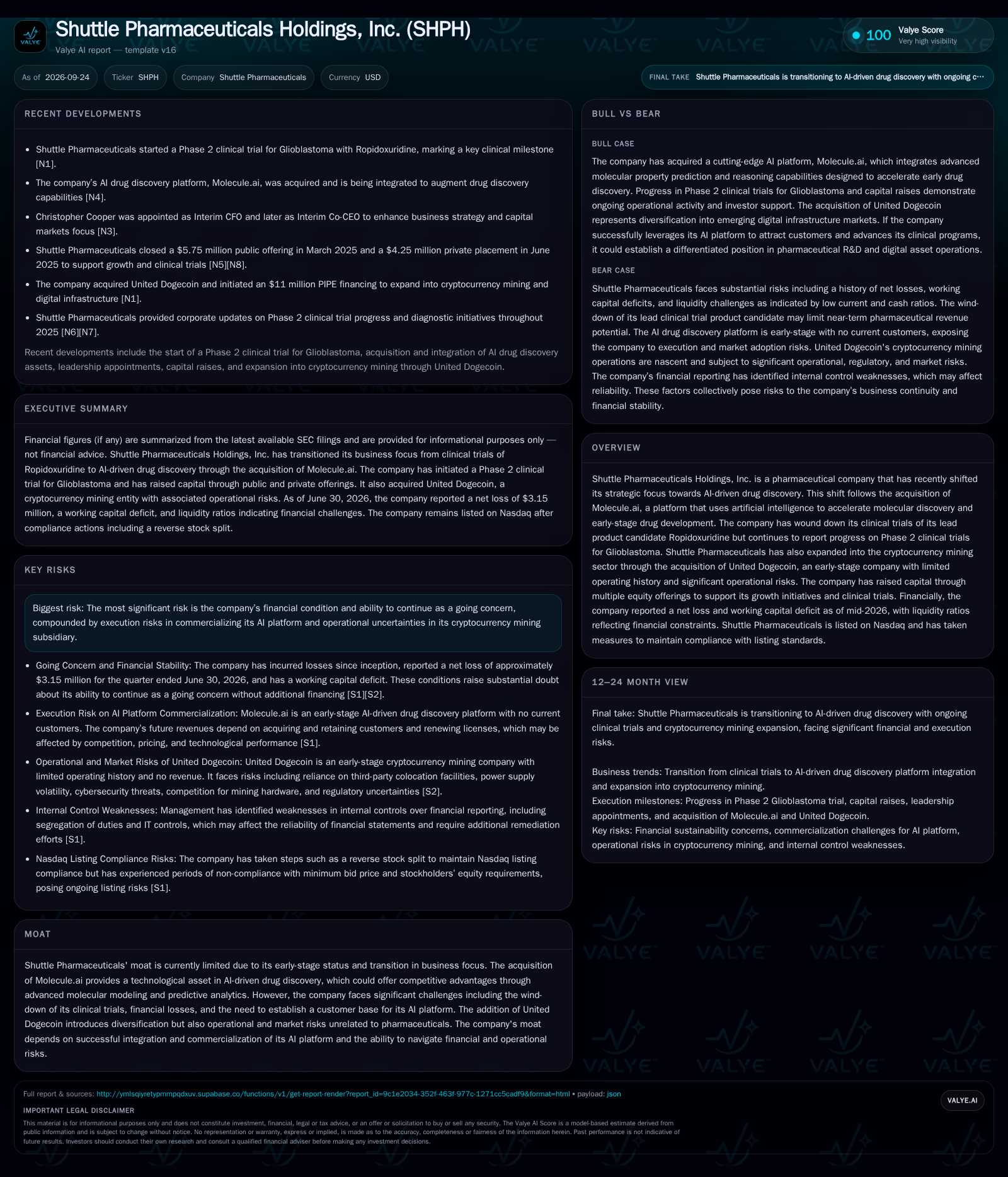
Shuttle Pharmaceuticals is attempting a high-risk transformation: shifting away from its legacy clinical trials to focus on AI-enabled drug discovery after acquiring Molecule.ai. This pivot comes as the company faces a working capital deficit, continued net losses, and substantial doubt regarding its ability to continue as a going concern without new funding. The success of this strategy depends on rapid commercialization of its AI platform and the ability to attract customers or partners, all while managing operational risks and maintaining Nasdaq compliance. [S1] [S2]
Shuttle Pharmaceuticals Holdings, Inc. stands at a strategic crossroads: having exited active clinical development of its lead drug candidate, the company is now betting on AI-driven drug discovery through its recent acquisition of Molecule.ai. This dramatic pivot comes amid severe financial constraints, a history of operating losses, and urgent questions about the viability of its new business model. The company's ability to attract customers to its AI platform, secure additional financing, and deliver operational execution will determine whether its reinvention can succeed—or whether financial and execution risks will overwhelm its ambitions.
Strategic Pivot, Acquisition, and Financial Strain: What’s Changed in 2026
Shuttle Pharmaceuticals has executed a major strategic pivot. In late 2025, the company acquired Molecule.ai—a software platform that leverages artificial intelligence for molecular discovery and early-stage drug development—signaling a transition away from its legacy clinical pipeline [S1]. Alongside this, Shuttle has wound down clinical trials for its former lead candidate, Ropidoxuridine, as of November 2025 [S1].
Financially, Shuttle faces acute constraints: as of June 30, 2026, it reported a net loss of $3.15 million for the period, cash and equivalents of just $90,238, and a working capital deficit with current liabilities ($3.48 million) far exceeding current assets ($396,353). Liquidity ratios are severely depressed, with a current ratio of 0.11 and a cash ratio of 0.5, and management has flagged 'substantial doubt' about the company’s ability to continue as a going concern without additional capital [S2].
Despite these challenges, the company has maintained its Nasdaq listing through a reverse stock split and multiple equity offerings, but the risk of delisting remains if financial stability is not restored [S1].
How Shuttle Could Monetize AI Drug Discovery—and the Capital Challenge
The commercial mechanics for Shuttle’s new AI-driven model remain unproven. Molecule.ai is designed to support early-stage drug discovery by offering molecular property prediction, cross-molecule evaluation, and LLM-based reasoning. In theory, this platform could generate revenue via SaaS licensing to pharmaceutical R&D organizations, fee-for-service contracts, or collaborative research partnerships.
However, as of the latest reporting, no revenue has yet been generated from Molecule.ai, and the company has not disclosed customer contracts or recurring revenue streams [S1]. The platform’s value proposition—accelerating and derisking early-stage drug discovery—is compelling in a pharmaceutical market increasingly focused on AI, but adoption barriers remain high: customers are typically conservative, require strong validation, and may prefer established providers.
Shuttle’s cost structure is now dominated by technology development, platform integration, and the need for intensive marketing and sales to build credibility in a crowded field. Fixed costs include platform maintenance, cloud infrastructure, and regulatory compliance, while variable costs will be driven by customer support, project delivery, and ongoing R&D. The company reported cash and liquidity metrics for the period; these figures do not by themselves establish operating runway, investment capacity, financial flexibility, or financing capacity.
Market Positioning and Competitive Pressures in AI-Enabled Drug Discovery
Shuttle enters the AI drug discovery arena facing formidable competition from both AI-native startups and established pharma technology vendors. Large incumbents and well-funded AI biotech firms have already demonstrated traction with proprietary platforms, robust data assets, and partnerships with major pharmaceutical companies.
The company’s potential advantage comes from Molecule.ai’s integrated property prediction and LLM-based reasoning, which could, if validated, offer more reproducible and scalable discovery workflows. However, the absence of a customer base, published case studies, or peer-reviewed validation leaves Shuttle at a disadvantage relative to more mature competitors.
Switching costs in pharmaceutical R&D technology can be significant—once a platform is integrated into discovery workflows, users are reluctant to migrate unless clear, validated advantages are demonstrated. This dynamic raises the bar for Shuttle’s go-to-market strategy: the company will likely need to demonstrate superior results in pilot projects, publish compelling data, or secure marquee customer wins to shift market perception and drive adoption.
What Success Looks Like: Early Wins, Platform Validation, and Funding Inflows
In a favorable scenario, Shuttle’s Molecule.ai platform secures early pilot projects or partnerships with mid-size biotechs or academic groups, demonstrating clear value in accelerating molecular discovery. If these collaborations yield improved hit rates, lead optimization, or cost savings—ideally validated in peer-reviewed publications or conference presentations—the company could rapidly build credibility.
Early customer wins would provide reference accounts and, crucially, the revenue needed to support operational expenses. An uptick in inbound interest, media attention, or inbound partnership inquiries would further validate the model.
This pathway would also make it easier for Shuttle to raise additional capital on improved terms, reducing going concern risk and enabling further investment in platform development and marketing. Confirmation of this scenario would come from announced customer contracts, revenue from the AI platform, increased R&D spending supported by new funding, and positive customer testimonials or validation studies.
Incremental Progress Under Tight Constraints: Survival Mode and Proving Value
The most plausible near-term outcome is one of incremental progress under severe financial constraints. Shuttle may be able to complete integration of Molecule.ai, develop proof-of-concept pilot studies, and initiate outreach to potential customers. However, with limited cash and a working capital deficit, the pace of development and commercialization will be dictated by the company’s ability to secure bridge financing or small capital infusions.
Operational focus will likely remain on demonstrating technical capabilities and generating early validation data. The company could secure small pilot projects or non-dilutive grants, but broader adoption may lag until the platform is more fully validated.
Evidence supporting this scenario would include news of bridge funding, additional equity raises, progress updates on pilot collaborations, and incremental improvements in liquidity ratios. Falsification would involve failure to secure new funding or evidence that operational progress has stalled due to resource constraints.
When Reinvention Stalls: Funding Shortfalls, No Traction, and Heightened Delisting Risk
The principal downside scenario centers on Shuttle’s inability to secure additional funding before cash is depleted, forcing drastic cost cuts or even bankruptcy. Without traction for Molecule.ai—no customer wins, no credible validation, and no partnership interest—the company’s new business model fails to gain momentum.
Under this scenario, Shuttle could lose Nasdaq compliance due to market cap or equity shortfalls, triggering delisting and further constraining access to capital. Failure to remediate internal control weaknesses could also erode stakeholder trust and increase operational risk.
Confirmation of the downside would include missed payroll, layoffs, a going concern warning escalating to bankruptcy proceedings, or delisting notices from Nasdaq. Additional evidence would be the absence of any announced customer contracts, negative liquidity trends, and inability to raise even small bridge financings.
Milestones That Will Determine the Outcome of Shuttle’s Strategic Pivot
Disclosure of Molecule.ai platform revenues or paid pilot project contracts—if disclosed—would directly test commercial traction.
Updates on customer acquisition, partnership announcements, or reference collaborations with biotechs or academia would indicate market acceptance.
Evidence of peer-reviewed validation, conference presentations, or published technical benchmarks would help confirm the platform’s competitive differentiation.
Announcements of additional equity raises, bridge financings, or non-dilutive grant funding will be crucial to sustaining operations.
Progress reports on remediation of internal control weaknesses would indicate improved operational resilience.
News regarding maintenance or loss of Nasdaq listing status will directly impact access to public markets and future capital formation.
Any disclosed customer testimonials or case studies demonstrating tangible drug discovery improvements would help validate the core value proposition.
Disclaimer: This is research-only, informational analysis and not investment advice. It may include AI-generated interpretation and general industry context. Always verify important details using primary sources.

Comments