
TRIO-TECH INTERNATIONAL: Semiconductor Test Surge Meets Margin Compression and Volatility Risks
A near-doubling of revenue in TRIO-TECH’s core semiconductor back-end segment highlights how testing demand is riding the AI and capacity expansion wave, but sharply lower margins and persistent net losses underline the operating leverage—and fragility—of the business model.
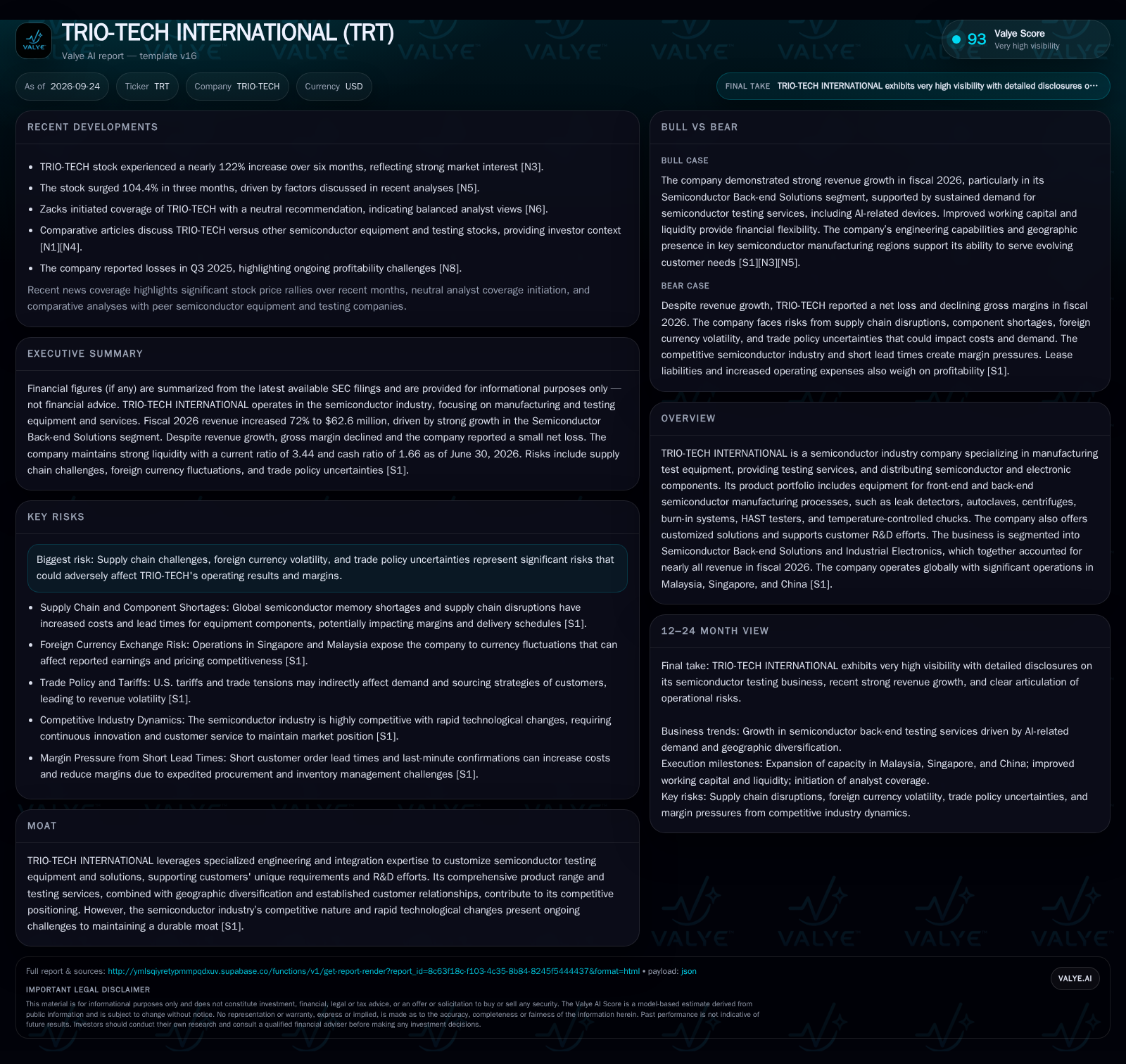
TRIO-TECH INTERNATIONAL posted a 72% revenue jump in 2026, driven by a 99% surge in its semiconductor back-end solutions business. However, gross margin fell nearly 9 percentage points and the company slipped into an operating loss, reflecting intensifying cost and pricing pressures. Working capital and cash have grown, improving short-term potential financial flexibility, but the company remains exposed to supply chain, currency, and trade-policy turbulence. The key issue is whether robust demand for semiconductor testing can translate into durable, profitable growth or whether margin compression and industry volatility will continue to erode operating leverage. [S1]
TRIO-TECH INTERNATIONAL’s 2026 results reflect the dual-edged nature of the current semiconductor cycle: surging demand for back-end test equipment amid global AI and chip expansion, but also severe margin compression and persistent profitability challenges. While revenue growth is impressive and liquidity has improved, the company’s ability to convert this momentum into sustainable earnings remains unproven. With volatile supply chains, unpredictable order patterns, and heavy exposure to global trade and currency risks, TRIO-TECH’s next phase will hinge on its capacity to defend margins and extract durable value from its engineering and geographic advantages.
Record Revenue Expansion Collides with Margin Squeeze
TRIO-TECH INTERNATIONAL reported a 72% revenue increase in fiscal 2026, reaching $62.6 million, with its Semiconductor Back-end Solutions (SBS) segment nearly doubling to $49 million. This surge was attributed to strong demand for semiconductor testing services, particularly those linked to AI-related devices. However, gross profit margin fell sharply from 25.1% to 16.6%, with gross profit rising only 14% despite the large revenue gain. The company swung to an operating loss of $204,000 and posted a near break-even net loss of $34,000. Working capital rose 27.1% to $32.2 million, and cash and equivalents almost doubled to $21.4 million, reflecting improved liquidity. These developments underscore the tension between top-line growth and bottom-line pressure, setting the stage for questions about TRIO-TECH’s ability to achieve profitable scale. [S1]
How Volume Growth Outpaces Margin Control in Semiconductor Test
TRIO-TECH’s core economic engine is the manufacturing and customization of test equipment for semiconductor processes, alongside recurring testing services. The SBS segment is highly sensitive to semiconductor capital expenditure cycles, with revenues often tied to the ramp-up of new fab lines, AI chip production, and the increasing complexity of device qualification. While recent volume growth has been robust, the company’s gross margin deterioration suggests that variable costs—components, expedited logistics, and inventory holding—are rising faster than realized pricing or operational efficiency gains.
The sharp margin compression is likely driven by a combination of global component shortages, more expensive procurement to meet short order lead times, and competitive pricing pressures. Operating leverage, which should in theory improve with scale, is being offset by the need to hold higher inventories and absorb cost volatility. The company’s capital requirements are moderate in absolute terms (PPE at $6.6M), but lease liabilities and working capital swings can amplify cash flow risk during periods of rapid expansion or demand shocks. The current asset-heavy approach (inventory, receivables, PPE) provides delivery capability but may limit nimbleness if industry conditions reverse.
Specialization, Engineering Depth, and the Race Against Commoditization
TRIO-TECH’s competitive proposition hinges on its ability to customize and integrate a range of test equipment for both front-end and back-end semiconductor processes, acting as an extended R&D partner for customers. Its geographic presence in Malaysia, Singapore, and China, close to major manufacturing hubs, is a clear asset. However, the semiconductor test and equipment industry is intensely competitive, with larger players offering scale, broader product portfolios, and deeper service capabilities.
The risk of commoditization is real: as testing requirements become more standardized or as customers bring certain test capacities in-house, smaller providers may face margin compression and project-based revenue volatility. TRIO-TECH’s value will depend on its ability to stay ahead of evolving test protocols (AI, memory, advanced packaging), maintain engineering differentiation, and adapt quickly to shifting geographic and technological demand patterns. Currency volatility and trade policy shifts further complicate this landscape, as customer sourcing strategies and regional investment cycles can swing rapidly.
AI and Advanced Packaging Demand Unlocks Profitable Scale
If global demand for AI chips, memory, and advanced packaging continues to accelerate, TRIO-TECH could benefit from sustained high volumes in both equipment sales and testing services. In this scenario, capacity expansions in Malaysia, Singapore, and China would deliver operating leverage, with higher utilization rates allowing the company to spread fixed costs and selectively raise prices. Engineering partnerships and customization could secure recurring business from leading-edge customers, while geographic diversification would buffer supply chain and tariff risks.
Confirmation of this scenario would come from a recovery in gross margin (moving back toward or above 20%), a return to consistent operating income, and evidence of multi-year customer relationships or backlog. Improved days inventory held and DSO (days sales outstanding) would signal more predictable demand and improved working capital management. Continued growth in cash generation, not just revenue, would indicate that scale is finally translating into sustainable profitability.
Profitability Remains Elusive Amid Persistent Margin Pressures
The most plausible outcome is that TRIO-TECH continues to capture cycles of strong demand—especially from AI and memory segments—but struggles to expand margins meaningfully due to ongoing cost and pricing pressures.
Evidence supporting this scenario would include ongoing volatility in gross margin below 20%, continued reliance on holding higher inventories, and relatively flat or marginally positive net income. Operating cash flow would remain lumpy, reflecting the unpredictable nature of customer orders and procurement cycles. The company’s stock price could remain sensitive to industry news and demand signals, but underlying earnings power would remain constrained unless structural improvements are made.
Supply Chain Shocks and Trade Volatility Erode Operating Cushion
A more adverse scenario would see a reversal or plateau in semiconductor capital spending, exacerbated by persistent component shortages, currency swings, or new trade/tariff disruptions. In this environment, TRIO-TECH could face order cancellations, elongated sales cycles, and the need to discount or write down inventory. Margin compression would deepen, and the company could post larger and more persistent operating losses as fixed costs (leases, personnel, inventory carrying costs) become harder to cover.
Evidence for this downside would include a further drop in gross margin (toward or below 15%), sustained operating and net losses, and negative operating cash flow. Rising days inventory held or DSO would signal deteriorating demand visibility and cash conversion.
Testing the Thesis: What Will Distinguish Durable Growth from Cyclical Volatility at TRIO-TECH?
Gross profit margin trend: Sustained recovery toward or above 20% would indicate improved pricing power or cost control; further declines would flag ongoing margin risk.
Operating income consistency: A return to and maintenance of positive operating income would demonstrate that scale is translating into earnings.
Customer concentration and contract duration (if disclosed): Greater revenue visibility from multi-year or recurring contracts would reduce volatility.
Days sales outstanding (DSO) and days inventory held: Continued improvement in these working capital metrics would signal healthier demand and cash conversion.
Revenue mix evolution: A shift toward higher-margin, customized solutions or services would suggest improved competitive positioning.
Expansion of PPE and leased assets: Monitoring whether investment in capacity is matched by revenue and margin gains, rather than simply increasing fixed costs.
Impact of supply chain and trade disruptions: Any new disclosures of delayed shipments, cost overruns, or order cancellations would test resilience.
Cash flow from operations: Positive and growing operating cash flow would provide the strongest evidence of business model viability.
Disclaimer: This is research-only, informational analysis and not investment advice. It may include AI-generated interpretation and general industry context. Always verify important details using primary sources.

Comments