
BlackBerry’s Transition: Embedded Software Leadership, Secure Communications, and the Next Phase of Recurring Revenue
BlackBerry’s QNX platform powers hundreds of millions of vehicles and is expanding into new embedded markets, while enhanced secure communications offerings target regulated enterprises. The company’s financial discipline and patent portfolio offer stability, but growth hinges on deeper penetration of non-automotive embedded systems and sustained traction in enterprise security.
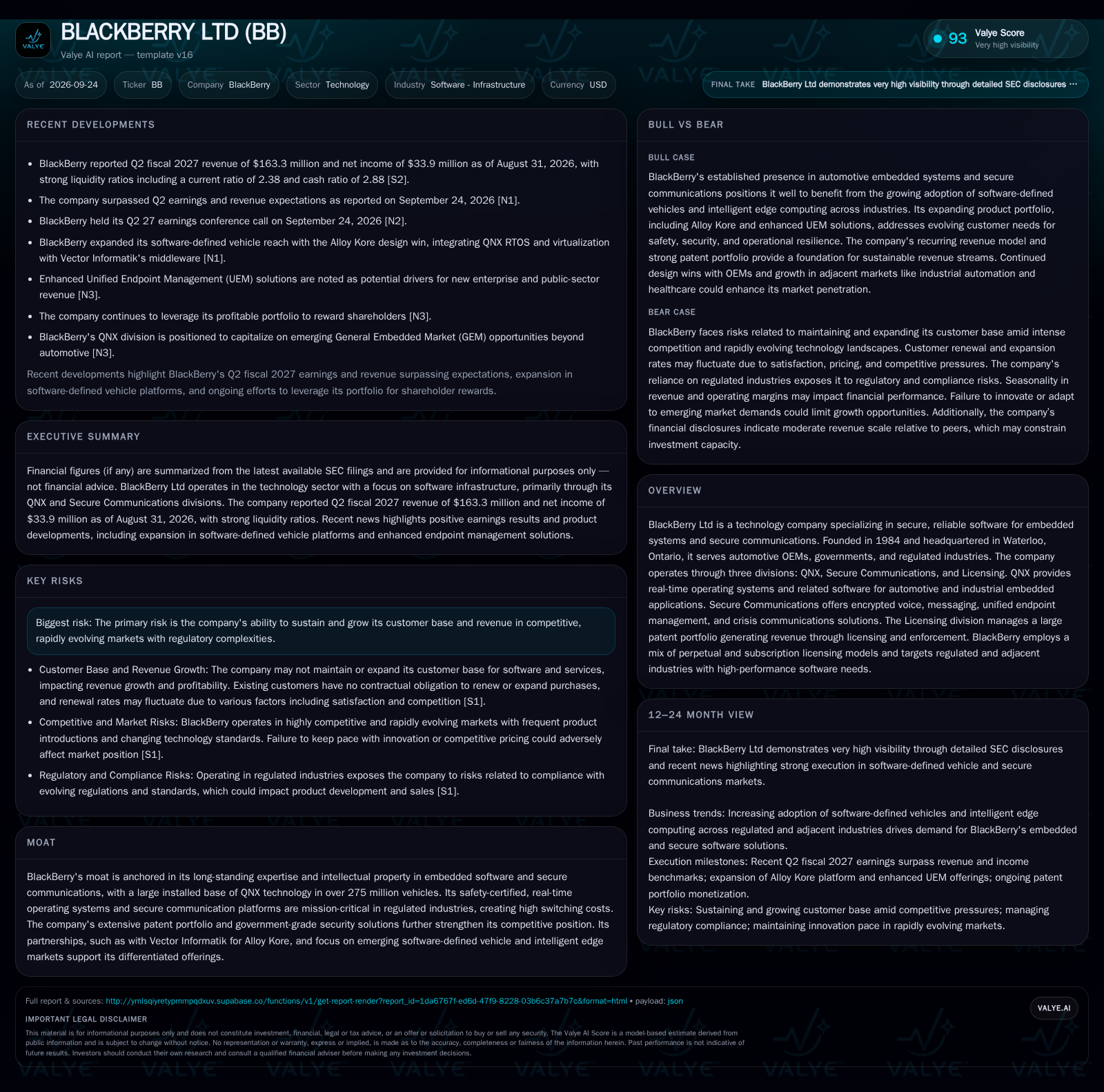
BlackBerry’s Q2 fiscal 2027 results showed revenue of $163.3 million and net income of $33.9 million, backed by a reported cash position and reported current ratio [S2]. Growth is anchored in QNX’s dominance in automotive embedded software—now targeting new verticals—and Secure Communications’ push for enterprise and government contracts. The challenge is expanding the customer base and recurring revenue amid competitive and regulatory pressures.
BlackBerry’s latest results underscore its evolution from a legacy device maker to a specialist in embedded software and secure communications, with QNX now a foundational layer in automotive and industrial systems. The company’s financial health is solid, but the next phase of growth depends on capturing new embedded markets and converting product enhancements into recurring enterprise contracts. The strategic question is whether BlackBerry can translate its technical credibility and patent strength into sustained, diversified revenue in the face of intensifying competition and regulatory scrutiny.
Recent Results Highlight Core Divisions and Emerging Avenues
BlackBerry reported Q2 fiscal 2027 revenue of $163.3 million and net income of $33.9 million, with a cash and equivalents balance of $266.2 million and a current ratio of 2.38 as of August 31, 2026 [S2]. These metrics reflect ongoing profitability and prudent capital management. Notably, the QNX division continues to anchor the business, with its technology embedded in over 275 million vehicles, and recent wins such as the Alloy Kore integration with Vector Informatik indicating ongoing momentum in the automotive sector and a foothold in broader embedded markets [S1] [N1]. The Secure Communications division is pushing enhanced UEM solutions to drive new enterprise and public-sector business, potentially broadening BlackBerry’s addressable market [N3]. These developments matter because they signal both the durability of QNX’s automotive franchise and the company’s attempt to diversify revenue streams through innovation and adjacencies.
Revenue Streams, Cost Structure, and the Leverage of Embedded Scale
BlackBerry’s economics hinge on a blend of perpetual and subscription licensing models, producing a mix of upfront and recurring revenue [S1]. The QNX division, historically driven by design wins with automotive OEMs and Tier 1 suppliers, benefits from high switching costs due to deep integration and safety certifications. Once embedded, QNX software generates multi-year royalty streams as vehicles ship, with incremental unit economics improving as software content per vehicle rises. As BlackBerry pursues adjacent markets like robotics, medical devices, and industrial automation, the question is whether similar volume and royalty dynamics can be replicated outside automotive, or if pricing/margins will differ due to market fragmentation and less stringent safety requirements.
Secure Communications, focused on UEM and critical event management, targets regulated enterprises and governments. This segment could deliver higher recurring subscription revenues if adoption deepens, but may involve longer sales cycles and more intensive support costs. The Licensing division’s patent monetization offers high-margin, but potentially volatile, income. Overhead is primarily composed of R&D, necessary to maintain certifications and keep pace with evolving standards—especially as the company courts new verticals. Operating leverage may increase if QNX gains share in non-automotive embedded markets, but fixed costs could rise if expansion requires substantial go-to-market or technical investment.
QNX’s Entrenchment Meets Expanding Competition and Substitution Threats
Within automotive embedded software, QNX’s safety certifications, deterministic real-time performance, and installed base provide a substantial moat, making displacement by rivals costly and risky for OEMs. However, the rise of open-source alternatives, in-house OEM software stacks, and new entrants in the software-defined vehicle space represent growing substitution threats. As BlackBerry targets embedded opportunities beyond automotive, it faces a more fragmented landscape with established competitors in industrial, medical, and IoT operating systems.
The Secure Communications division must contend with large enterprise software vendors and specialized security providers offering UEM, encrypted messaging, and event management—often with broader distribution or deeper integration into enterprise IT ecosystems. BlackBerry’s differentiation rests on its reputation for government-grade security and compliance, but maintaining this edge will require continuous investment and adaptation to evolving regulatory and threat environments. The company’s patent portfolio underpins some pricing power and negotiating leverage but is not a substitute for product adoption.
How Broader Embedded Adoption and UEM Momentum Could Unlock Growth
A bullish scenario unfolds if BlackBerry successfully extends QNX into non-automotive embedded markets at scale, leveraging its safety and reliability credentials to win design-ins across robotics, industrial automation, and medical devices. This would increase royalty-bearing shipments and diversify revenue away from automotive cyclicality. Simultaneously, if enhanced UEM and secure communications solutions gain traction with new enterprise and public-sector clients, recurring revenue could accelerate, lowering earnings volatility.
Evidence supporting this outcome would include a rising cadence of non-automotive QNX design wins, public customer announcements in new verticals, and a step-change in reported recurring revenue mix. Margin expansion could follow if incremental embedded sales deliver operating leverage without proportionate increases in R&D or sales expense. Falsification would come from stagnation in non-automotive contract announcements or failure to report sustained increases in subscription revenue.
Sustained Automotive Core, Selective Expansion, and Incremental Progress
The most plausible trajectory is that BlackBerry maintains its dominant QNX position in automotive, securing periodic design wins and modestly expanding per-vehicle software content as the industry transitions toward software-defined architectures. Penetration into adjacent embedded markets proceeds, but at a measured pace, with pilot projects and limited volume compared to automotive. Secure Communications delivers stable but competitive revenue as BlackBerry’s UEM enhancements are adopted by a subset of security-sensitive enterprises and government agencies.
This scenario would be confirmed by steady QNX royalty revenues, periodic new automotive and selective non-automotive design wins, and gradual growth in Secure Communications ARR (if disclosed). Falsification would occur if QNX’s automotive share erodes, or if enterprise/agency wins for UEM solutions fail to materialize despite product launches.
Competitive Displacement and Failure to Diversify Revenue Streams
The adverse case arises if automotive OEMs accelerate the shift to open-source or proprietary operating systems, eroding QNX’s embedded base and future royalty streams. Simultaneously, if BlackBerry’s efforts to penetrate non-automotive embedded markets stall—due to lack of differentiation, pricing pressure, or longer adoption cycles—the company’s dependence on a maturing automotive market becomes a vulnerability. In Secure Communications, intensifying competition from larger or more agile vendors could compress margins and limit market share gains.
Evidence for this scenario would include a decline in disclosed QNX design wins, customer losses in automotive, stagnating or shrinking Secure Communications revenue, and downward revisions to recurring revenue guidance. Persistent increases in R&D or sales costs without corresponding revenue growth would also be a warning sign.
Metrics and Developments That Will Reveal BlackBerry’s Next Chapter
The number and scale of new QNX design wins in non-automotive embedded markets (e.g., robotics, industrial, medical devices) would help test the diversification thesis.
Changes in the mix and growth rate of recurring versus perpetual software revenue—if disclosed—would indicate success in shifting the business model.
Adoption rates and contract values for enhanced UEM and Secure Communications offerings in the enterprise and public sector would signal competitive traction.
Updates on QNX’s share in next-generation software-defined vehicle architectures, including partnerships and production rollouts, would show whether the automotive moat is holding.
Reported attrition or renewal rates among large automotive and enterprise customers—if disclosed—would illuminate retention risk.
Trends in R&D and sales expenses relative to revenue would reveal whether operating leverage is improving or cost pressure is rising.
Any legal, regulatory, or patent enforcement developments affecting the Licensing division could drive non-operating income volatility.
Disclosures of customer or partner shifts toward open-source or in-house software stacks in core target markets would signal rising substitution risk.
Disclaimer: This is research-only, informational analysis and not investment advice. It may include AI-generated interpretation and general industry context. Always verify important details using primary sources.

Comments