
Legacy Education Inc.: Healthcare-Focused Expansion, Regulatory Hurdles, and the Economics of Scale
Legacy Education Inc. leverages accredited healthcare programs and a regional campus network to capitalize on rising demand for skilled medical professionals. With recent profit gains and expansion plans targeting new geographies and programs, the company faces both opportunity and risk in a fragmented and tightly regulated post-secondary education market.
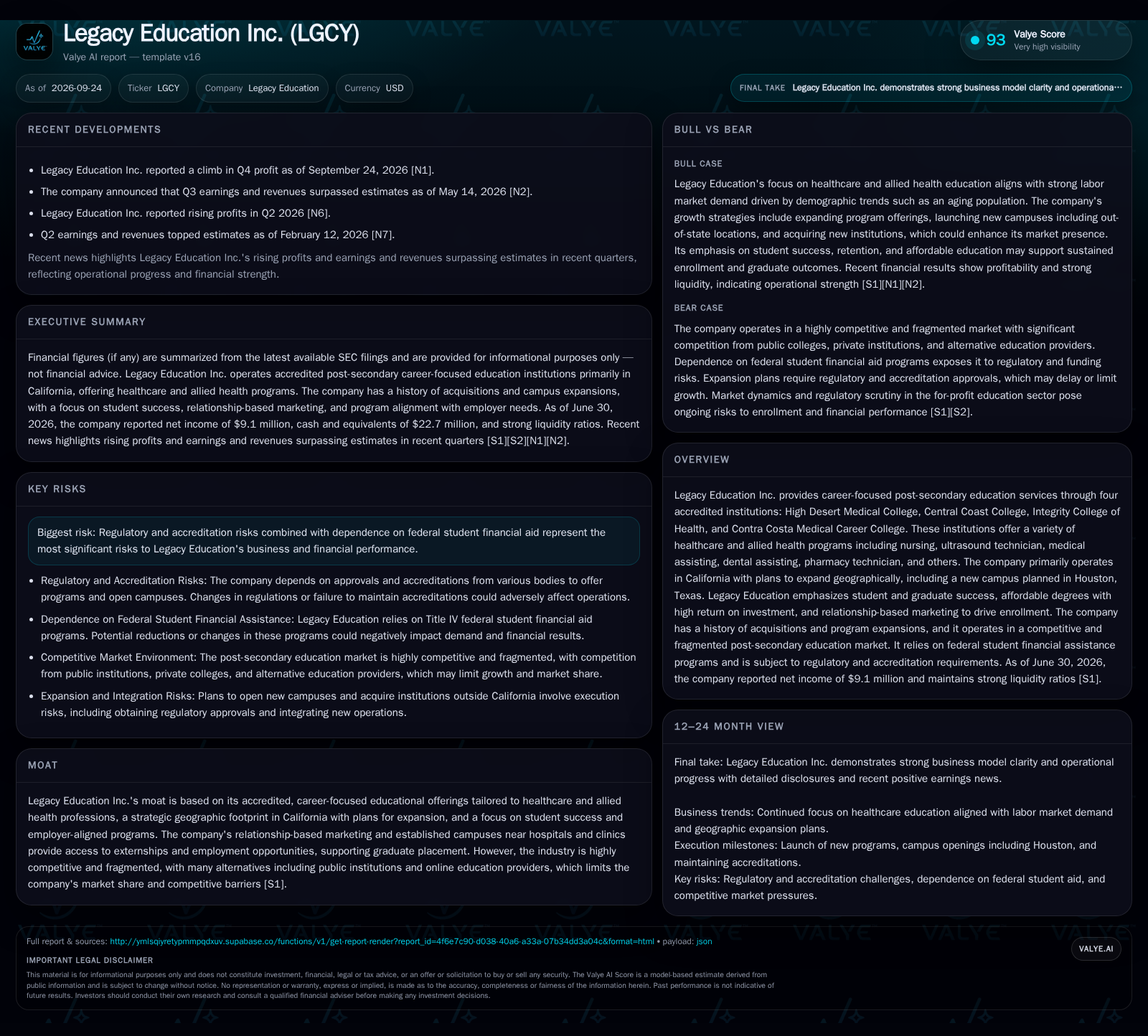
Legacy Education Inc. is riding strong demand for healthcare education, as shown by rising profits and recent campus/program expansion. Its future depends on navigating regulatory approvals, sustaining student outcomes, and scaling efficiently amid intense competition and reliance on federal aid. Execution on new markets and program launches will be pivotal in determining whether recent financial momentum is durable. [S1] [N1] [N2]
Legacy Education Inc. is pursuing growth by expanding its accredited healthcare education offerings and scaling beyond its California base. Recent quarters have seen profits climb and revenues outpace expectations, reflecting both operational momentum and robust demand for career-focused medical training. However, the company’s future will be shaped by its ability to secure regulatory approvals for new campuses and programs, maintain high student completion rates, and adapt to an increasingly competitive and policy-dependent education landscape. The next phase hinges on how well Legacy can turn recent growth into sustained, scalable economics.
Profitability Surges and Geographic Expansion Shape the Current Landscape
Legacy Education Inc. reported net income of $9.1 million for the fiscal year ended June 30, 2026, with quarterly profits and revenues surpassing estimates across Q2, Q3, and Q4. These results reflect robust operational execution and strong demand for healthcare and allied health programs. As of June 2026, the company served over 3,300 students across its four accredited institutions, with High Desert Medical College (HDMC) as the largest contributor. Notably, Central Coast College (CCC) is preparing to open a new campus in Houston, Texas in November 2026, contingent on regulatory approvals. The company reported cash and liquidity metrics for the period; these figures do not by themselves establish operating runway, investment capacity, financial flexibility, or financing capacity. [S1] [N1] [N2]
How Education Scale and Program Mix Drive Margins and Funding Needs
Legacy Education’s economics hinge on enrollment volumes, program mix, and regulatory-driven cost structures. Healthcare programs—such as nursing, medical assisting, and dental hygiene—typically command higher tuition than generalist offerings, often justified by employer demand and career-oriented outcomes. The company’s focus on accredited, high-ROI programs could support premium pricing, but tuition is often capped by regulatory scrutiny and competition from public institutions.
Fixed costs include faculty, facilities, regulatory compliance, and accreditation overhead, while variable costs scale with student headcount (e.g., instructional materials, clinical placements). Operating leverage is achieved as incremental enrollments fill existing program cohorts and campuses, diluting fixed costs. New campus launches (e.g., Houston) and program expansions require upfront capital and working capital for staffing, marketing, and regulatory filings, but can yield attractive returns if enrollment targets are met and regulatory hurdles cleared.
Legacy’s reliance on Title IV federal aid programs means cash flows are closely tied to student financial aid disbursements and regulatory timelines. This dependence creates both a stabilizing effect (as federal aid is countercyclical) and a vulnerability to policy shifts or compliance failures.
An additional dimension influencing Legacy Education's economics is the interplay between program duration and cash flow timing. Shorter certificate programs can accelerate revenue recognition and reduce student attrition risk, but may yield lower per-student lifetime revenue compared to longer-degree programs. Conversely, multi-year degrees require sustained student engagement and capital allocation over time, increasing exposure to dropout risk and regulatory compliance complexity. Balancing program portfolio composition to optimize cash flow predictability while meeting diverse student and employer needs is critical for financial stability and growth.
Navigating a Crowded Field: Accreditation, Employer Alignment, and Switching Frictions
Legacy Education operates in a highly fragmented post-secondary education market, competing with public community colleges, private universities, proprietary schools, and emerging online and hybrid models. Accredited healthcare programs create a partial moat—especially when aligned with local employer needs and clinical placement opportunities—yet barriers to entry are not insurmountable for well-capitalized competitors.
Relationship-based marketing and established regional campuses near hospitals and clinics offer some local network effects, supporting externship pipelines and graduate placement. However, switching frictions for students are moderate: cost, program flexibility, and perceived ROI remain key decision drivers, and public institutions often undercut proprietary providers on price.
Digital education and alternative credentialing threaten traditional program economics, especially as employers increasingly consider skills-based hiring. Legacy’s ability to maintain strong completion and placement rates is crucial to preserving its competitive edge.
The competitive landscape is further complicated by evolving employer preferences toward competency-based hiring and micro-credentialing, which may erode demand for traditional degree pathways. Legacy Education’s ability to integrate flexible learning modalities and stackable credentials could enhance appeal to non-traditional students and working professionals. However, this requires investment in curriculum innovation and technology platforms, potentially increasing upfront costs and operational complexity. Failure to adapt to these trends risks obsolescence, while successful adaptation could create differentiation and new revenue streams.
Expansion and Accreditation Success Unlocks Multi-State Growth
If Legacy Education secures timely regulatory and accreditation approvals for new campuses (such as Houston) and program launches (e.g., dental hygiene, expanded nursing tracks), it could accelerate enrollment growth and diversify revenue streams beyond California. Successful execution would leverage fixed-cost infrastructure, improving margins as new cohorts fill out existing and new locations.
Continued outperformance in student retention, graduation, and job placement—combined with effective relationship-based marketing—could drive higher referral rates and could support premium pricing. If the company sustains multi-quarter profit growth and maintains regulatory compliance, it could establish a defensible regional network with scale-driven economics.
Evidence confirming this scenario would include regulatory approvals for new campuses/programs, consistent enrollment growth, rising cohort completion rates, and sustained margin expansion in quarterly reports.
Moderate Growth Amid Regulatory Delays and Competitive Headwinds
The most probable outcome is steady but moderate expansion: Legacy launches the Houston campus after standard regulatory lags and begins rolling out new programs at a measured pace. Enrollment grows incrementally, but competition from public and alternative providers keeps pricing power in check.
Margins remain healthy if existing campuses operate near capacity and retention/completion rates hold, but operating leverage is capped by the need for ongoing investment in compliance, marketing, and faculty as the company enters new markets. Title IV funding continues to underpin cash flows, but any tightening of federal aid rules could dampen growth.
Confirmation would come from steady enrollment and revenue increases, stable or gradually improving profitability, and no major regulatory or compliance setbacks. Falsification would be signaled by stalled program launches, flat enrollments, or a material decline in operating margins.
Regulatory Setbacks and Policy Shifts Disrupt Expansion and Enrollment
A plausible adverse scenario involves Legacy encountering significant regulatory or accreditation delays for new campuses or programs, leading to missed enrollment cycles and underutilized capacity. Heightened scrutiny of for-profit and career colleges could result in tighter Title IV eligibility or funding constraints, directly impacting student access and the company’s cash flows.
If alternative providers or public institutions aggressively expand healthcare offerings, Legacy could face pricing pressure and higher student acquisition costs. Lower retention or placement rates would erode brand value and referral marketing effectiveness, further compressing margins.
This scenario would be confirmed by public disclosures of delayed or denied regulatory approvals, material declines in student headcount, increased bad debt or refund rates, and a sharp drop in quarterly profitability.
Milestones That Will Shape Legacy Education’s Strategic Trajectory
Enrollment growth by institution and program, especially at new campuses such as Houston and for recently launched tracks—if disclosed.
Regulatory and accreditation approval timelines and outcomes for new campuses and healthcare programs.
Cohort retention and graduation rates across key programs (e.g., nursing, dental hygiene), as these are leading indicators of student success and brand equity.
Job placement outcomes and employer partnership expansion, particularly in newly entered geographies.
Quarterly margin trends and operating leverage as fixed-cost investments in new locations are absorbed.
Changes in Title IV funding rules or federal student aid policy that could affect student access and revenue stability.
Integration and performance of recently acquired institutions, including Contra Costa Medical Career College, and the impact on consolidated financials.
Marketing efficiency and student acquisition costs, especially as digital and referral channels are scaled or tested in new markets.
Disclaimer: This is research-only, informational analysis and not investment advice. It may include AI-generated interpretation and general industry context. Always verify important details using primary sources.

Comments