
Stitch Fix at an Inflection: AI Personalization, Client Retention, and the Economics of Scalable Styling
Stitch Fix’s blend of AI-driven recommendations and human styling has built a differentiated client experience, but the company’s recent loss, missed revenue targets, and persistent competitive and sourcing pressures highlight the challenge of converting personalization at scale into sustained profitability.
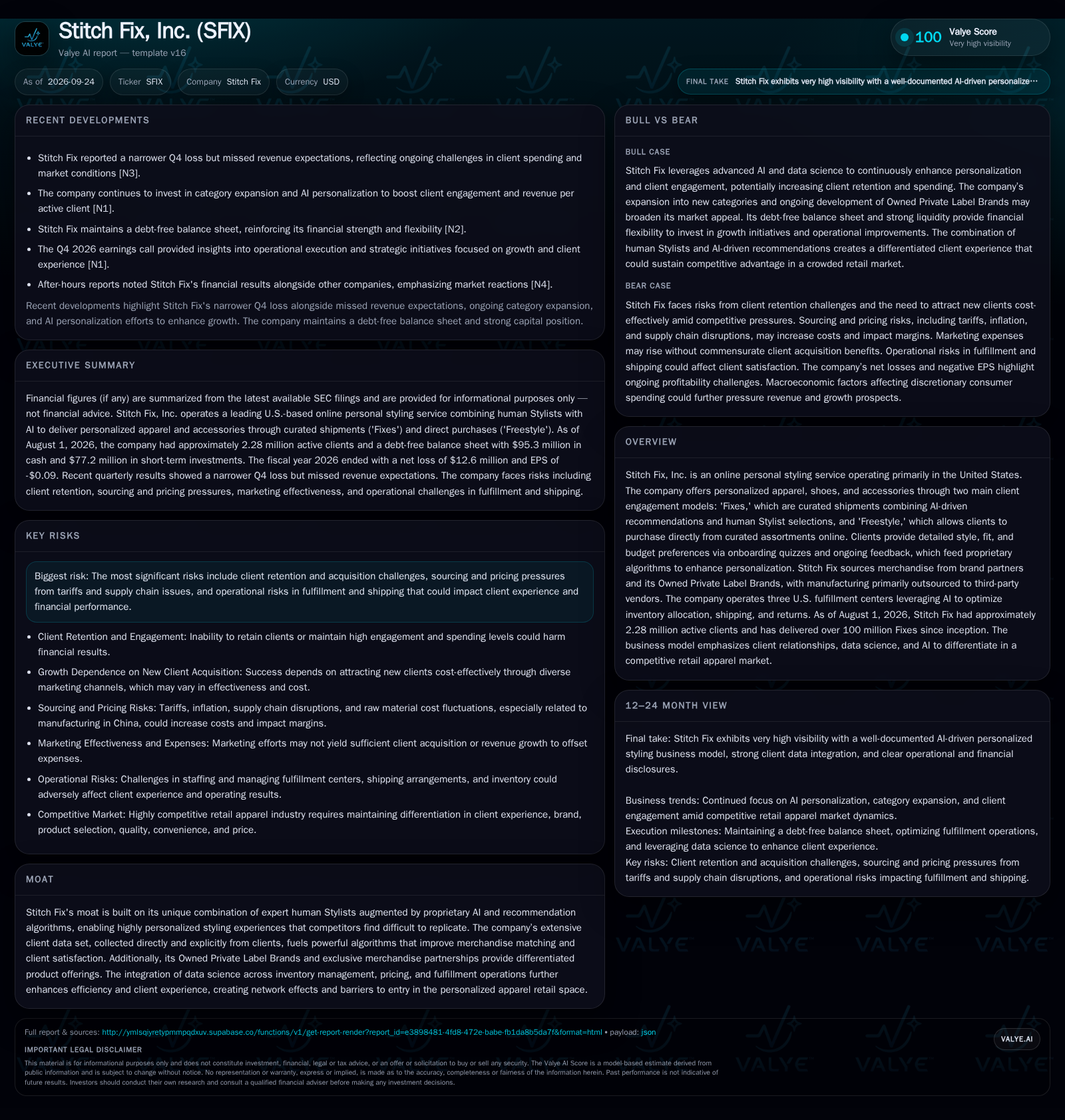
Stitch Fix ended fiscal 2026 with a net loss of $12.6 million, a narrowing Q4 loss, and 2.28 million active clients, while investing in category expansion and AI personalization. [S1] [N1] [N2] [N3]
Stitch Fix has long positioned itself as a pioneer in fusing human stylists with AI-driven recommendations, seeking to redefine apparel retail through personalized curation. Yet, the company’s fiscal 2026 results reveal the tension between investment in technology and category expansion, and the persistent challenges of client retention, cost inflation, and intense competition. [S1] [N1] [N2] [N3]
Recent Financials and Strategic Initiatives Define the Near-Term Outlook
Stitch Fix ended fiscal 2026 with a reported net loss of $12.6 million, or -$0.09 per share, and missed Q4 revenue expectations despite narrowing the quarterly loss [S1] [N3]. The company had approximately 2.28 million active clients as of August 1, 2026, a figure that reflects the ongoing challenge of retaining and growing its client base in a competitive market [S1]. As of the end of the reporting period, Stitch Fix reported $95.3 million in cash and $77.2 million in short-term investments, supporting a debt-free balance sheet [S1] [N2]. Management continues to emphasize investments in category expansion and AI personalization as levers to drive future engagement and revenue per client [N1]. The company reported cash and liquidity metrics for the period; these figures do not by themselves establish operating runway, investment capacity, financial flexibility, or financing capacity.
Personalization at Scale: Stitch Fix’s Model and Its Leverage Points
Stitch Fix’s core revenue engine relies on converting client data into curated apparel shipments ('Fixes') and direct online sales ('Freestyle'), with the company capturing gross margin on merchandise sourced from both third-party brands and Owned Private Label lines [S1]. The styling fee for Fixes is credited toward purchases, creating an incentive for conversion, but the overall economics depend on repeat engagement and the value of each transaction. While AI-driven personalization is designed to optimize inventory turnover and reduce markdowns, the cost base includes significant investment in data science, fulfillment center operations, and marketing.
The company has no debt, which reduces fixed financial costs and provides optionality, but the net loss for 2026 underscores that current scale and mix have not yet yielded sustained profitability [S1]. Capital is tied up in inventory and fulfillment infrastructure, with variable costs in shipping and returns management. Operating leverage could materialize if client growth or order frequency accelerates, but there is a risk that higher marketing or sourcing costs could outpace any incremental margin gains. The challenge remains whether the AI-powered model can drive higher lifetime value per client faster than the cost to acquire and serve them rises.
Differentiation Versus Commoditization in Digital Apparel Retail
Stitch Fix’s main competitive advantage lies in its combination of human stylists and proprietary AI, which enables a level of personalization that pure-play e-commerce or traditional retail often cannot match [S1]. The proprietary dataset, built from direct client inputs, feeds algorithms that refine merchandise curation and drive engagement. Owned Private Label Brands and exclusive merchandise provide some insulation from direct price competition and enable differentiation in product assortment.
However, the apparel market is saturated with alternatives—from mass-market e-commerce giants to niche DTC brands and subscription services. These competitors may have scale advantages, lower customer acquisition costs, or broader assortments. The risk is that if the Stitch Fix experience is not meaningfully superior, client churn could rise and pricing power erode, especially as macroeconomic pressures make consumers more price-sensitive. The company’s moat depends on continuously improving the perceived value of personalization and convenience to justify its economics.
If AI-Driven Personalization Deepens Client Loyalty and Spend
The most favorable outcome for Stitch Fix would be a scenario where ongoing investments in AI and data science translate into measurable improvements in client retention, engagement, and average order value. If category expansion (e.g., new apparel segments or accessories) and enhanced Freestyle offerings enable the company to capture a larger share of wallet from existing clients, operating leverage could follow as marketing and fulfillment costs are spread over a growing revenue base.
Confirmation of this scenario would come from sustained growth in active clients, rising revenue per client, higher repeat purchase rates, and evidence that margins are improving despite sourcing or marketing headwinds. Additional signs would include positive operating cash flow and a return to profitability, indicating that the personalization engine is finally delivering durable economic returns. Falsification would be indicated by continued stagnation or decline in client metrics, persistent net losses, or rising costs that offset any topline gains.
Personalization Gains Meet Margin Headwinds in a Crowded Market
A more likely medium-term scenario is that Stitch Fix continues to iterate its AI and merchandise strategy, achieving modest improvements in client engagement but facing ongoing margin pressures from sourcing costs, marketing spend, and fulfillment complexity. The company leverages its reported balance sheet position to invest in technology and category depth, but the gains in client loyalty or average revenue per user are incremental rather than transformative.
This pathway would be confirmed by stable or slightly rising active client numbers, a gradual narrowing of losses, and periodic revenue volatility linked to broader apparel discretionary spending trends. If cost inflation or competitive pricing intensifies, any improvement in client metrics could be offset by margin compression. Falsification of this scenario would require either a marked acceleration in profitable client growth or, conversely, a sharp deterioration in retention or margin signaling deeper structural issues.
Client Attrition and Cost Pressures Erode the Value Proposition
In a negative scenario, Stitch Fix could face accelerating client churn or declining engagement, driven by either competitive encroachment or macroeconomic pressures that push consumers toward lower-cost or more flexible alternatives. If marketing and fulfillment costs remain high while sourcing becomes more expensive due to tariffs or supply chain disruptions, negative operating leverage could set in—where each incremental client or shipment adds less to the bottom line.
This outcome would be confirmed by a sustained decline in active clients, falling revenue per user, widening net losses, and deterioration in gross margins. Additional warning signs would include rising inventory or fulfillment costs relative to revenue, and any need to raise external capital to fund ongoing operations. Falsification would come from stabilization or improvement in client metrics and a demonstrated ability to stem margin erosion even in a tough market.
Tracking the Stitch Fix Thesis: Where Personalization Meets Profitability
Active client count and growth rates: Continued reporting on this metric will indicate whether Stitch Fix is successfully retaining and attracting new clients [S1].
Revenue per active client: If disclosed, this would help assess the impact of AI personalization, category expansion, and Freestyle engagement on spend per customer.
Gross margin trends: Monitoring whether gross margins are stable, improving, or pressured by sourcing and markdowns will clarify the economics of the personalization model.
Marketing spend as a percentage of revenue: This ratio, if disclosed, would reveal whether client acquisition and engagement are becoming more or less efficient.
Fulfillment and shipping costs relative to revenue: Rising logistics expenses could erode operational leverage; this metric would help track that risk.
Inventory turnover and markdown rates: These would show how effectively Stitch Fix manages assortment and demand forecasting, critical for margin sustainability.
Operating cash flow and profitability milestones: Movement toward positive cash flow and net profit would signal that the business model is scaling successfully.
Client churn/retention rates: If disclosed, these would directly test whether personalization is delivering defensible long-term relationships.
Disclaimer: This is research-only, informational analysis and not investment advice. It may include AI-generated interpretation and general industry context. Always verify important details using primary sources.

Comments