
Astrotech: Commercializing Next-Gen Mass Spectrometry Across Fragmented Vertical Markets
Astrotech’s core mass spectrometry platform has enabled certified deployments in security and promising pilots in agriculture and industrial process control, but persistent losses and capital needs pose existential risks absent sustained adoption or material recurring revenue.
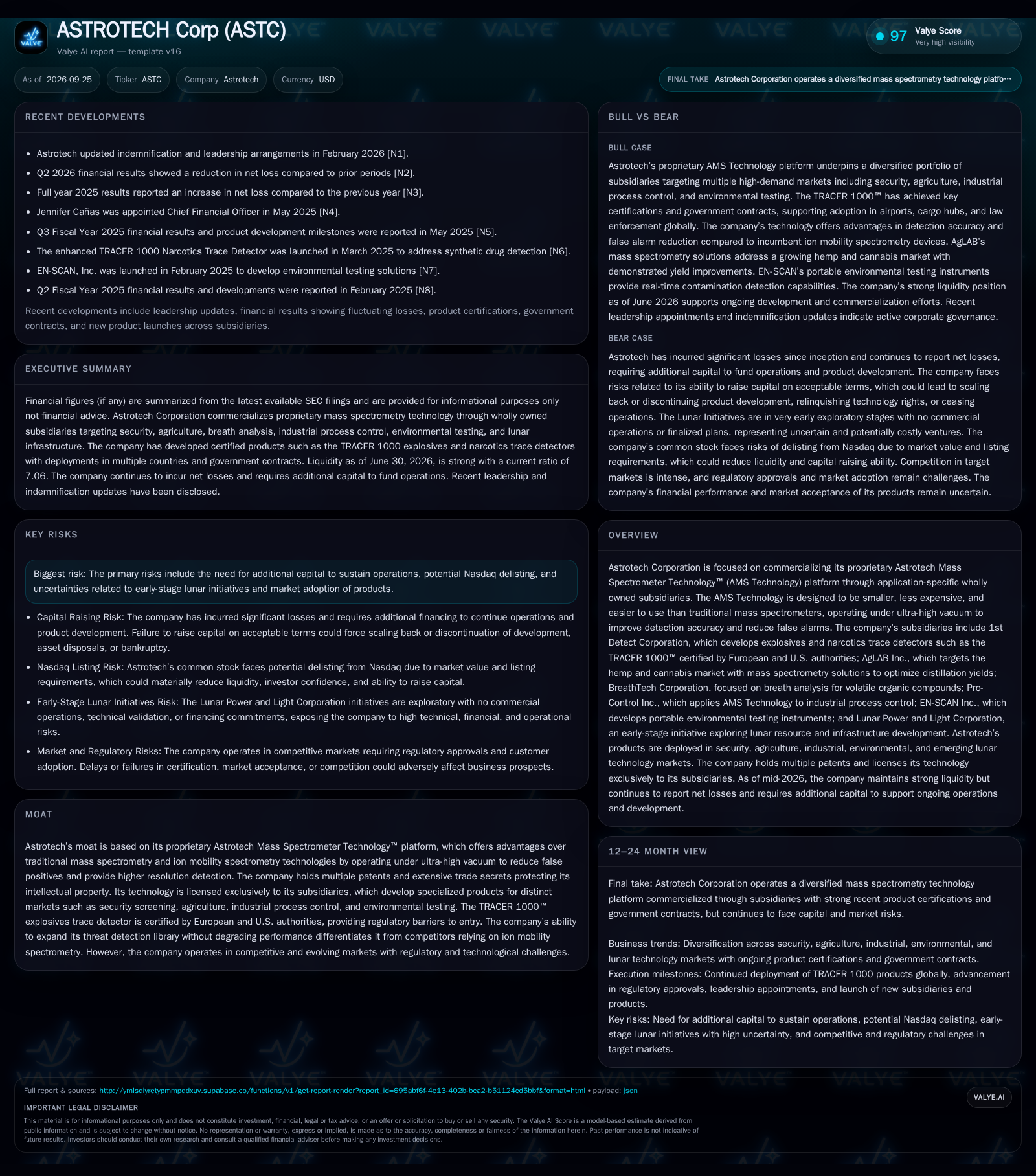
Astrotech leverages its proprietary AMS Technology across a portfolio of subsidiaries in security, agriculture, industrial, and environmental markets. Key wins include government certifications for the TRACER 1000 and initial deployments in 37 sites across 16 countries. However, the company continues to operate at a loss and will require additional capital to sustain operations, with delisting risk looming over its Nasdaq listing. The core question is whether Astrotech can convert vertical pilots and early contracts into scale adoption before funding challenges intensify. [S1] [S2]
Astrotech Corporation has built a technology foundation around its proprietary AMS mass spectrometry platform—a system designed to be smaller, more affordable, and more accurate than traditional mass spectrometers. Through wholly owned subsidiaries, Astrotech targets a wide swath of verticals from airport security to cannabis processing and environmental monitoring. The company’s flagship TRACER 1000 has achieved regulatory certifications and international deployments, yet Astrotech’s financial profile remains dogged by persistent losses and the need for new capital infusions. The next phase will test whether diversified pilots and early government contracts can be transformed into scalable, recurring revenue streams before funding constraints or market setbacks undermine the story.
Certifications, Deployments, and Persistent Losses: The Current State of Play
Astrotech’s most material developments as of September 2026 are concentrated in three areas: (1) The TRACER 1000 explosives and narcotics trace detector has achieved regulatory certification from both the European Civil Aviation Conference and U.S. TSA, enabling sales to airport security and air cargo operators. It is now deployed in approximately 37 sites across 16 countries, marking a significant milestone in validation and market penetration. (2) The AgLAB subsidiary’s technology has shown field trial yield improvements of 15–30% in cannabis extraction, and a master lease agreement with SC Laboratories opens a potential channel to industry clients. (3) Despite these wins, Astrotech continues to report significant net losses—$14.43 million for fiscal 2026—and management explicitly anticipates the need for further capital raising to fund operations and development. Risks of Nasdaq delisting due to market value and listing requirements add urgency to the company’s financing timeline. [S1] [S2] [N3]
How the AMS Platform Could Enable Scalable Economics—And Where the Model is Unproven
Astrotech’s business model relies on leveraging its patented AMS Technology across subsidiaries targeting sector-specific problems. In security, revenue is generated through sales of TRACER 1000 units to airports, cargo facilities, and government agencies, with the potential for maintenance contracts or software upgrades if a service model gains traction. In agriculture and industrial process control, the economic proposition centers on enabling customers to realize higher yields or improved purity, justifying premium pricing or value-based pricing models. Environmental and breath analysis verticals remain pre-commercial.
The company’s economics are currently dominated by fixed R&D and SG&A costs, with hardware sales offering lumpy, high-margin revenue when orders land, but little evidence of recurring revenue or installed-base monetization to smooth cash flow. If Astrotech can transition to a model in which recurring software, support, or consumables revenue attaches to each deployed unit, operating leverage could improve markedly. However, as of now, the company has not demonstrated material recurring revenue streams, and the capital intensity of ongoing product development and regulatory certification remains high. [S1] [S2]
Astrotech’s current cash and current ratios are strong, but a persistent net loss trajectory and anticipated need for new capital suggest the business is not yet self-funding. The ultimate economic viability will hinge on either (a) scaling deployments in regulated markets with long replacement cycles and service contracts, or (b) pivoting to higher-margin, less capital-intensive segments.
Competitive Moat: Proprietary Tech Versus Incumbents and Substitutes
Astrotech’s core advantage is its AMS Technology, which claims smaller form factor, lower cost, and higher accuracy than traditional mass spectrometry and ion mobility spectrometry (IMS) competitors. The ability to operate under ultra-high vacuum and reduce false positives is a differentiator in security and process control applications, where regulatory scrutiny and operational uptime are critical.
However, the company faces entrenched competition from established mass spectrometry vendors (e.g., Thermo Fisher, Agilent) in laboratory and process applications, as well as IMS-based device makers in security. The TRACER 1000’s regulatory certifications provide an entry barrier, but pricing pressure and procurement inertia in government sales may dampen margin expansion. In cannabis processing and industrial verticals, the real challenge is converting field trial results into broad adoption—especially given the fragmented and price-sensitive customer base.
Astrotech’s intellectual property portfolio provides some protection, but switching costs for customers may be low unless the company can establish a large installed base with proprietary threat libraries, software updates, or consumables that lock in ongoing relationships. In environmental and lunar segments, the competitive landscape is less defined, but also less commercially validated at this stage.
From Pilots to Platforms: What a Winning Adoption Flywheel Looks Like
A favorable scenario for Astrotech would see TRACER 1000 deployments expand beyond the initial 37 sites to become a potentially leading standard in airport and cargo security, leveraging its regulatory certifications and threat detection advantages. If government or quasi-government agencies standardize on AMS-based detection for new procurement cycles, recurring revenue from service contracts and software updates could follow.
Simultaneously, if AgLAB’s field trial results drive commercial adoption across major cannabis and hemp processors, and the master lease agreement with SC Laboratories yields meaningful sales, that vertical could become a reliable contributor. Industrial process control and environmental testing could scale in similar fashion if early adopters validate the value proposition.
Confirmation would come via: (a) a material increase in the installed base of TRACER 1000 units, (b) evidence of multi-year service or software contracts attached to deployments, (c) recurring revenue disclosure, and (d) customer testimonials or industry partnerships signaling standardization. Falsification would be indicated by stalled deployment numbers, lack of follow-on orders, or customer churn after initial pilots.
Fragmented Progress: Incremental Growth Amid Funding Pressures
The most plausible near-term scenario is continued incremental progress: Astrotech secures additional TRACER 1000 sales in select geographies and wins occasional government or industrial contracts, but adoption remains fragmented and lumpy. AgLAB and Pro-Control notch pilot wins but do not yet reach scale, and environmental/lunar initiatives remain in development.
The company continues to invest in R&D and regulatory approvals, sustaining a high burn rate. Periodic capital raises bridge the funding gap, but the risk of dilution or unfavorable terms grows if operating losses persist. The Nasdaq listing remains at risk, potentially reducing the company’s ability to access public markets.
Evidence for this scenario would include steady but modest increases in deployment counts, continued announcements of pilot projects, ongoing net losses, and periodic financing activity. Evidence against would be either a dramatic ramp in deployments/service revenue (upside), or a sharp curtailment of operations due to funding failure (downside).
Funding Squeeze and Market Resistance: How Momentum Could Stall
A negative scenario unfolds if Astrotech fails to convert pilots and certifications into commercial scale. Delays in procurement cycles, regulatory setbacks, or aggressive competitive pricing could stall TRACER 1000 sales. In the cannabis and industrial segments, if customers balk at premium pricing or fail to see sustained yield improvements, adoption may plateau.
A more acute risk is a failure to raise new capital on acceptable terms as losses persist and the Nasdaq delisting risk materializes, reducing liquidity and investor confidence. Under this scenario, Astrotech could be forced to scale back operations, divest assets, or even consider bankruptcy or asset sales if cash runs out.
Confirmation would be seen in missed deployment targets, reductions in R&D or headcount, withdrawal from verticals, or a delisting event. A positive turn would require a surprise capital infusion or a major customer win that reverses cash burn.
Milestones That Will Define Astrotech’s Commercial Traction and Funding Outlook
Number of new TRACER 1000 deployments, especially with new government or quasi-government customers, as a proxy for market acceptance and installed-base growth.
Disclosure of recurring revenue streams—such as multi-year service, software, or consumables contracts—which would indicate progress toward a more resilient business model.
Updates on capital raising activity, including terms, dilution, and runway extension, as the company’s ability to fund operations is a gating factor for all growth scenarios.
Evidence of follow-on orders or expanded deployments from initial pilot customers, signaling satisfaction and network effects.
Progress in AgLAB’s commercial adoption, particularly any material sales or lease volumes resulting from the SC Laboratories partnership.
Nasdaq listing compliance updates, as delisting would sharply reduce the company’s potential financial flexibility and investor access.
If disclosed, gross margin trends for hardware versus service components, which would clarify the potential for operating leverage as deployments scale.
Any material regulatory, legal, or operational setbacks in key verticals, which could delay or derail the commercialization roadmap.
Disclaimer: This is research-only, informational analysis and not investment advice. It may include AI-generated interpretation and general industry context. Always verify important details using primary sources.

Comments