
Ferrellgas Partners: Complex Capital Stack, Governance Frictions, and the Contours of Distribution Risk
Ferrellgas Partners L.P. is defined by the interplay of high leverage, restrictive covenants, and a layered governance structure that shapes its capacity to deliver value to unitholders. Distribution sustainability, operational flexibility, and the real cost of capital all hinge on the operating partnership’s performance—making external shocks and internal constraints equally pivotal.
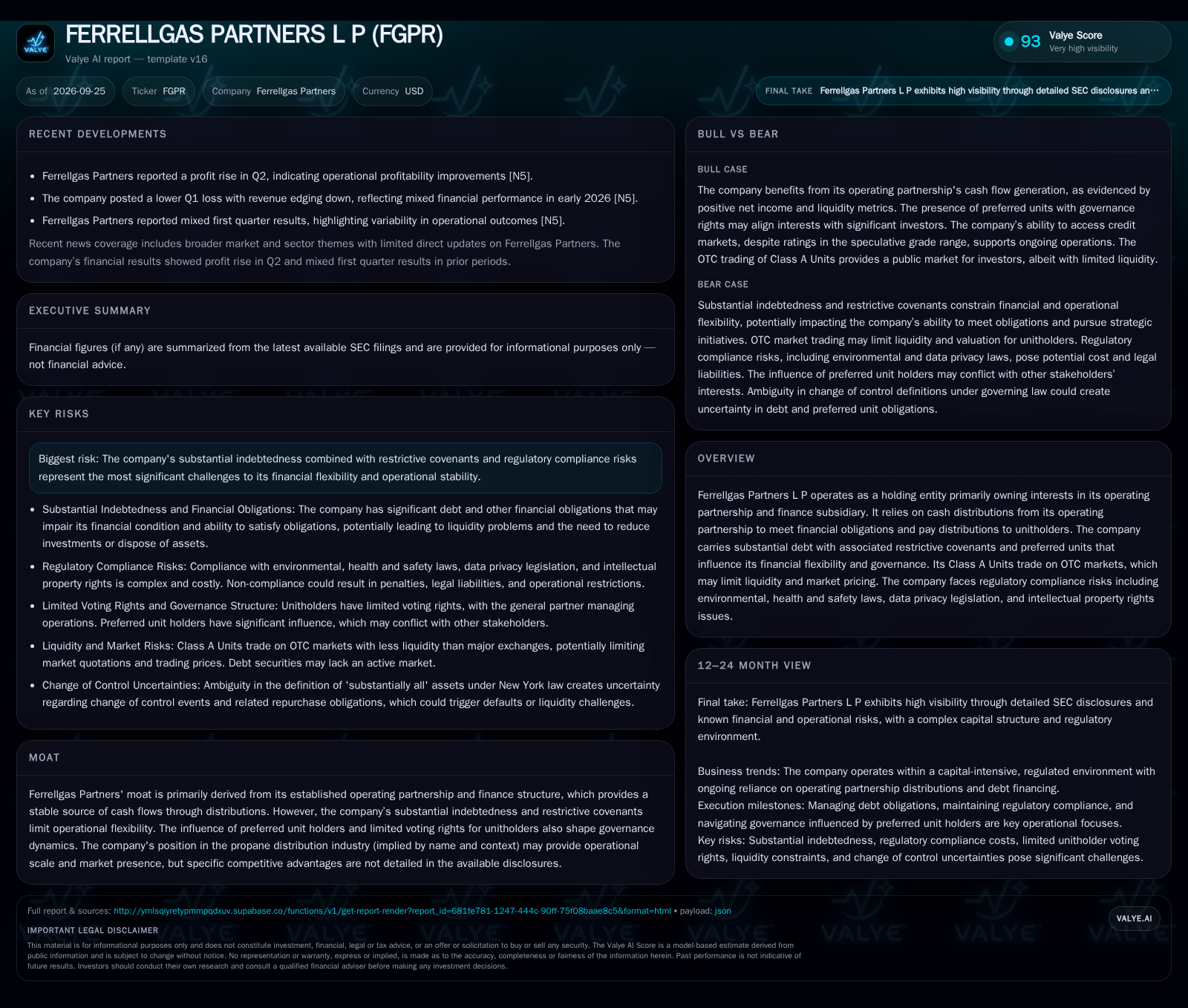
Ferrellgas Partners L.P. is a holding entity whose fortunes are tightly bound to its operating partnership’s ability to generate distributable cash flow. The company’s substantial debt, restrictive covenants, and preferred unit structure create significant governance and financial complexity. [S1]
Ferrellgas Partners L.P. stands as a textbook case of a leveraged holding company with a multilayered governance and capital structure. Its economic destiny is inseparable from the financial performance and distribution policies of its operating partnership, while restrictive debt covenants and the influence of preferred unit holders sharply define the boundaries of managerial discretion. In this context, even modest shocks—to cash flows, compliance costs, or capital markets access—can have outsized effects on unitholder distributions and enterprise value. The challenge for investors is to parse which risks are already embedded in valuations and which could still surprise.
Recent Financial Snapshot Highlights Leverage and Distribution Dependence
The company reported cash and liquidity metrics for the period; these figures do not by themselves establish operating runway, investment capacity, financial flexibility, or financing capacity. Net income for the fiscal year ended July 2026 was $71.7 million. Importantly, the company’s structure as a holding entity means it relies solely on distributions from its operating partnership for servicing its own obligations and for unitholder payouts. These distributions are not guaranteed and are subject to both operational performance and the constraints imposed by restrictive debt covenants. The $700 million in preferred units with director designation rights adds further complexity to governance and capital allocation. Class A Units trade on the OTC market, which may depress trading liquidity and complicate market price discovery. [S1]
How the Holding Structure Shapes Cash Generation and Potential Financial Flexibility
Ferrellgas Partners L.P.'s economics are fundamentally those of a pass-through entity: it collects distributions from its operating partnership and allocates these across debt service, preferred distributions, and common unitholder payouts. Its own cost structure is minimal, but its fixed obligations—including interest on substantial debt and preferred unit distributions—are significant. The company’s ability to generate distributable cash flow is ultimately a function of the operating partnership’s performance, which is likely tied to propane distribution and related services, a sector known for moderate margins, high seasonality, and capital intensity.
The presence of restrictive covenants in credit facilities and bond indentures further limits the flexibility to adjust capital allocation, pursue acquisitions, or increase distributions. While leverage can amplify returns when cash flows are robust, it also heightens vulnerability to operational setbacks, commodity price swings, or regulatory penalties. The capital stack’s complexity—with both senior unsecured debt and preferred units—means that incremental cash flows are allocated according to a strict hierarchy, with common unitholders absorbing the bulk of downside risk if operating partnership performance falters.
Governance Structure and Industry Dynamics: Where Advantages and Frictions Emerge
Ferrellgas’s competitive stance is shaped less by direct operational tactics—since it functions as a holding company—and more by its ability to extract and allocate cash flows from the operating partnership. In the broader propane distribution industry, scale can provide purchasing leverage, logistical efficiencies, and some pricing power, but these advantages are often offset by commodity cyclicality and regulatory costs. The company’s capital structure, with preferred units able to designate a director and exert significant influence, creates a governance dynamic not typical among peers.
The reported liquidity position of OTC-traded units may deter institutional investors and depress valuation multiples, while restrictive covenants can prevent opportunistic investments or aggressive market-share moves by the operating partnership. In contrast, unitholders’ limited voting rights mean that strategic direction is set by the general partner and, to a lesser extent, by preferred holders, potentially leading to misaligned incentives if the priorities of these stakeholders diverge from those of common unitholders.
Improved Operating Partnership Performance Unlocks Distribution Growth
The most constructive scenario for Ferrellgas Partners would see the operating partnership achieve stable or growing cash flows—driven by effective cost management, disciplined capital allocation, or favorable propane demand dynamics. This would enable consistent or rising distributions to the holding company, allowing it to service debt, meet preferred obligations, and raise payouts to common unitholders. If the operating partnership can demonstrate resilience to input cost volatility and regulatory costs, the risk premium embedded in unit pricing could compress.
Confirmation of this scenario would come from sequential increases in distributable cash flow, reduced leverage ratios at the operating partnership, and evidence that restrictive covenants are not binding actual business decisions. Additional evidence would include a tightening of OTC market bid-ask spreads or increased trading volumes, suggesting renewed investor interest and confidence in distribution sustainability.
Financial Constraints Define a Narrow Range of Outcomes
The most plausible near-term outcome is that Ferrellgas Partners continues to operate within the tight bounds set by its current capital structure. Distributions from the operating partnership are likely to cover debt and preferred obligations, with modest residual cash available for common unitholders. The company’s leverage and restrictive covenants will continue to limit operational and potential financial flexibility, making it difficult to respond to adverse events or pursue organic growth.
This scenario would be confirmed by stable but unremarkable net income, no material changes in leverage, and a continuation of OTC trading patterns with reported liquidity position. Any material regulatory action, debt covenant breach, or shift in commodity markets could quickly tilt the outcome toward downside risk.
Distribution Cuts and Governance Tensions Emerge from Cash Flow Shortfalls
Should the operating partnership experience a decline in cash flows—due to commodity price drops, increased regulatory costs, or operational issues—Ferrellgas Partners may be forced to reduce or suspend distributions to common unitholders. The burden of debt service and preferred distributions means common unitholders are first to absorb the impact of any downturn. Restrictive covenants could further limit management’s options, potentially forcing asset sales or distressed financing.
Downside confirmation would come from a reduction or suspension of distributions, an uptick in covenant-related disclosures, or the exercise of governance rights by preferred holders (such as director appointments or vetoes of management actions). A widening of OTC unit bid-ask spreads or a sharp drop in trading volumes would also signal distress or eroding investor confidence.
Testing the Thesis: What to Track as Ferrellgas Partners Navigates Its Constraints
Trends in distributions and cash flow from the operating partnership to the holding company—reported quarterly if disclosed—will be the earliest signal of sustainability or stress.
Changes in leverage ratios or interest coverage at both the holding company and operating partnership levels would help test the company’s ability to absorb shocks or pursue new investments.
Any amendments or waivers to restrictive debt covenants, which would indicate either financial stress or successful renegotiation of capital constraints.
Board composition changes, especially if preferred holders exercise their right to designate a director, would signal shifts in governance dynamics.
Material regulatory or legal disclosures, particularly related to environmental, health, safety, or data privacy incidents, could foreshadow increased compliance costs.
OTC trading liquidity: Bid-ask spreads, average daily volumes, or notable changes in unit pricing would provide a market-based read on investor sentiment and access to capital.
Announcements of additional preferred or common unit issuances, which could dilute existing unitholders and affect distribution per unit.
If disclosed, operating partnership customer retention rates or propane volume trends would help gauge the durability of underlying cash flows.
Disclaimer: This is research-only, informational analysis and not investment advice. It may include AI-generated interpretation and general industry context. Always verify important details using primary sources.

Comments