
Donaldson Co: Filtration Scale, Integration Stakes, and the Next Phase of Industrial Mix
Donaldson's global filtration platform delivers resilient growth and margin progress, but the acquisition of Facet Filtration brings both strategic reach and integration risk. Margin management, raw materials volatility, and the evolving industrial mix shape the company’s next inflection.
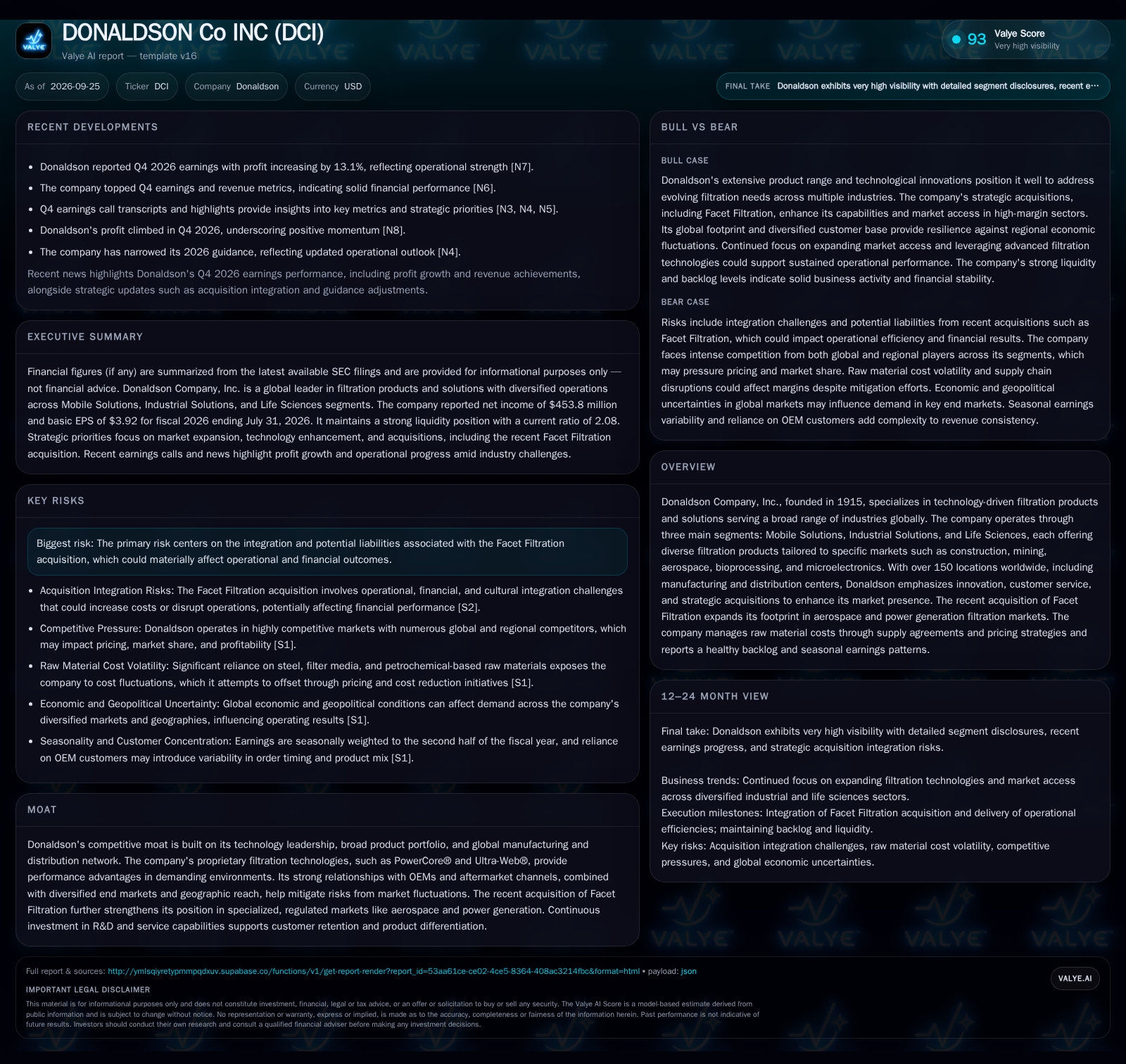
Donaldson Company reported a 13.1% profit increase in Q4 2026 and expanded its backlog to $684.2 million, with Mobile Solutions driving over 60% of net sales. The recent Facet Filtration acquisition strengthens its position in aerospace and power generation, but integration risks remain material. Margin performance hinges on managing raw material costs, pricing, and capturing value from advanced filtration technologies. Strategic execution and operational discipline will be tested as Donaldson navigates a shifting industrial landscape and competitive pressures. [S1] [N7]
Donaldson Company, a century-old filtration leader, is leveraging its scale and technology to capture growth across industrial, mobile, and life sciences markets. Recent financial results highlight continued operational progress, with a double-digit profit increase and a growing backlog. However, the acquisition of Facet Filtration introduces both strategic upside and execution risk, testing Donaldson’s ability to integrate new capabilities while maintaining margin discipline. As raw material costs remain volatile and competitive pressures intensify, the company’s next phase depends on its ability to manage complexity, innovate, and deliver on integration promises.
Recent Financial Momentum and Strategic Expansion
Donaldson reported a 13.1% increase in Q4 2026 profit, capping a year of robust operational performance and solidifying its position in the global filtration market [N7]. Net income for fiscal 2026 reached $453.8 million, with basic EPS of $3.92. The company’s backlog stood at $684.2 million as of July 31, 2026, up from $552.2 million the prior year, indicating strong business activity and near-term demand visibility [S1].
The acquisition of Facet Filtration in fiscal 2026 marks a strategic push into aerospace, defense, and power generation filtration, aiming to expand Donaldson’s reach in regulated and higher-margin markets. However, the integration of Facet comes with operational and financial risks, as acknowledged by management [S1] [S2].
Mobile Solutions remains the primary revenue driver, accounting for 62.3% of net sales, while Industrial Solutions and Life Sciences contribute 29.1% and 8.6% respectively [S1]. Raw material inputs, especially steel and petrochemical-based products, continue to represent a significant portion of cost of sales and a persistent margin lever [S1].
Filtration Economics: Volume, Mix, and Margin Levers
Donaldson’s revenue engine is driven by a blend of OEM and aftermarket sales across its industrial, mobile, and life sciences segments. The Mobile Solutions segment, serving off-road, on-road, and aftermarket customers, is heavily influenced by equipment production cycles and maintenance intervals. Aftermarket filter replacements provide a recurring revenue base, but OEM volumes are more cyclical and sensitive to end-market capital spending.
Pricing power is tempered by competitive dynamics, but Donaldson has historically offset raw material cost inflation through supply agreements and price adjustments. With raw materials representing approximately 67% of cost of sales, even modest input volatility can materially impact gross margin. The company’s ability to pass on costs or substitute materials is a key determinant of margin resilience [S1].
Operating leverage is achieved through the scaling of fixed manufacturing, R&D, and SG&A costs across a broad product and geographic portfolio. The recent increase in backlog suggests near-term volume support, but integration costs from acquisitions like Facet could temporarily dilute margins if synergies are delayed or cost structures prove higher than anticipated. Capital needs are moderate and largely tied to sustaining manufacturing scale and incremental investment in technology or capacity as demand grows.
Technology, Breadth, and the Competitive Filtration Landscape
Donaldson competes in a fragmented global filtration market where technology differentiation, product reliability, service quality, and global reach shape competitive outcomes. Its proprietary solutions—such as PowerCore® and Ultra-Web® technologies—provide performance advantages in demanding environments, particularly for OEMs in construction, mining, and transportation.
The company’s broad product portfolio and global manufacturing network enable it to serve both large multinational OEMs and regional distributors, creating switching frictions for customers who value consistent product quality and supply reliability. However, price competition from both global and regional players remains intense, particularly in commoditized filter categories.
Recent expansion into aerospace and power generation filtration through the Facet Filtration acquisition positions Donaldson in more regulated, higher-barrier markets. These sectors typically value certifications, performance, and compliance, which can support higher margins and customer stickiness, but also require ongoing investment in R&D and compliance. The question is whether Donaldson can successfully leverage its scale and integration capability to capture share from incumbents and defend against new entrants with specialized offerings.
Strategic Integration and Innovation Unlock Margin Expansion
A favorable scenario for Donaldson sees the company integrating Facet Filtration efficiently, capturing synergies in aerospace and power generation, and accelerating growth in high-margin, regulated markets. Successful integration would enable cross-selling, technology transfer, and cost optimization, while leveraging Donaldson’s global distribution and service footprint.
Margin expansion would be supported by disciplined raw material sourcing, effective price pass-through, and continued innovation in advanced filtration technologies—particularly in Life Sciences, where growth rates and margins are structurally higher. The backlog provides a buffer, allowing for smoother revenue conversion and operational planning.
Evidence supporting this scenario would include above-peer margin improvement, successful retention and expansion of key aerospace and power generation accounts, and a sustained increase in revenue mix from high-value, regulated markets. Confirmation could also come from positive updates on integration milestones and new product launches that gain traction in advanced markets.
Sustaining Core Growth Amid Integration and Cost Headwinds
The most plausible outcome is that Donaldson maintains stable growth in core Mobile and Industrial Solutions, with incremental contributions from Life Sciences and Facet Filtration. Integration of Facet proceeds with manageable disruption, but synergies are realized gradually rather than immediately, and some operational inefficiencies persist in the near term.
Raw material cost volatility remains a recurring challenge, but the company manages to offset most input inflation through a combination of pricing, supply chain initiatives, and incremental efficiency gains. Competitive pressure tempers pricing power, especially in commoditized filters, but Donaldson’s technology and service differentiation help preserve market share.
Evidence for this scenario would be continued modest net sales growth, stable or slightly improving gross margins, and steady backlog levels. Falsification would come from persistent integration setbacks, loss of major OEM or regulated accounts, or a material decline in profitability due to cost overruns.
Acquisition Stumbles and Commodity Shocks Erode Performance
A negative scenario unfolds if the Facet Filtration integration proves more complex and costly than expected, resulting in operational disruption, customer attrition, or unexpected liabilities. This could erode margins and distract management attention from core operations, amplifying execution risk.
Simultaneously, a spike in steel or petrochemical-based input costs—without sufficient ability to pass these increases through to customers—would compress margins, particularly if competitive dynamics force price concessions. A slowdown in key end markets (e.g., construction, mining, or aerospace) would further pressure volumes and utilization rates, reducing operating leverage.
Confirmation of this scenario would include rising integration costs, negative margin surprises, order cancellations or lost backlog, and declining profitability. Falsification would require evidence of smooth integration, stable customer retention, and effective cost management despite commodity swings.
Testing Donaldson’s Next Chapter: Integration, Margins, and Mix
Progress on Facet Filtration integration—timing, cost synergies, and customer retention—would help validate the acquisition thesis.
Trend in gross margin and operating margin, especially in the wake of raw material price volatility, would indicate pricing power and cost management effectiveness.
Backlog evolution, both in aggregate and by segment, would provide insight into demand strength and revenue visibility.
Revenue and margin contribution from Life Sciences and newly acquired aerospace/power generation businesses would help test the success of strategic diversification.
OEM and aftermarket sales mix, if disclosed, would clarify the balance of recurring versus cyclical revenue streams.
Customer concentration in Mobile Solutions and any changes in major account relationships would help gauge revenue resilience.
Capital expenditures and R&D investment levels, relative to historical trends, would signal ongoing commitment to innovation and operational scale.
Order cancellations, customer attrition, or unplanned integration charges would be early warning signs for downside risk.
Disclaimer: This is research-only, informational analysis and not investment advice. It may include AI-generated interpretation and general industry context. Always verify important details using primary sources.

Comments