
Marine Petroleum Trust: Royalty Income, Transparency Gaps, and the Dividend-Driven Investment Equation
Marine Petroleum Trust operates as a pure-play royalty trust, distributing income from petroleum assets to unitholders. Its appeal lies in regular dividends, but minimal operational control and limited financial transparency heighten exposure to commodity swings and add uncertainty for investors.
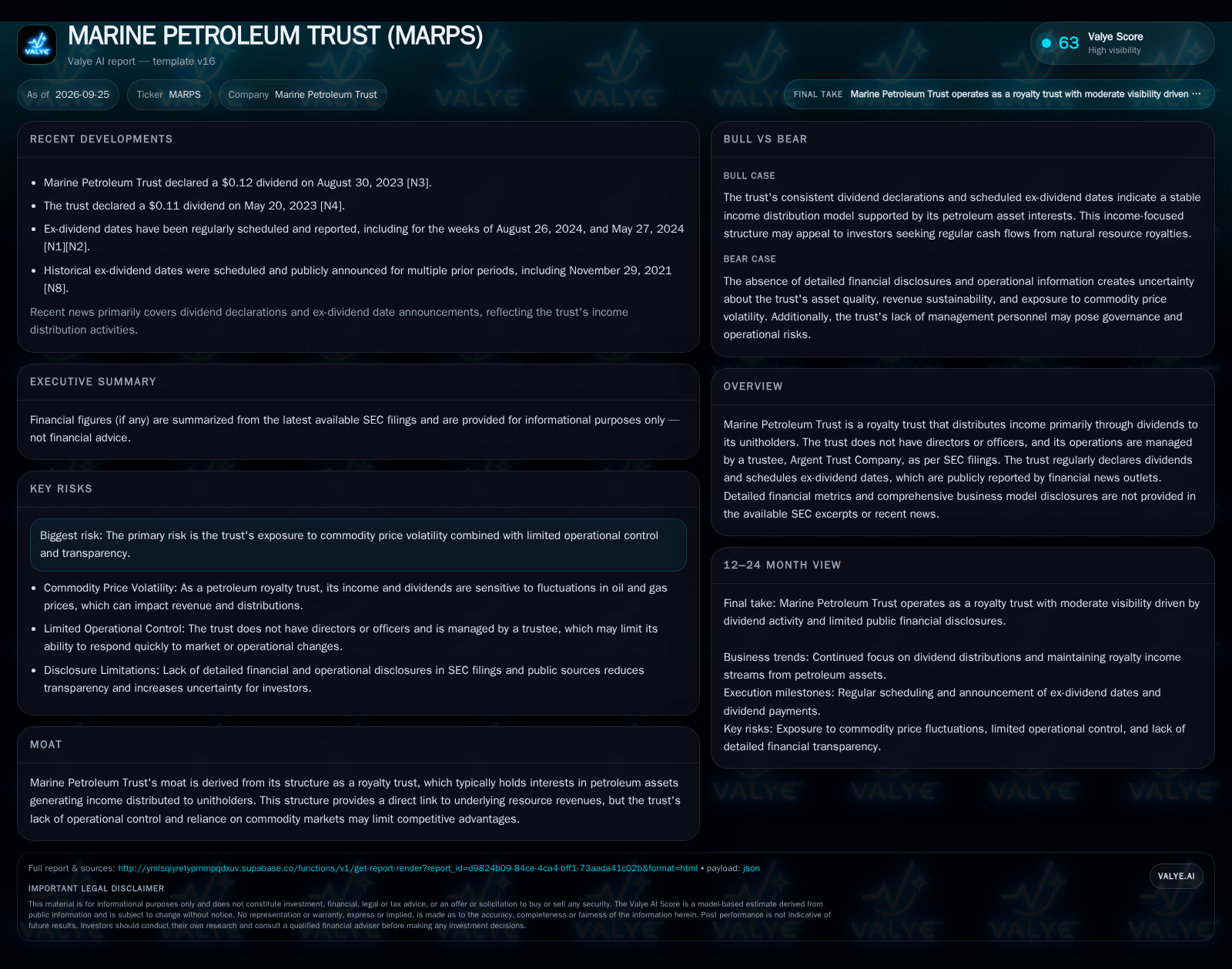
Marine Petroleum Trust (MARPS) is a royalty trust distributing income from petroleum assets, with recent dividends declared at $0.12 and $0.11 per unit in 2023. The trust has no directors or officers, operates through a trustee, and provides limited public financial disclosure. Its investment case centers on income potential, but is tempered by commodity price exposure, absence of active management, and low transparency. Close attention to dividend trends and any changes in disclosure practices is warranted. [S1] [S2] [N3] [N4]
However, this simplicity comes at a price—investors must accept a lack of operational control, limited ability to respond to market shifts, and a pronounced opacity around asset quality and future revenue potential. Recent dividend declarations underscore the trust’s income orientation, but with commodity prices and distribution sustainability in flux, the investment thesis remains tightly bound to external energy markets and the trust’s approach to disclosure. [S1] [S2] [N3] [N4]
Dividend Declarations Spotlight Income Focus Amid Sparse Disclosure
Marine Petroleum Trust recently declared a $0.12 per unit dividend on August 30, 2023, and a $0.11 dividend on May 20, 2023, reinforcing its primary function as a vehicle for distributing royalty income to unitholders. [N3] [N4] The trust operates without directors or officers, instead relying on Argent Trust Company as its trustee. [S1] [S2] Notably, detailed financial and operational disclosures are limited in the available filings and news, leaving investors with little visibility into underlying asset performance or future revenue prospects. This combination of regular dividend activity and minimal transparency defines both the appeal and the ambiguity of the MARPS investment case.
How Royalty Trust Economics Shape Unitholder Returns
As a royalty trust, Marine Petroleum Trust does not operate oil or gas assets directly; instead, it receives a fixed share of production revenues from underlying petroleum interests. This structure means the trust incurs minimal operating expenses and is insulated from direct capital expenditure needs or operational risks typically borne by producers. Distributable cash is primarily a function of commodity prices, production volumes, and the terms of the underlying royalty agreements.
The absence of active management or reinvestment policy means nearly all net income after trustee fees and administrative costs is passed through as dividends. There is little to no retained earnings or growth reinvestment, and distributions are highly sensitive to revenue fluctuations. In downturns, distributions can decline rapidly, while in periods of high commodity prices, payouts may rise. Fixed costs are minimal, so there is little traditional operating leverage, but unitholders are exposed to a form of revenue leverage tied to energy market swings.
Because the trust does not reinvest in new reserves, its long-term cash flow is likely to decline as underlying assets deplete unless new interests are acquired or developed—a scenario that typically requires external action or trust modification.
The trust’s reliance on fixed royalty agreements inherently limits its flexibility to adapt to changing market conditions or operational challenges. For instance, if underlying production declines faster than anticipated, the trust cannot renegotiate terms or invest in enhanced recovery techniques to stabilize cash flows. This rigidity means that the timing and magnitude of distributions are largely predetermined by existing contracts, which may not reflect evolving commodity price environments or technological advancements in extraction. Consequently, investors must consider the embedded contractual risk profile alongside commodity exposure when assessing long-term return prospects.
Royalty Trust Structure: Advantages and Structural Constraints
Marine Petroleum Trust’s competitive position stems from its pure royalty trust structure, which appeals to income-oriented investors seeking exposure to energy sector cash flows without direct operational risk. The trust’s administrative simplicity and pass-through economics can offer tax advantages and transparency in distribution mechanics, at least when commodity prices are healthy.
However, MARPS lacks the ability to control or enhance underlying asset performance, respond to market dislocations, or pursue acquisitions—functions typical of active operators or more flexible royalty companies. Its closest peers are other publicly traded royalty trusts, which compete primarily on the stability, visibility, and sustainability of their distributions rather than on operational prowess. Larger, more diversified royalty companies or master limited partnerships may offer greater scale, asset renewal, and risk management, but with different risk profiles and cost structures.
Substitution risk is present for investors choosing between royalty trusts, income-oriented energy equities, or fixed-income instruments, especially as interest rate environments shift and commodity cycles evolve.
Rising Commodity Prices and Improved Disclosure Could Revitalize the Investment Case
If global oil and gas prices rise substantially or remain elevated, Marine Petroleum Trust’s distributable income could increase materially, resulting in higher dividends and renewed investor interest. The trust’s simple structure ensures that most incremental revenue is passed directly to unitholders, amplifying the effect of commodity price upswings.
A secondary but important upside lever would be any improvement in disclosure practices—such as more detailed reporting on production volumes, asset decline rates, or royalty agreement terms. Enhanced transparency could reduce uncertainty, broaden the potential investor base, and support higher valuation multiples.
Evidence confirming this scenario would include a series of increasing dividends, new or expanded disclosure in SEC filings, and positive commentary from income-focused investment analysts.
Distribution Stability Hinges on Commodity Markets and Status Quo Disclosure
The most plausible scenario is that Marine Petroleum Trust continues to distribute dividends in line with realized oil and gas prices and production from its legacy assets, while maintaining minimal public disclosure. Distributions may fluctuate quarter to quarter, but absent a major shift in commodity prices or asset performance, the trust’s payout profile will likely reflect broader energy market trends.
Investor returns in this scenario will be shaped by the interplay between commodity cycles and the trust’s existing asset base. The lack of detailed reporting will continue to limit visibility, making it difficult to assess long-term sustainability or to anticipate inflection points in distributions until they are announced.
Commodity Downturn or Asset Depletion Threaten Distribution Continuity
A sustained decline in oil and gas prices, significant unplanned production interruptions, or rapid asset depletion could sharply reduce the trust’s distributable income, resulting in lower or suspended dividends. Because the trust lacks operational control and does not reinvest in new assets, it is especially vulnerable to adverse market or field-specific events.
The lack of transparency compounds downside risk: investors may not be able to anticipate or fully understand the causes of declining distributions, increasing the likelihood of sudden negative sentiment or capital flight.
Evidence confirming this scenario would include consecutive dividend reductions, unexpected payout suspensions, or adverse commodity market developments without accompanying explanatory disclosure from the trustee.
Tracking Dividend Trends and Transparency to Test the MARPS Thesis
Monitor the size and consistency of quarterly dividend declarations for signs of underlying revenue stability or stress.
Track any changes in the level of detail provided in SEC filings—improved production, reserve, or asset-level disclosures would be significant.
Watch for macro oil and gas price movements, as these directly affect distributable income and thus the trust’s payout capacity.
Assess any announcements regarding changes to the underlying royalty interests, asset portfolio, or trustee arrangements.
Look for evidence of asset depletion or production decline, such as consecutive dividend reductions or commentary (if disclosed) on declining volumes.
Monitor peer royalty trust and energy sector dividend trends for relative performance context.
A useful metric would be the ratio of distributions to estimated production volumes, if any such data becomes available.
Disclaimer: This is research-only, informational analysis and not investment advice. It may include AI-generated interpretation and general industry context. Always verify important details using primary sources.

Comments