
Woodbridge Liquidation Trust: Litigation Pause, Asset Recovery, and the Endgame for Claimholders
Woodbridge Liquidation Trust, established to recover and distribute proceeds from a high-profile bankruptcy, faces a critical inflection: with major claims resolved and most assets liquidated, the resumption and size of future distributions now hinge on the outcome of a material construction defect litigation. The trust’s waterfall structure and legal framework provide claimholder clarity, but timing and recovery potential remain clouded by ongoing legal and real estate market risks.
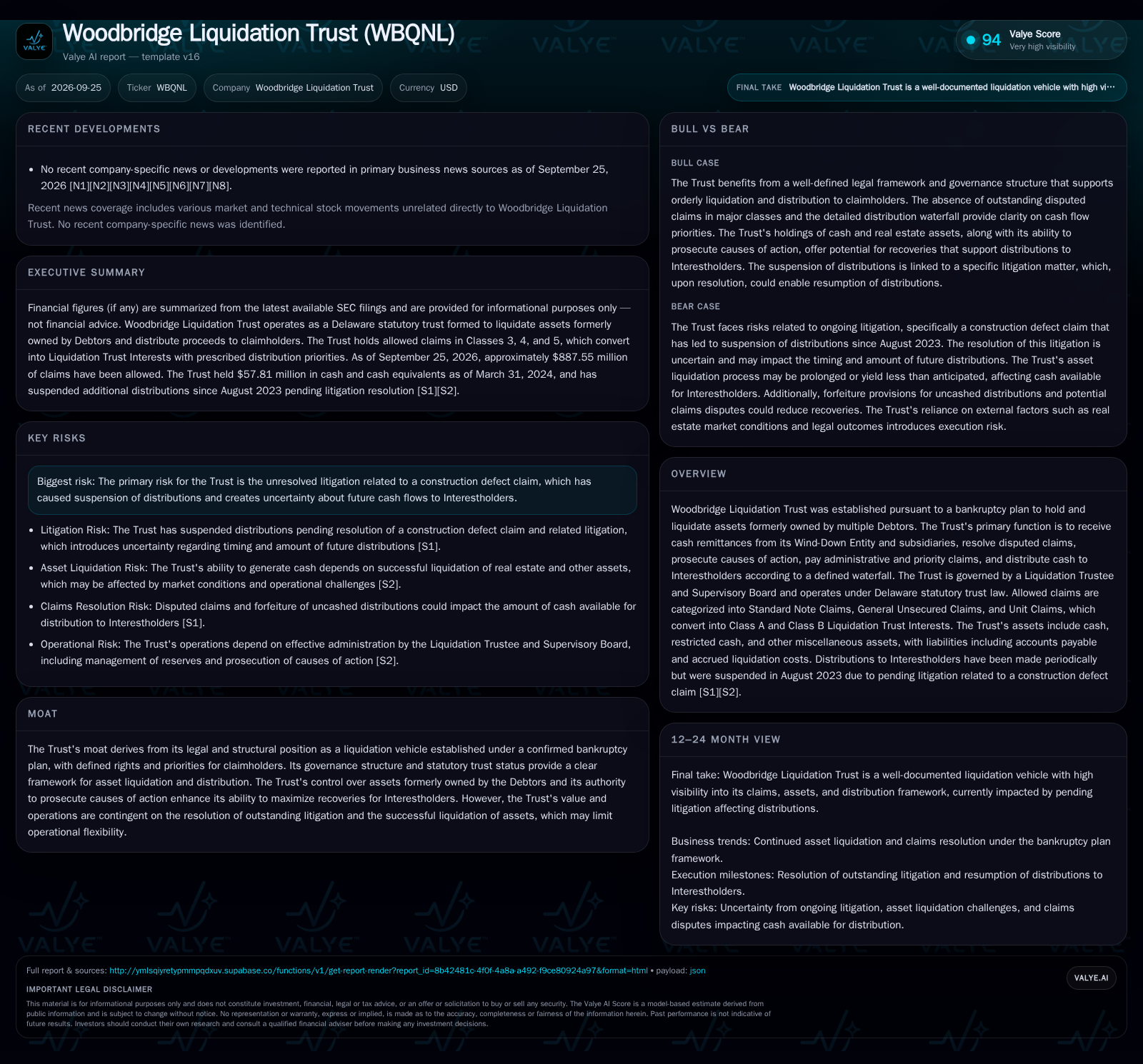
Woodbridge Liquidation Trust has resolved its major claims and liquidated most assets, with $887.55 million in allowed claims and $57.81 million in cash as of March 2024. However, distributions to claimholders have been suspended since August 2023 due to unresolved construction defect litigation. The trust’s future distributions—and ultimate claimholder recovery—now depend on legal outcomes and the final wind-down of its asset base. [S1] [S2]
Woodbridge Liquidation Trust stands out as a high-visibility bankruptcy wind-down vehicle, with its business model anchored in liquidating legacy real estate and distributing cash to holders of allowed claims. With all major claims now resolved and a clear legal distribution framework, the trust’s endgame has come into focus. Yet, a prolonged suspension of distributions—pending the outcome of a critical construction defect lawsuit—means claimholders are left waiting, with the trust’s final recovery and timeline subject to legal and market variables beyond its direct control. The next phase will be defined not by operating performance, but by how efficiently and favorably the trust can conclude litigation and monetize remaining assets. [S1] [S2]
Litigation-Driven Suspension and Asset Status: Where the Trust Stands Now
Woodbridge Liquidation Trust has resolved $887.55 million in allowed claims across its core creditor classes, with no disputed claims outstanding in these categories as of September 2026. The trust’s net assets in liquidation stood at $35.86 million at June 2026, and it reported $57.81 million in cash and cash equivalents as of March 2024. Importantly, all distributions to claimholders have been suspended since August 2023, pending the resolution of a construction defect litigation tied to the trust’s real estate assets. This litigation represents the primary gating factor for further distributions, and its outcome will directly affect both the timing and scale of final recoveries for interestholders. [S1] [S2]
Liquidation Mechanics: Flow of Funds, Cost Structure, and Recovery Drivers
Woodbridge’s economics are defined by its liquidation mandate—convert remaining real estate and miscellaneous assets to cash, resolve claims, cover administrative and legal expenses, and distribute proceeds to claimholders according to a fixed priority waterfall. There are no ongoing business revenues; cash inflow depends on asset sales and legal recoveries. Outflows include administrative expenses, legal fees (notably those related to litigation and claims prosecution), and distributions. The waterfall structure prioritizes Class A over Class B interests, with a fixed 10% annual interest rate (compounded) accruing on outstanding claims from December 2017, increasing the total payout required before subordinated classes see recovery. The trust’s cost base is relatively fixed, but episodic legal costs—especially from ongoing litigation—can create volatility in net asset value. There is limited operating leverage: scale benefits are minimal, and capital needs are front-loaded around litigation and asset disposal, rather than recurring investment.
A critical factor influencing recovery dynamics is the interplay between legal expenditures and asset liquidation timing. While legal fees can be substantial and unpredictable, they are essential to maximizing recoveries from contested claims or litigation settlements. The trust must balance the marginal benefit of extended litigation efforts against the diminishing returns of protracted legal costs. Additionally, the pace at which real estate assets are sold impacts liquidity and distribution timing; rapid sales may depress prices due to market absorption limits, whereas slower dispositions risk market value erosion or increased holding costs. Strategic sequencing of asset sales in conjunction with litigation progress can therefore materially affect net recoveries and distribution schedules.
Structural Advantages and Constraints: Legal Priority, Market Exposure, and Execution Limits
The trust’s competitive edge is rooted in legal certainty rather than market positioning. As a court-sanctioned liquidation vehicle, it has statutory authority to pursue asset sales and litigation, with a governance structure designed for transparency and creditor protection. The absence of ongoing disputed claims in major classes reduces uncertainty around the distribution base. However, the trust’s value creation is fundamentally capped by the proceeds it can extract from asset sales and litigation—external market forces (such as real estate pricing) and legal outcomes are the primary determinants. Unlike traditional asset managers or REITs, the trust cannot reinvest or pursue growth; its only mandate is wind-down and payout. This sharply limits flexibility, but also reduces competitive threats—no other entity can claim the residual value of these assets.
The trust’s structural constraints inherently limit its ability to adapt to changing market conditions, as it cannot pursue new revenue streams or reinvest proceeds. This inflexibility magnifies the importance of external factors such as real estate market cycles and judicial timelines. However, the trust’s legal priority status offers a degree of insulation from competitive claims on the assets, effectively giving it a senior position in the capital structure. This seniority reduces uncertainty over the claim pool but also caps upside potential since the trust cannot leverage assets to generate additional value. The absence of operational leverage means that efficiencies must come from cost control and effective legal strategy rather than scale or growth.
Favorable Litigation Outcome and Asset Monetization Unlock Residual Value
If the pending construction defect litigation is resolved favorably—either via a swift settlement or a court decision in the trust’s favor—distributions could resume promptly at a higher-than-expected level. Additional upside could come from successful prosecution of remaining causes of action or unexpectedly strong residual asset sales (for example, if real estate markets rebound or specific properties command premium prices). Confirmation of this scenario would include public disclosure of a settlement or legal victory, resumption of distributions, and a positive revision to net asset value in subsequent filings. Falsification would occur if litigation drags on, is settled unfavorably, or if asset sales underperform expectations, reducing distributable proceeds.
Slow Litigation Resolution and Gradual Asset Runoff Define the Likely Endgame
The most plausible path is a protracted litigation process that eventually resolves, but not without additional legal costs and delays. Asset sales likely proceed at cautious, market-driven valuations, with little surprise to the upside or downside. Once litigation is settled, distributions resume, but at a level reflecting both the accreted interest owed to claimholders and the erosion from legal and administrative expenses. Confirmation would come from gradual updates in SEC filings: legal reserve adjustments, incremental asset sales, and eventual distribution announcements. Falsification would be a sudden, material loss in litigation or an unexpected asset impairment, which would force a downward revision to net recoveries.
Adverse Legal Outcome and Asset Impairment Erode Ultimate Recoveries
In a less favorable scenario, the construction defect litigation results in a significant liability or settlement against the trust, consuming a large portion of remaining cash and net assets. Simultaneously, if residual real estate assets are sold in a distressed market or are further impaired, the distributable pool could shrink below current expectations. This could lead to a downward revision in net assets, reduced or delayed distributions, and potential frustration among claimholders. Evidence would include adverse legal judgments, large reserve increases, or SEC disclosures signaling impairment charges or negative asset sale outcomes.
Milestones That Will Determine Claimholder Recovery from Woodbridge
Resolution status of the construction defect litigation—settlement, dismissal, or adverse judgment—as disclosed in SEC filings or trust updates.
Announcement and timing of resumed cash distributions to Class A and B Interestholders, including amounts and waterfall structure.
Updates on the sale or valuation of remaining real estate or miscellaneous assets, especially if market conditions shift or new buyers emerge.
Legal and administrative expense trends, particularly any material increases in litigation reserves or costs that could erode net asset value.
Any new causes of action prosecuted by the trust, and their impact on asset recovery or legal costs, if disclosed.
Forfeitures or reversals of prior distributions due to uncashed checks or claims disputes—impacting the distributable pool.
Changes in net assets in liquidation or cash balances in subsequent SEC filings—indicating shifts in recovery potential.
Material changes in the claims base (e.g., late-emerging or reclassified claims), though no such claims are currently outstanding.
Disclaimer: This is research-only, informational analysis and not investment advice. It may include AI-generated interpretation and general industry context. Always verify important details using primary sources.

Comments