
Cannabis Suisse Corp.: Survival Mode, Product Ambitions, and the Mechanics of a Microcap CBD Platform
Yet, it continues to announce new CBD products and an AI-driven IT initiative. The question is whether any of these efforts can overcome existential financial distress and the frictions of scale, governance, and market credibility.
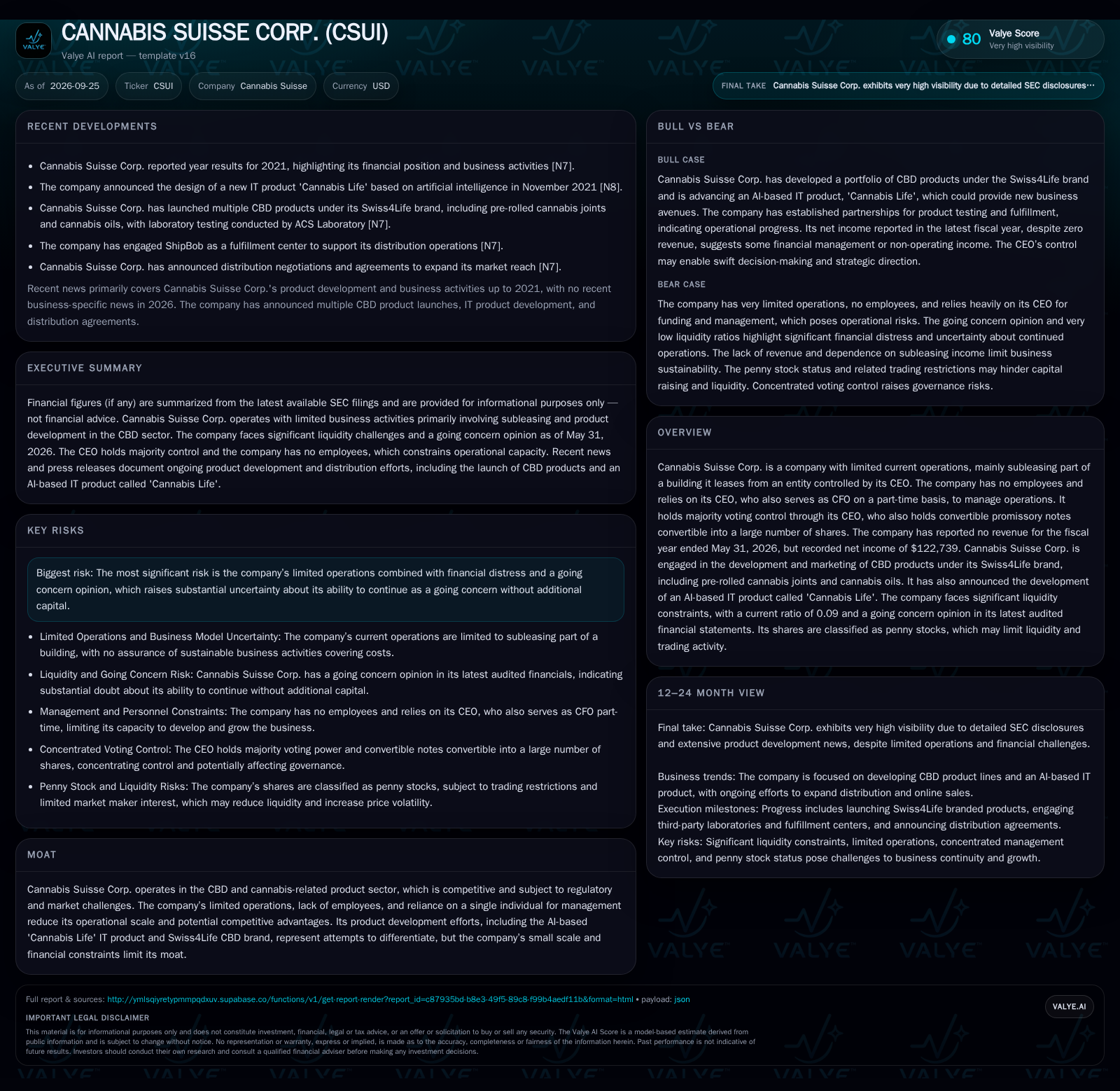
Cannabis Suisse Corp. faces severe operational and financial constraints: no employees, a CEO with total control, zero reported revenue, and a going concern opinion. Despite this, the company is developing new CBD products and an AI-based IT platform, leveraging partnerships for testing and fulfillment. The core issue is whether these product initiatives can meaningfully change the company's commercial trajectory before capital runs out [S1].
Cannabis Suisse Corp. sits at the intersection of microcap distress and entrepreneurial ambition. With no operating revenue, virtually no liquid assets, and a sole executive responsible for all management functions, the company faces existential risk. Yet, it continues to announce new CBD product lines and a foray into AI-driven IT solutions, aiming to build commercial relevance from a standing start. The major question is whether these launches represent a credible pivot or simply a last effort to attract capital in the face of overwhelming financial and operational headwinds.
Zero Revenue, One-Person Control, and a Going Concern Red Flag
As of May 31, 2026, Cannabis Suisse Corp. reported zero operating revenue and net income of $122,739, a figure likely attributable to non-operating items rather than business activity.Cash and equivalents stood at $476, with current liabilities of $565,399, resulting in an extraordinarily reported current ratio of 0.09 and a cash ratio of zero. The company's audited financial statements carry a going concern opinion, explicitly stating substantial doubt about its ability to continue without new capital. The CEO, who also serves as CFO and controls the board, holds a majority of the voting stock and convertible notes that could be turned into over 135 million shares. The company has no employees, and its only operational activity is subleasing part of a building from a related party controlled by the CEO [S1].
How the Economics of a Microcap CBD Platform Could Work—If It Can Scale
Cannabis Suisse’s theoretical business model is anchored in the development and sale of CBD consumer products under the Swiss4Life brand and, prospectively, an AI-driven IT product ('Cannabis Life'). In a typical CBD products company, gross margins hinge on manufacturing scale, direct-to-consumer channel mix, and brand pricing power. However, with zero reported revenue and no employees, Cannabis Suisse is not currently operating a viable commercial engine.
The company's use of third-party fulfillment (ShipBob) and laboratory testing (ACS Laboratory) suggests an asset-light approach, limiting fixed costs but also constraining margin capture and direct customer relationships. If products are sold via online platforms like Shopify, variable fulfillment, payment processing, and digital marketing costs would dominate the cost structure. The absence of in-house sales or marketing teams further limits the ability to drive volume or command premium pricing.
Capital needs are acute: with negligible cash and a negative working capital position, the company cannot fund inventory, marketing, or product development at scale without external financing. If future revenue materializes, operating leverage could be high due to low fixed overhead, but the current structure precludes meaningful scale or margin expansion.
Competitive Realities: Brand Experiments in a Crowded CBD and AI Market
The CBD sector is intensely competitive, with thousands of brands vying for consumer attention, regulatory approval, and distribution. Barriers to entry are low, but sustained differentiation depends on product quality, credible testing, branding, and distribution relationships. Cannabis Suisse’s engagement with ACS Laboratory for potency testing and ShipBob for fulfillment indicates awareness of quality and logistics, but these are available to any market participant and do not constitute a durable moat.
The announced 'Cannabis Life' AI-based IT product signals an attempt to diversify or create a tech-enabled wedge, but the commercial mechanics and market fit remain unproven. In technology-driven wellness and cannabis markets, network effects, proprietary data, and platform stickiness are necessary for defensibility—none of which are apparent at the current scale.
The company's penny stock status, extreme liquidity constraints, and lack of operating scale make it an outlier even among microcap peers. Its governance structure, with the CEO in full control, may enable rapid pivots but also raises counterparty, capital access, and governance risk.
What a Breakout Would Require: Credible Revenue, External Funding, or a Strategic Pivot
A positive inflection would likely require the company to secure external funding (via equity, debt, or strategic partnership), enabling it to invest in marketing, inventory, and direct sales for its Swiss4Life CBD products. If the AI-based Cannabis Life platform demonstrates genuine market fit—such as adoption by dispensaries, clinics, or wellness platforms—and generates recurring software or licensing revenue, the company could establish a revenue base with attractive margins.
Evidence that would confirm this scenario includes: reported revenue from CBD or IT products in future filings, new capital raised on reasonable terms, announcements of major distribution or technology partnerships, and disclosure of customer adoption metrics. If the company can demonstrate recurring revenue streams, positive gross margins, and sustainable operating cash flow, the bull case would gain credibility.
Most Likely: Ongoing Stasis, Limited Activity, and Eventual Dilutive Financing or Restructuring
The most plausible path is a continuation of minimal operations—periodic product announcements and limited subleasing income, but no meaningful commercial scale or revenue. The company may attempt to raise small amounts of capital through highly dilutive equity or convertible debt offerings, given its penny stock status and illiquid shares. Operationally, the absence of staff, infrastructure, and working capital will likely continue to constrain any real market presence.
Confirmation of this scenario would come from continued zero or negligible revenue in filings, repeated going concern opinions, and further reliance on related-party transactions or insider financings. If the company remains dependent on the CEO for all managerial and financial functions, and no material customer or distribution wins are reported, stasis is likely to persist.
How Complete Stagnation or Delisting Could Unfold
The adverse scenario is driven by exhaustion of the company’s minimal cash resources, inability to raise new capital, and eventual cessation of operations. The penny stock status and extreme illiquidity could result in trading suspensions or delisting if regulatory compliance lapses. Without employees or a viable operating business, the company could ultimately dissolve, enter receivership, or have its remaining assets liquidated.
Evidence for this scenario would be a further decline in working capital, explicit disclosure of default or inability to meet obligations, delisting notices, or a lack of any new filings or press releases. Loss of the CEO as the sole executive would also likely trigger dissolution, given the absence of succession or operating structure.
Milestones That Could Test Whether Cannabis Suisse Transitions from Survival to Growth
Any disclosure of product revenue from Swiss4Life CBD lines or the Cannabis Life IT product in future filings would be a critical test of commercial traction.
Evidence of successful capital raising—such as a new equity or debt issuance on terms not massively dilutive to existing shareholders—would help determine funding viability.
Announced or completed third-party distribution agreements, with clear volume or revenue commitments, would signal progress beyond subleasing income.
If disclosed, customer adoption metrics for the Cannabis Life AI platform (e.g., number of dispensaries or clinics using it) would clarify product-market fit.
Updates on regulatory compliance or legal status of CBD/AI products in target markets would help assess operational risk and addressability.
Disclosure of additional employees, or the hiring of dedicated sales/marketing personnel, would indicate a shift away from sole reliance on the CEO.
Changes in board composition or governance structure, particularly dilution of the CEO’s control, would affect risk and potential capital access.
Announcements of delisting warnings, trading suspensions, or failure to file required financial statements would be clear negative inflections.
Disclaimer: This is research-only, informational analysis and not investment advice. It may include AI-generated interpretation and general industry context. Always verify important details using primary sources.

Comments